How Cognitive Production Scheduling Systems Slash Downtime
Unexpected line stoppages still bleed cash from modern factories. ABB’s latest survey pegs downtime losses at up to $500,000 an hour. Moreover, 44% of decision-makers endure monthly interruptions, risking customer commitments. Consequently, operations leaders now seek predictive strategies that react in minutes, not shifts.
One solution stands out: cognitive production scheduling systems. These AI-augmented platforms fuse optimization, digital twins, and shop-floor data in real time. Therefore, schedules update automatically when machines falter or materials run late. Early adopters in automotive, aerospace, and electronics already report dramatic reductions in changeovers and repair delays. Meanwhile, vendors such as Siemens, Rockwell, and Simio are packaging the technology for mainstream rollouts. This article unpacks the market momentum, technical foundations, benefits, obstacles, and next steps for industry professionals evaluating a deployment.
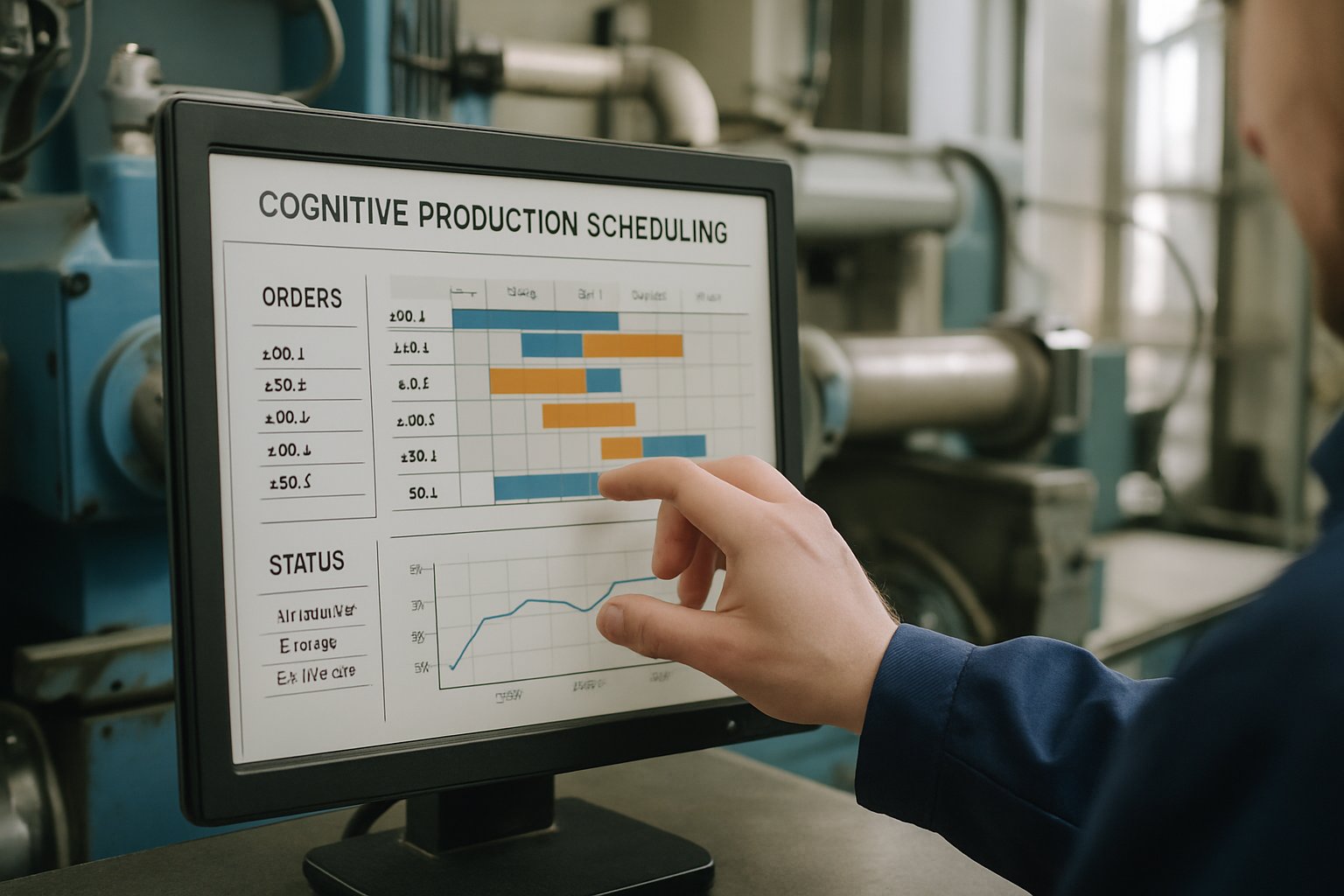
A worker interacts with a cognitive production scheduling system for seamless operations.
Cognitive Production Scheduling Systems
At its core, a cognitive production scheduling system combines four capabilities. Firstly, an advanced planning and scheduling solver models constraints for machines, tools, and labor. Secondly, digital twins simulate what-if scenarios to validate plan feasibility. Thirdly, machine-learning models forecast demand, quality, and asset health. Finally, live IIoT integration feeds sensor data every minute.
Consequently, the engine can reschedule work orders when a bearing reaches predicted failure or a rush order arrives. Human planners view suggested sequences, tweak priorities, and commit with a click. This closed loop improves factory throughput by aligning maintenance, materials, and workforce capacity. Academic studies now show reinforcement-learning agents generating feasible schedules in seconds. In practice, Siemens Opcenter users saw 50% faster responses to disturbances. Deloitte’s pilots also trimmed mean time to repair by up to 40%.
These fundamentals illustrate how technology and process improvements converge. Such evidence confirms why cognitive production scheduling systems are moving from pilot to portfolio programs.
Market Drivers Accelerate Adoption
Several converging forces push manufacturers toward AI-driven scheduling. Global supply volatility demands shorter planning cycles and robust contingency playbooks. Analysts increasingly list cognitive production scheduling systems among the top three investment priorities for smart factories. Moreover, edge computing prices continue to fall, enabling real-time analytics next to machines.
Grand View Research values the digital twin market in the tens of billions and expects 20%-plus CAGRs. APS software revenues are projected to climb at double-digit rates through 2030. Furthermore, large vendors now bundle scheduling with generative copilots, lowering entry barriers for midsize plants. Regulatory pressure on energy use also elevates interest because optimized sequences cut idle time and waste.
Meanwhile, leadership surveys link competitive advantage to resilient production ecosystems. Consequently, boards approve budgets when finance teams quantify downtime at $10,000 an hour or more. The expanding ecosystem of consultants, integrators, and cloud providers supports scale deployments. Therefore, market momentum looks durable for the next five years.
Investment signals and policy trends together create sustained pull. Therefore, market momentum looks durable for the next five years.
Core Technology Building Blocks
Successful deployments depend on a well-structured technology stack. Firstly, high-fidelity sensors stream vibration, temperature, and utilization metrics through secure gateways. IIoT integration ensures latency stays below seconds, allowing immediate anomaly detection. The heart of cognitive production scheduling systems is this closed-loop architecture.
Secondly, a unified data model synchronizes ERP orders, MES events, and maintenance logs. Moreover, cognitive analytics engines blend optimization heuristics with reinforcement learning to balance multiple objectives. Digital twins then evaluate each candidate schedule against constraints like tooling sequences and changeover windows. In contrast, legacy spreadsheet tools lack this simulation rigor.
Edge inference nodes keep sensitive data on-site while cloud services handle heavy training loads. Consequently, compute costs remain manageable. Finally, collaborative interfaces present planners with explainable recommendations and risk scores. When properly configured, the stack boosts factory throughput without massive rip-and-replace projects. Many organizations start small, integrating predictive maintenance alerts into the scheduler. Subsequent phases extend coverage to energy, labor, and supply disruptions.
Tangible Benefits Reported Widely
Real plants are already recording measurable gains. Vendor case studies, while promotional, offer helpful reference points.
Siemens Opcenter: 15% reduction in changeover time; on-time-in-full improved to 98%.
Rockwell and Hexcel: unplanned downtime fell from 2.0% to 0.4%, saving roughly $70,000 per incident.
Simio digital twin pilot: 81% drop in schedule deviation versus fixed-rate plans.
Deloitte IntelligentOps: 20-40% shorter mean time to repair across pilot lines.
Moreover, ABB’s global survey links every hour of stoppage to at least $10,000 in losses for 83% of respondents. Consequently, quick wins resonate strongly with financial stakeholders. Plants adopting cognitive production scheduling systems often report faster scenario testing and fewer firefighting meetings. Because schedules adapt proactively, factory throughput rises and labor overtime falls.
However, experts caution that results vary by baseline maturity and data quality. Nevertheless, momentum appears consistent across automotive, consumer goods, and aerospace.
Persistent Barriers And Risks
Despite encouraging numbers, deployments still stumble on familiar roadblocks. Data readiness tops the list. Many legacy PLCs lack contextual tags, forcing expensive retrofits for reliable IIoT integration. Furthermore, siloed IT and OT teams complicate governance models for cloud connectivity.
Skills shortages also hurt. Experienced planners may distrust models that re-sequence jobs without explanation. Consequently, change-management efforts must include targeted training and clear authority matrices. Cybersecurity remains another concern because expanded attack surfaces threaten safety. Moreover, vendor claims sometimes rely on narrow pilot windows, masking seasonal complexity.
Independent audits are still limited, leaving ROI projections open to challenge. Therefore, leaders should benchmark against their own downtime and performance baselines, not industry averages. Selecting partners that provide transparent methodologies, open APIs, and hybrid deployment options reduces risk. Thorough legal reviews of data residency and intellectual property clauses are equally vital.
Implementation Best Practice Steps
Seasoned practitioners favor incremental rollouts over ambitious big-bang programs. Start with a focused pilot line where baseline metrics are well documented. Subsequently, expand coverage once value is proven.
Define baseline KPIs: unplanned downtime, changeover time, factory throughput, and schedule adherence.
Assess data quality and close sensor gaps to support secure IIoT integration.
Select a vendor that supports open APIs, explainable AI, and edge options.
Establish a cross-functional governance team of planners, maintenance, and IT security.
Scale iteratively, updating change-management plans with each wave.
Consequently, each phase delivers measurable savings while lessons feed forward. Professionals can enhance their expertise with the AI Marketing Strategist™ certification. The curriculum covers stakeholder alignment, ROI modeling, and digital-twin validation techniques relevant to cognitive production scheduling systems. Moreover, certification projects reinforce collaboration skills essential for sustaining higher equipment output. Therefore, teams emerge better equipped to blend analytics insights with frontline knowledge. Such readiness positions organizations for the next wave of autonomous scheduling.
Future Outlook And Guidance
Industry analysts expect cognitive production scheduling systems to evolve toward multiagent autonomy by 2028. Reinforcement-learning bots will negotiate sequences across parallel lines, optimizing energy as well as cost. Meanwhile, generative AI copilots will explain schedule trade-offs in natural language, boosting trust. Furthermore, tighter standards for data interoperability should simplify IIoT integration across vendor equipment.
Regional regulations on AI transparency may also shape algorithm design. Nevertheless, early movers will continue to enjoy compound gains because every avoided hour of downtime frees capacity and cash. Companies that embed cognitive production scheduling systems into strategic roadmaps will position themselves for hyper-connected supply networks. Executives should therefore monitor academic breakthroughs, vendor consolidation, and cybersecurity frameworks.
A quarterly review of technology maturity, workforce skills, and results helps maintain momentum. These forward-looking actions safeguard competitiveness amid rapid shifts.
Advanced scheduling has shifted from theoretical promise to practical necessity. Early adopters confirm sizable drops in downtime, quicker changeovers, and higher capacity utilization. Moreover, new vendor offerings and maturing digital twins lower barriers that once stalled adoption. Yet, success hinges on clean data, thoughtful change management, and vigilant cybersecurity.
Organizations that pilot carefully, measure relentlessly, and scale iteratively will unlock sustained competitive advantage. For professionals, ongoing education proves invaluable. Consequently, earning credentials such as the AI Marketing Strategist™ certification deepens strategic insight and signals commitment to innovation. Take the next step today and lead your facility toward resilient, data-driven manufacturing.