

AI CERTs
4 months ago
AI Liquidity Forecasting Models Free Capital for Regional Banks
Regional banks felt intense liquidity pressure after the 2023 failures. Consequently, many treasurers embraced advanced analytics to avoid similar shocks. Today, AI liquidity forecasting models promise sharper visibility, longer horizons, and faster scenario analysis. Furthermore, these tools align with rising regulatory expectations for granular, intraday oversight. The market momentum now touches both internal asset-liability desks and bank-to-corporate services. Meanwhile, balance sheet intelligence is becoming a strategic differentiator, and accurate cash flow prediction supports competitive lending growth.
AI Liquidity Forecasting Models
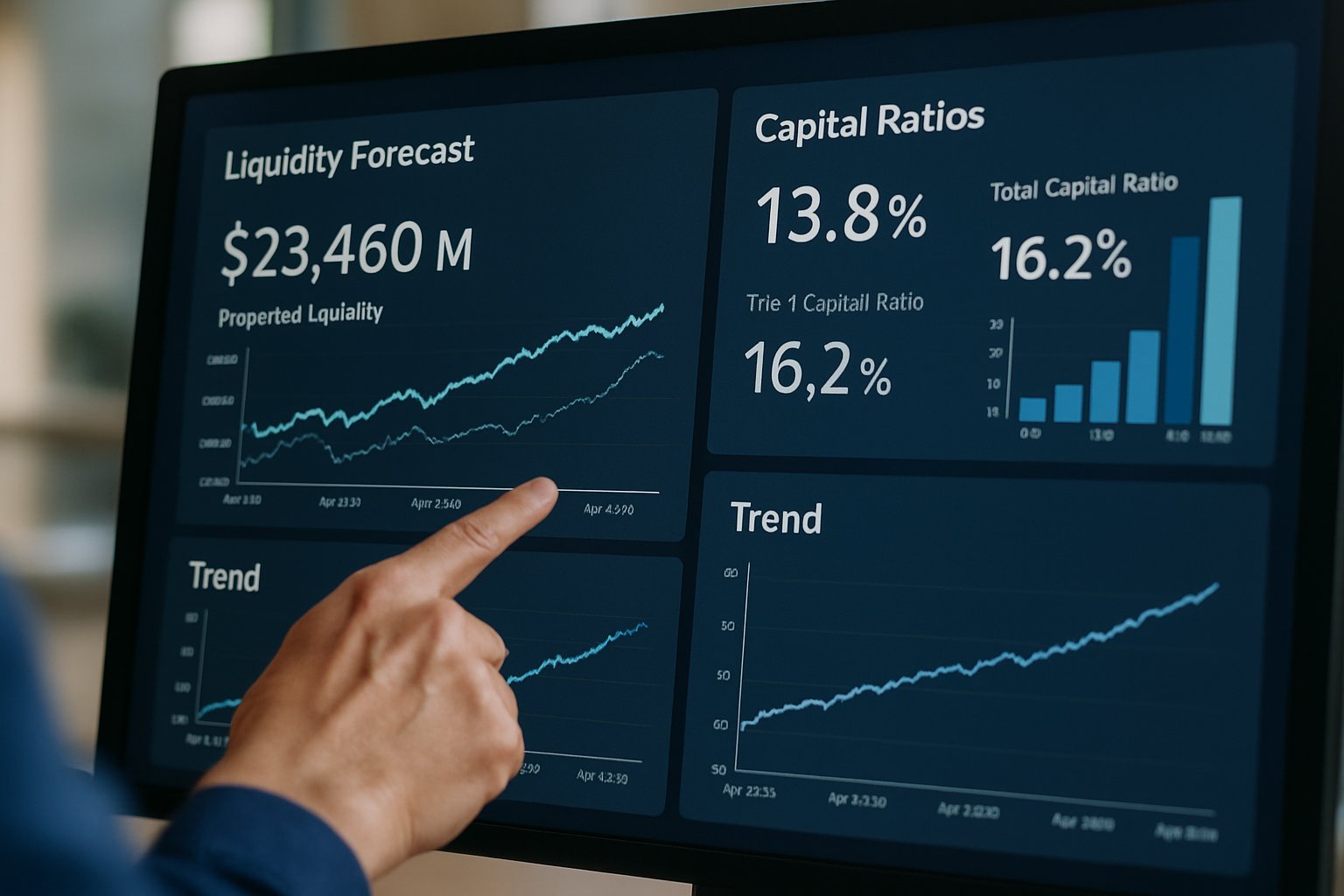
Vendors such as Kyriba and large institutions like J.P. Morgan have rolled out powerful AI liquidity forecasting models across North America. Moreover, academic work using GRU networks shows lower mean absolute errors when predicting Liquidity Coverage Ratios. In practice, regional banks can now forecast 91 days ahead with sub-1 % error, according to J.P. Morgan case material. Nevertheless, regulators still demand clear explainability before capital buffers shrink.
Regional Banking Landscape Today
Post-crisis supervisory priorities shifted toward daily liquidity metrics. Consequently, regional banks hold costly high-quality liquid assets as insurance. However, overly conservative buffers depress return on equity. Improved balance sheet intelligence helps justify leaner reserves without risking compliance. Additionally, market studies indicate North America accounted for 38 % of global liquidity-analytics revenue in 2024, highlighting regional adoption strength. Therefore, institutions unable to modernize face widening cost gaps.
Key Technology Drivers Explained
Several innovations underpin recent gains. Firstly, vast API connectivity streams intraday data into cloud models. Secondly, time-series deep learning captures nonlinear behaviors better than legacy regressions. Moreover, alternative data—news sentiment and payment-rail feeds—enrich features for sharper cash flow prediction. In contrast, manual spreadsheets cannot scale stress scenarios or real-time insight. Consequently, treasury teams reallocate effort from data wrangling to actionable decision support. That shift accelerates productization of forecasting as a service.
Capital Allocation Benefits Detailed
Accurate forecasts translate into tangible balance-sheet outcomes. Moreover, smaller precautionary buffers release funds for higher-yield assets. The following benefits resonate most with regional executives:
- Reduced idle HQLA through precise 30-day projections
- Lower wholesale funding costs via intraday optimization
- Quicker stress testing enabling agile Asset-Liability Committee actions
- New revenue streams from corporate cash flow prediction services
Vendor statistics support the upside. Kyriba processed over 100 million API calls in 2025, proving enterprise-grade scale. Additionally, corporate liquidity examined by Kyriba topped $3.5 trillion, illustrating the serviceable market. Consequently, banks adopting AI liquidity forecasting models report improved earnings spreads. These advantages confirm the strategic need for balance sheet intelligence. However, governance risks still require diligent control.
Governance Risks Mitigated Effectively
Model-risk frameworks remain essential. Therefore, treasurers deploy champion-challenger setups, drift detection, and explainable-AI dashboards. Additionally, FDIC speeches emphasize transparency following recent crises. In contrast, opaque black-box systems could trigger supervisory pushback. Nevertheless, combining machine accuracy with human oversight satisfies examiners while unlocking efficiency. Robust cyber controls also protect sensitive transaction data. Meanwhile, contingency plans address vendor or cloud outages. Such layered defenses keep adoption momentum intact.
Implementation Checklist Essentials Explained
Regional banks starting the journey can follow a structured roadmap:
- Integrate core-ledger, payment-rail, and market feeds via secure APIs
- Curate training data covering stress periods for reliable cash flow prediction
- Launch pilot AI liquidity forecasting models with defined accuracy targets
- Embed explainability tools for ALCO and examiner review
- Establish continuous monitoring, back-testing, and drift alerts
- Document controls within enterprise model inventories and BC plans
Furthermore, consultancies like Capgemini provide integration guidance, while fintech vendors supply turnkey components. Consequently, smaller banks avoid extensive in-house builds yet retain governance autonomy. These steps ensure balance sheet intelligence grows sustainably. Next, leaders must cultivate talent capable of managing both technology and regulatory nuance.
Professional Certification Pathways Available
Skill shortages threaten project timelines. Fortunately, professionals can enhance their expertise with the AI Project Manager™ certification. Moreover, the curriculum blends data science, finance, and governance, aligning tightly with treasury transformation needs. Additionally, certified staff communicate model insights clearly to regulators, boosting institutional credibility. Consequently, staffing investments complement technical upgrades, securing long-term value. Balanced teams also iterate AI liquidity forecasting models faster and sustain superior cash flow prediction.
These talent pathways reinforce disciplined adoption. However, continuous learning remains critical because model techniques evolve rapidly.
Adoption drivers, technical gains, and governance practices now align. Therefore, regional banks can unlock capital while satisfying oversight. Nevertheless, execution discipline decides ultimate success.
Future sections provide actionable next steps. Consequently, institutions can move from experimentation to measurable financial impact.
Regional banks face margin pressure, rising supervision, and digital competition. However, evidence shows AI liquidity forecasting models reduce forecast error, extend horizons, and free constrained capital. Moreover, enriched data pipelines deliver superior balance sheet intelligence, while deep learning improves cash flow prediction. Governance frameworks and professional certifications mitigate adoption risks. Consequently, forward-looking treasurers who invest now gain strategic flexibility and new revenue options. Explore specialized learning paths today and position your institution for resilient growth.
Disclaimer: Some content may be AI-generated or assisted and is provided ‘as is’ for informational purposes only, without warranties of accuracy or completeness, and does not imply endorsement or affiliation.


