

AI CERTs
2 months ago
How Clinical Trial Matching Engines Speed U.S. Enrollment
Signing participants for U.S. drug studies often drags on for months, draining budgets and delaying breakthroughs.
Consequently, clinical trial matching engines have emerged to shrink this painful enrollment window through data-driven automation.
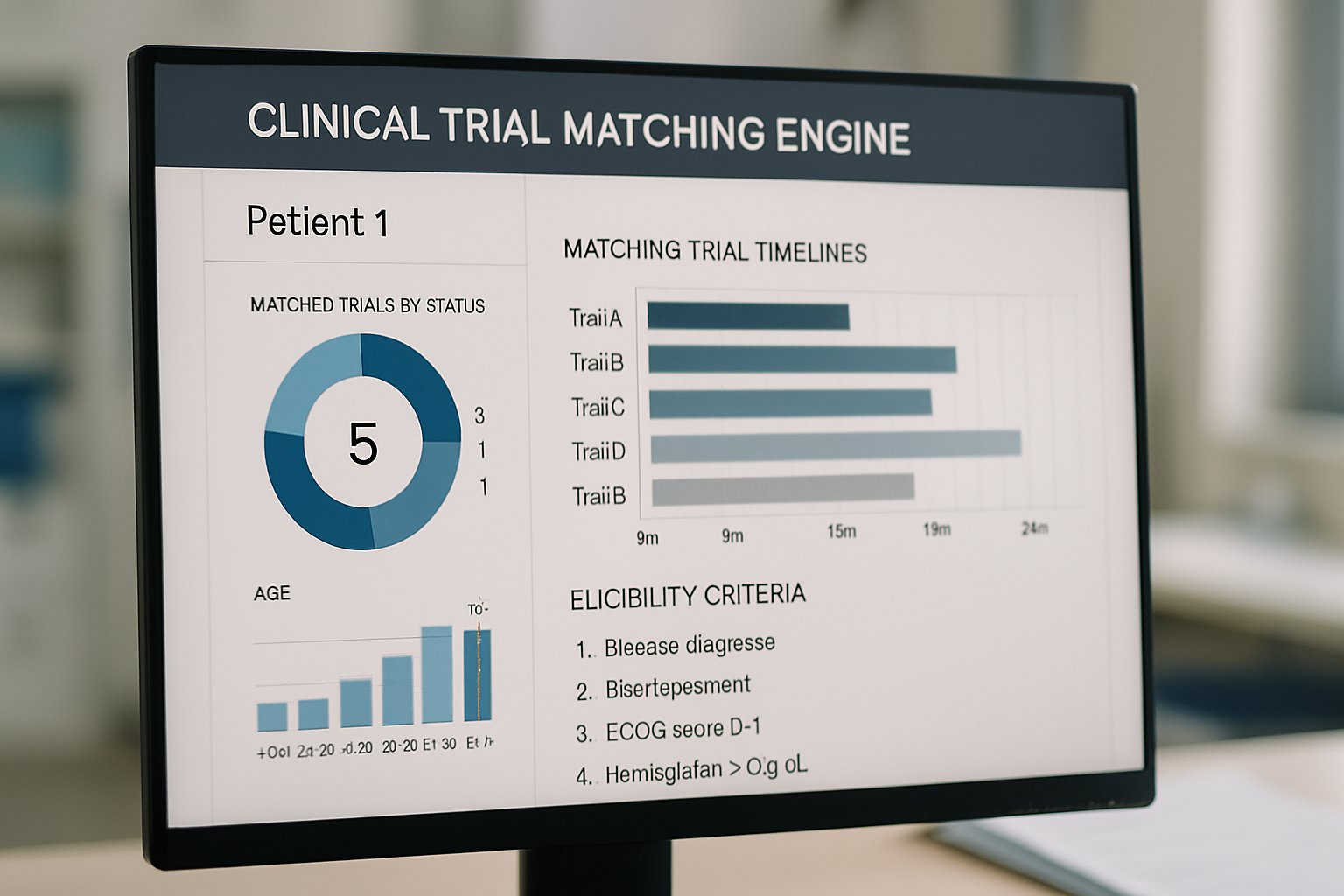
Moreover, recent large-language-model pilots report screening time drops above 40 percent, inviting intense investor and regulator attention.
This article dissects the technology, market forces, evidence, and obstacles shaping the next generation of trial recruitment.
Meanwhile, we spotlight key players and regulatory moves that every sponsor or health-system leader should monitor closely.
Readers will also learn how patient eligibility AI integrates with electronic health records to flag suitable volunteers instantly.
Consequently, life sciences analytics teams now gain real-time insights into recruitment bottlenecks and protocol feasibility.
Market Demand Accelerates Rapidly
Sponsors face median enrollment periods nearing sixteen months, according to the IQVIA Institute’s 2024 analysis.
Consequently, budget overruns and delayed approvals threaten portfolio returns.
In contrast, clinical trial matching engines promise faster identification of qualified patients across fragmented sites.
Moreover, market reports forecast matching software revenue reaching nearly $400 million by 2030, with double-digit growth.
These financial signals fuel acquisitions such as Tempus’s Deep 6 takeover covering 30 million records and 750 provider locations.
Therefore, intense demand sets the stage for rapid technology deployment.
However, understanding the innovations is vital before committing capital.
Accelerating demand and funding underscore the urgency for smarter enrollment solutions.
Consequently, we next examine the technology powering those solutions.
Key Engine Innovations Emerging
Modern engines blend natural language processing with large language models to parse messy eligibility criteria.
Furthermore, retrieval-augmented pipelines first narrow thousands of trials, then apply criterion-level scoring for precision.
TrialGPT, published in Nature Communications, retrieved over ninety percent of relevant studies while saving clinicians 42 percent screening time.
Additionally, genomics modules mine unstructured pathology notes, advancing patient eligibility AI for precision oncology.
Meanwhile, site-local deployments preserve privacy through federated learning, a growing focus within life sciences analytics teams.
Consequently, clinical trial matching engines now offer explainable rationales that clinicians can review within electronic health records.
These technical advances boost accuracy and clinician trust.
However, evidence on real enrollment impact deserves equal scrutiny.
Evidence Shows Mixed Results
Randomized and observational studies offer contrasting pictures of performance.
Dana-Farber’s MatchMiner cut enrollment time for precision medicine trials by 22 percent in retrospective analyses.
Nevertheless, a 2025 JAMA randomized study found AI alerts alone failed to raise therapeutic trial enrollment.
Vendor statements appear even rosier, claiming three-fold recruitment speed at certain oncology centers.
In contrast, independent audits of those numbers remain scarce.
Therefore, healthcare executives should demand transparent studies before adopting clinical trial matching engines system-wide.
Mixed evidence underscores the technology’s promise and its present limitations.
Subsequently, we explore obstacles blocking broader adoption.
Adoption Barriers Remain Stubborn
First, integration with heterogeneous electronic record systems demands costly interface engineering.
Moreover, privacy officers scrutinize data flows, especially when genomic information crosses institutional boundaries.
Algorithmic bias also threatens equitable access if training data underrepresent minority populations.
Consequently, life sciences analytics teams now run fairness audits before deployment.
Workflow change presents another hurdle because identification does not equal consent.
Nevertheless, combining digital outreach, travel support, and nurse navigators converts matches into enrollments.
In this context, clinical trial matching engines must integrate seamlessly with patient engagement systems.
Technical, ethical, and operational barriers can slow even the best algorithms.
However, evolving regulations aim to clarify requirements for trustworthy deployment.
Regulatory Landscape Rapidly Evolving
The FDA treats many matching tools as software as a medical device under its risk-based framework.
Furthermore, draft guidance on predetermined change control plans encourages transparent model updates and post-market monitoring.
Organizations deploying clinical trial matching engines should maintain rigorous validation artifacts and real-world performance dashboards.
Additionally, HIPAA and state privacy laws demand role-based access controls for sensitive genomic data.
Consequently, vendors promote on-premise or hybrid deployments to satisfy institutional review boards.
Meanwhile, regulators encourage explainability features so clinicians can audit patient eligibility AI decisions.
Regulatory clarity is improving yet still evolving with rapid technical change.
Therefore, forward-looking leaders must monitor guidance while planning future capabilities.
Future Outlook And Opportunities
Analysts expect machine-learning recruitment platforms to penetrate mid-size community hospitals within five years.
Subsequently, federated learning may unlock multicenter models without exporting raw records.
Consequently, clinical trial matching engines could tap data from thousands of sites while preserving privacy.
Moreover, generative interfaces will let coordinators query eligibility criteria using conversational prompts.
In parallel, real-time dashboards will integrate life sciences analytics with sponsor budgeting systems.
Professionals can deepen skills through the AI Engineer™ certification focused on production-grade healthcare AI.
These technological and workforce shifts widen the competitive gap between proactive and hesitant organizations.
Consequently, strategic guidance becomes indispensable.
Strategic Takeaways For Leaders
Based on current evidence and market signals, executives should follow five practical steps.
- Prioritize rigorous pilots that benchmark clinical trial matching engines against current manual workflows.
- Require transparent metrics for patient eligibility AI recall, precision, and enrollment conversion.
- Invest in staff training on new dashboards and life sciences analytics interpretation.
- Coordinate privacy, security, and regulatory teams before scaling across multiple hospitals.
- Link adoption roadmaps to quantified portfolio ROI targets and stage-gated funding.
Furthermore, leaders should revisit strategy every six months as technology and guidance evolve.
Nevertheless, deploying clinical trial matching engines without workflow reform will likely disappoint.
Therefore, alignment across data, people, and process remains crucial.
Conclusion And Next Steps
Clinical research stands at a pivotal moment.
Artificial intelligence can finally align eligible patients, open protocols, and busy coordinators at unprecedented speed.
However, evidence warns that technology alone will not guarantee higher enrollment.
Organizations deploying clinical trial matching engines must pair them with engagement programs, fairness audits, and continuous validation.
Consequently, early movers can compress timelines, cut costs, and unlock faster cures.
Consider pursuing the AI Engineer™ credential to lead your institution’s next AI deployment.
Act now, and your next study may enroll months sooner.


