

AI CERTs
4 months ago
How adaptive learning pathway engines reshape U.S. EdTech
Personalized instruction has shifted from aspiration to expectation across American classrooms and boardrooms. However, delivering tutoring at scale still challenges educators, vendors, and investors. Consequently, adaptive learning pathway engines promise a systematic answer. These engines model mastery, recommend next-best lessons, and adjust sequences in real time. Moreover, federal guidance, surging investment, and platform consolidation now accelerate deployment. Learner analytics provide the fine-grained data fuel, while AI curriculum personalization ties content to precise competencies. In contrast, privacy, bias, and access gaps create friction and scrutiny. Subsequently, we highlight emerging certifications that strengthen practitioner credibility. Readers will gain actionable insights for smarter adoption and evaluation decisions. Therefore, continue for a grounded, data-rich tour of a transforming EdTech landscape. Evidence truly matters here.
Adaptive Learning Pathway Engines
At the core, adaptive learning pathway engines build dynamic maps of each learner’s knowledge state. Furthermore, the engines update models after every click, hint, or hesitation. Additionally, emerging cognitive diagnostic models estimate concept mastery with fewer questions. Meanwhile, content is tagged with granular standards so AI curriculum personalization works across subjects. In contrast, reinforcement learners reward efficient sequences that maximize mastery probability. Vendors showcase telemetry scale. DreamBox claims 48,000 data points per student per hour. Learner analytics of this granularity allow tight feedback loops.
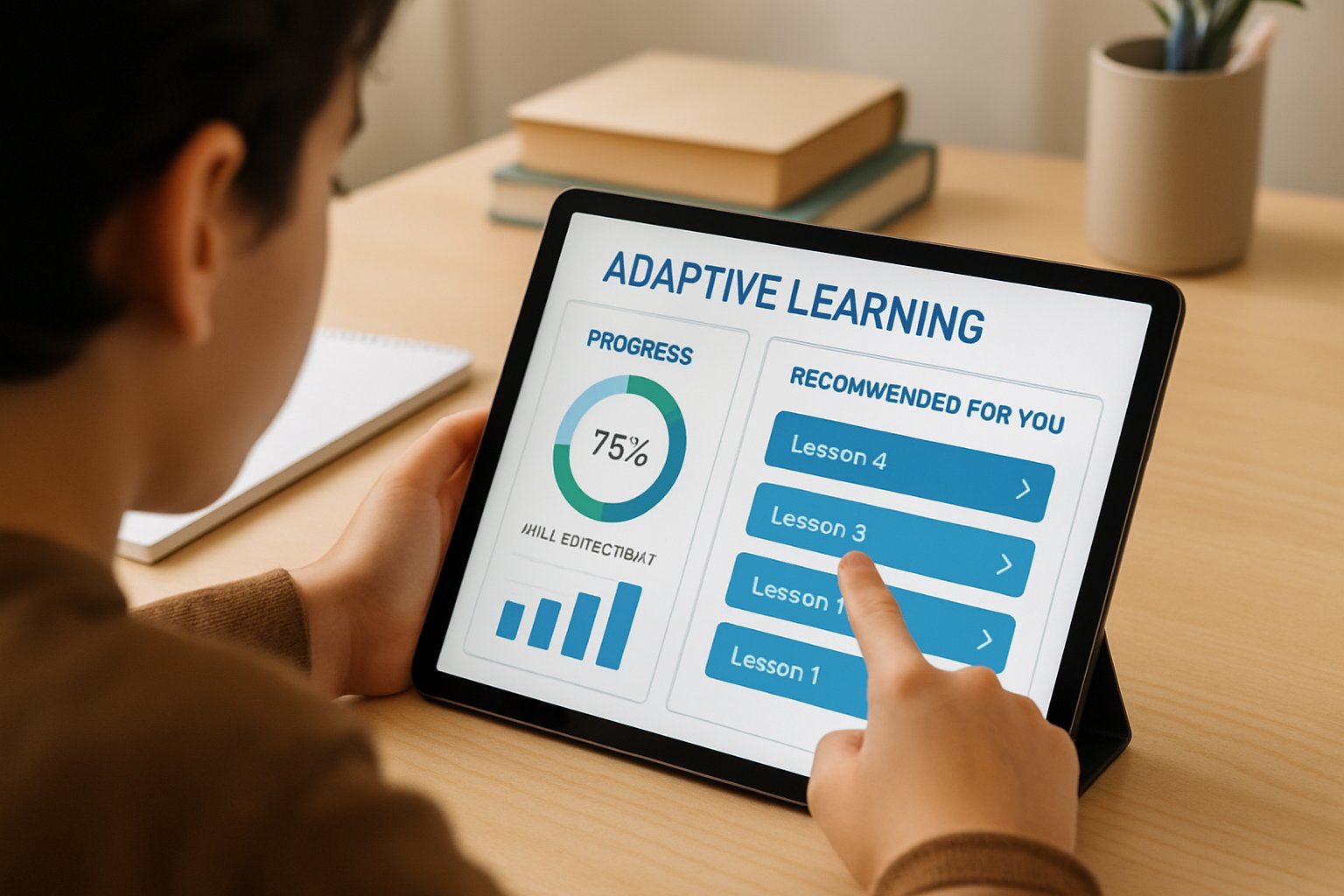
These technical foundations deliver individualized pacing and continuous diagnosis. However, product success depends on broader market forces. Consequently, policy momentum now shapes adoption trajectories.
Policy Shifts Driving Adoption
Federal attention intensified after the Department of Education released its 2024 AI integration toolkit. Moreover, districts now embed the document’s risk-management checklist into procurement requirements. Meanwhile, procurement officers appreciate the toolkit’s plain-language templates for vendor compliance attestations. States follow suit with algorithms-impact clauses and stricter data-retention timelines. Consequently, vendors emphasize transparency dashboards, privacy controls, and explainability layers during demonstrations. Adaptive learning pathway engines that meet these checklists gain faster district clearance, while slower peers lose bids. Subsequently, state edtech funds tie reimbursement eligibility to adherence metrics.
Policy now rewards privacy-forward design and auditability. Nevertheless, market pressure from consolidation also influences buyer choice. Therefore, examining vendor strategies becomes essential.
Vendor Landscape Consolidates Rapidly
Content giants have acquired niche adaptive specialists to bundle pathways with massive libraries. Discovery Education absorbed DreamBox, extending math personalization into reading and science catalogs. Similarly, Wiley owns Knewton Alta, and McGraw Hill leverages ALEKS for higher-ed mastery programs. Meanwhile, Coursera, LinkedIn Learning, and Cornerstone embed skills graphs and conversational tutors into enterprise stacks. Moreover, Docebo and Degreed integrate skills taxonomies that map company roles to required course clusters. Adaptive learning pathway engines now act as platform glue across catalog, assessment, and credential systems.
- Grand View Research forecasts AI education spend to hit USD 32B by 2030.
- DreamBox and ALEKS report millions of active K–12 and college users.
- Coursera cites higher completion after launching personalized pathways in 2025.
These numbers illustrate scale, yet independent validation remains uneven. Consolidation strengthens distribution and liquidity. However, evidence quality must keep pace to sustain trust. Next, we examine that evidence base.
Evidence Signals And Limitations
Math and STEM studies show consistent gains when adaptive engines support mastery-based pacing. Randomized controlled trials remain limited but show promising cognitive gains when dosage exceeds 40 minutes weekly. For instance, ALEKS deployments at Arizona State boosted pass rates in remedial algebra courses. Carnegie Learning and Knewton Alta demonstrate similar improvements in controlled college trials. Nevertheless, effect sizes shrink when teachers lack coaching, or devices fail to connect reliably. Researchers also flag algorithmic bias and opaque decision chains. Learner analytics can perpetuate unequal error rates across demographics. Adaptive learning pathway engines must therefore embed fairness testing, explainability, and opt-out controls. Educators emphasize that dashboards must surface actionable nudges, not merely colorful charts.
Efficacy exists but depends on context. Consequently, governance frameworks need equal attention alongside algorithms. Risk management enters focus next.
Risks Demand Strong Governance
Privacy remains the loudest concern as engines capture detailed clickstream, speech, and sentiment traces. Moreover, third-party data sharing has triggered FERPA and CCPA investigations. Therefore, privacy impact assessments increasingly appear in school board agendas. Algorithmic bias surfaces when training data underrepresents certain communities, producing skewed mastery predictions. In contrast, some vendors now process personalization on local devices to reduce cloud exposure. Edge inference also lowers latency, sustaining engagement during patchy connectivity. Contract teams increasingly require deletion timelines, impact audits, and public algorithm summaries. Professionals can enhance their expertise with the AI Prompt Engineer™ certification. District leaders evaluating adaptive learning pathway engines should demand independent audits.
Robust governance reduces legal and reputational risk. Nevertheless, correct implementation still demands resources and staff training. Finally, we look ahead to emerging trends.
Future Outlook And Recommendations
Market forecasts suggest double-digit compound growth through 2030, driven by workforce upskilling initiatives. Consequently, adaptive learning pathway engines will extend beyond academics into compliance, healthcare, and frontline training. Vendors should prioritize explainable models, edge processing, and open standards for data exchange. Open xAPI and LTI standards will likely dominate next-generation interoperability discussions. Meanwhile, buyers ought to pilot with clear success metrics, teacher supports, and equity audits. In contrast, closed ecosystems risk vendor lock-in and data silos. AI curriculum personalization must align with local goals, ensuring meaningful human oversight. Learner analytics dashboards should highlight actionable insights rather than overwhelming educators with noise.
Scaled success hinges on responsible design and evidence loops. Therefore, cross-functional collaboration remains essential. The conclusion synthesizes these insights.
Conclusion And Next Steps
Adaptive learning pathway engines now sit at the intersection of pedagogy, policy, and profit. Meanwhile, learner analytics and AI curriculum personalization convert engagement data into granular, career-aligned growth. Nevertheless, only transparent governance can unlock public trust. Consequently, institutions that pair evidence-based teaching with adaptive learning pathway engines will realize durable skill gains. Act now: review your procurement rubrics, pursue continuous audits, and explore specialist credentials to lead responsibly.
Disclaimer: Some content may be AI-generated or assisted and is provided ‘as is’ for informational purposes only, without warranties of accuracy or completeness, and does not imply endorsement or affiliation.


