

AI CERTs
6 months ago
How autonomous code orchestration agents turbocharge CI/CD
Speed defines software competitiveness today. However, build and release pipelines still drag for many U.S. teams. Recent breakthroughs in autonomous code orchestration agents promise to change that equation. These AI workers plan, code, test, and push fixes without constant human prompts. Consequently, release velocity shifts from compute limits toward review and governance capacity. Moreover, early adopters report shorter feedback loops and fewer mundane interrupts. Meanwhile, skeptics highlight mixed productivity evidence and new security risks. This article examines the trend, data, and next steps for engineering leaders.
Market Shift Accelerates Rapidly
Development assistance moved beyond code completion through 2024-2025. GitHub launched its Copilot coding agent, while GitLab shipped the Duo Agent Platform. Consequently, both platforms now showcase agents creating branches, running tests, and drafting pull requests. Harness, AWS, and CircleCI added self-healing deployment flows that complement these capabilities. In contrast, niche startups target autonomous CI repair for specialized tasks. Together, these advances redefine expectations for autonomous code orchestration agents in mainstream pipelines.
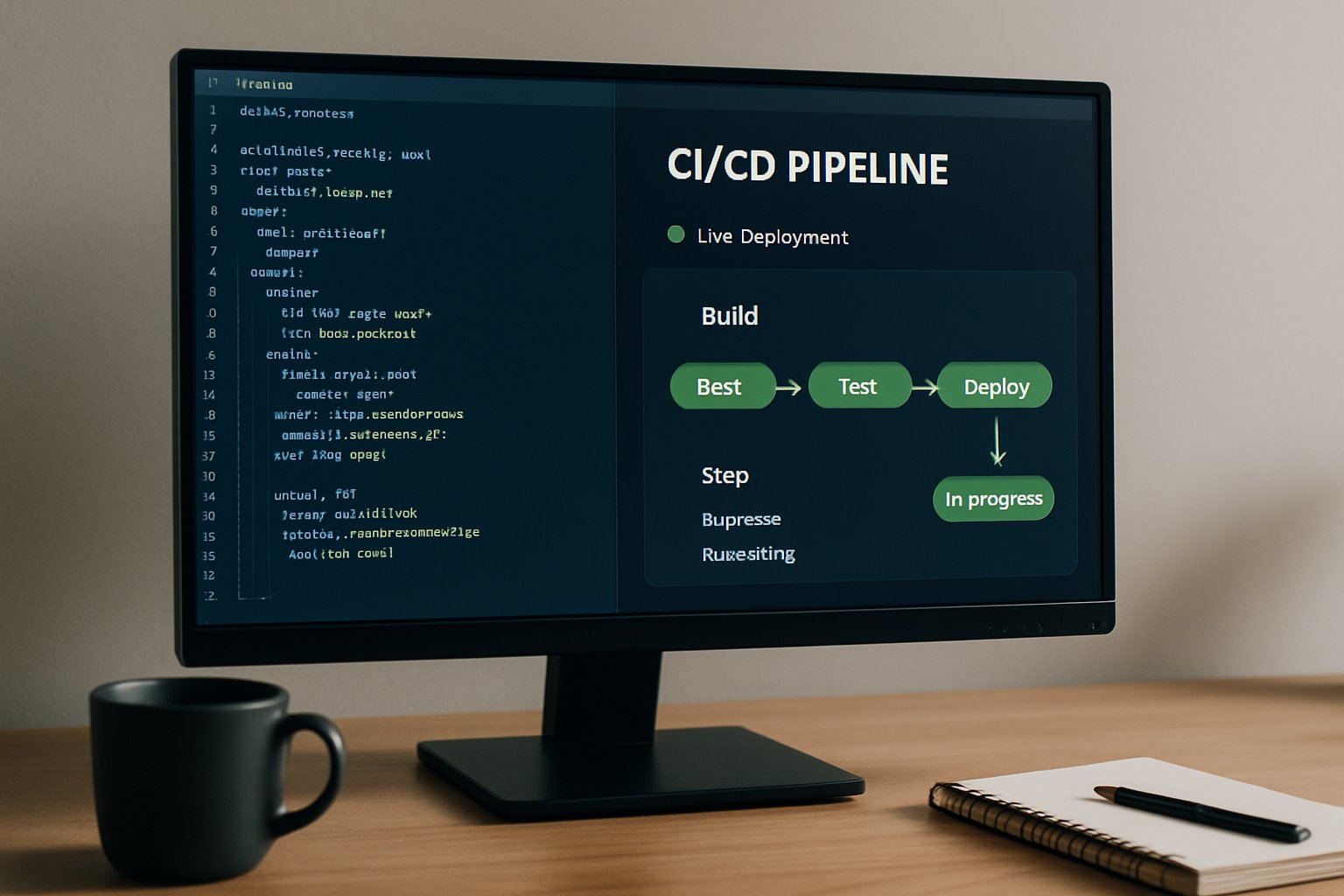
These market moves show strong vendor commitment. However, adoption still depends on enterprise guardrails and cultural readiness. Teams must align review workflows before scaling agents widely. These dynamics set the context for platform advances discussed next.
Key Platform Advances Explained
GitHub’s agent spins up isolated Actions runners, applies a Model Context Protocol, and produces ready-to-review pull requests. Thomas Dohmke described the flow as “secure and fully customizable.” Meanwhile, GitLab’s Duo Agent Platform offers model selection per job and integrates deeply with merge request approval rules. Moreover, cloud providers supply managed agent infrastructure for faster onboarding.
Furthermore, DevOps automation patterns emerge around GitOps. Agents now propose manifest changes, validate them, and trigger reconciliations on Argo or Flux. Therefore, autonomous code orchestration agents shift developer focus toward higher-level design decisions.
Platforms race to simplify orchestration. Yet feature richness raises governance complexity. Nevertheless, understanding performance data remains crucial, as the next section details.
Velocity Data Diverges Widely
Vendor experiments tout impressive gains. Controlled GitHub studies show up to 55% task speedups. Nevertheless, independent telemetry paints a nuanced picture. Uplevel observed no significant pull-request throughput change and a 41% higher bug rate.
- GitHub Octoverse 2025: 13.5B Actions minutes, 1M+ agent pull requests
- 180M developers now active on GitHub, highlighting scale pressure
- GitLab ranked a 2025 Gartner Leader, citing Duo adoption momentum
Consequently, data remains inconsistent across contexts. Some teams achieve meaningful CI/CD optimization; others struggle. Moreover, growing pull-request queues become new bottlenecks when agents fire changes faster than humans review.
These findings underline the importance of instrumented pilots. However, security and governance issues also demand attention, as explored next.
Security And Governance Imperatives
Increased autonomy widens attack surfaces. Therefore, enterprises must enforce signed artifacts, SBOMs, and secrets scanning inside pipelines. Cloud Security Alliance warns about model poisoning and dependency attacks. Additionally, agents need role-based permissions and immutable audit logs.
Meanwhile, regulators expect explainable change histories. Enterprises in finance or health often restrict auto-merge modes. Nevertheless, self-healing CI still improves MTTR when paired with rigorous policies. DevOps automation guardrails thus become non-negotiable companions to autonomous code orchestration agents.
Mitigating these risks preserves trust. Consequently, implementation practices matter, which the following section enumerates.
Implementation Best Practices Checklist
Successful rollouts begin with narrow experiments. Teams should target safe tasks like test generation or documentation updates first. Moreover, capture baselines for deployment frequency, lead time, and defect rates. Subsequently, compare metrics after enabling partial autonomy.
Pilot Narrow Scope First
Experts recommend a staged path:
- Enable suggestion-only mode behind feature flags.
- Allow agents to commit within forked branches.
- Require two human approvals before merges.
- Gradually raise automation level as confidence grows.
Furthermore, integrate security scans and policy gates into every agent branch. Professionals can enhance their expertise with the AI Foundation™ certification. This credential reinforces essential AI governance skills.
These steps align automation with compliance needs. Consequently, teams achieve balanced CI/CD optimization while maintaining oversight. The next section considers future trends.
Future Outlook And Steps
Analysts forecast multi-billion market growth for AI-native DevTools. Moreover, Satya Nadella envisions an “agentic web” where software components cooperate autonomously. Consequently, more tooling vendors will embed autonomous code orchestration agents directly into IDEs and deployment platforms.
However, rigorous independent studies remain scarce. U.S. engineering leaders should demand transparent DORA metrics before scaling. Additionally, security teams must evolve zero-trust models that include agent behavior baselines. Therefore, collaboration among platform, security, and compliance groups becomes essential.
These forward-looking steps will shape competitive advantage. Meanwhile, ongoing pilots will refine best practices in real environments.
Agents will not replace engineers, yet they will reshape workflows fundamentally. Consequently, early, measured adoption offers strategic benefits with manageable risk.
Conclusion
Autonomous code orchestration agents now orchestrate builds, tests, and fixes with minimal prompts. They drive promising DevOps automation gains and unlock fresh CI/CD optimization potential. However, evidence of productivity impact remains mixed, and security stakes have risen. Therefore, leaders should pilot narrowly, instrument metrics rigorously, and enforce robust guardrails. Professionals seeking structured knowledge can pursue the linked AI certification. Embrace autonomy thoughtfully, and your teams will ship faster while staying secure.
Disclaimer: Some content may be AI-generated or assisted and is provided ‘as is’ for informational purposes only, without warranties of accuracy or completeness, and does not imply endorsement or affiliation.


