

AI CERTs
2 months ago
Algorithmic Policy Impact Assessors Reshape Federal AI Oversight
Few federal reforms move as quickly as those targeting artificial intelligence. However, new mandates now compel agencies to document AI risks before launch. At the center stands a growing cadre of algorithmic policy impact assessors guiding each checklist. Consequently, high-impact systems must pass structured reviews covering fairness, safety, and rights. The White House cemented this duty through memoranda M-24-10 and M-25-21. These directives elevate Chief Artificial Intelligence Officers as ultimate gatekeepers. Moreover, public inventories expose where agencies lag. Industry vendors, auditors, and advocates now pore over every waiver request. Meanwhile, Congress and GAO demand measurable progress. This article unpacks the timeline, data, and practical stakes shaping today’s federal AI governance.
Federal AI Rules Evolve
OMB’s M-24-10, published March 2024, moved agencies from voluntary to mandatory AI risk management. In contrast, its 2025 successor, M-25-21, refined language yet retained strict pre-deployment impact assessment demands. Furthermore, both memos require inventory updates, independent evaluations, and CAIO sign-off before production use. These directives implicitly created space for algorithmic policy impact assessors to formalize review processes. Consequently, AI regulation tooling now mirrors documentation rules found in financial audit workflows.
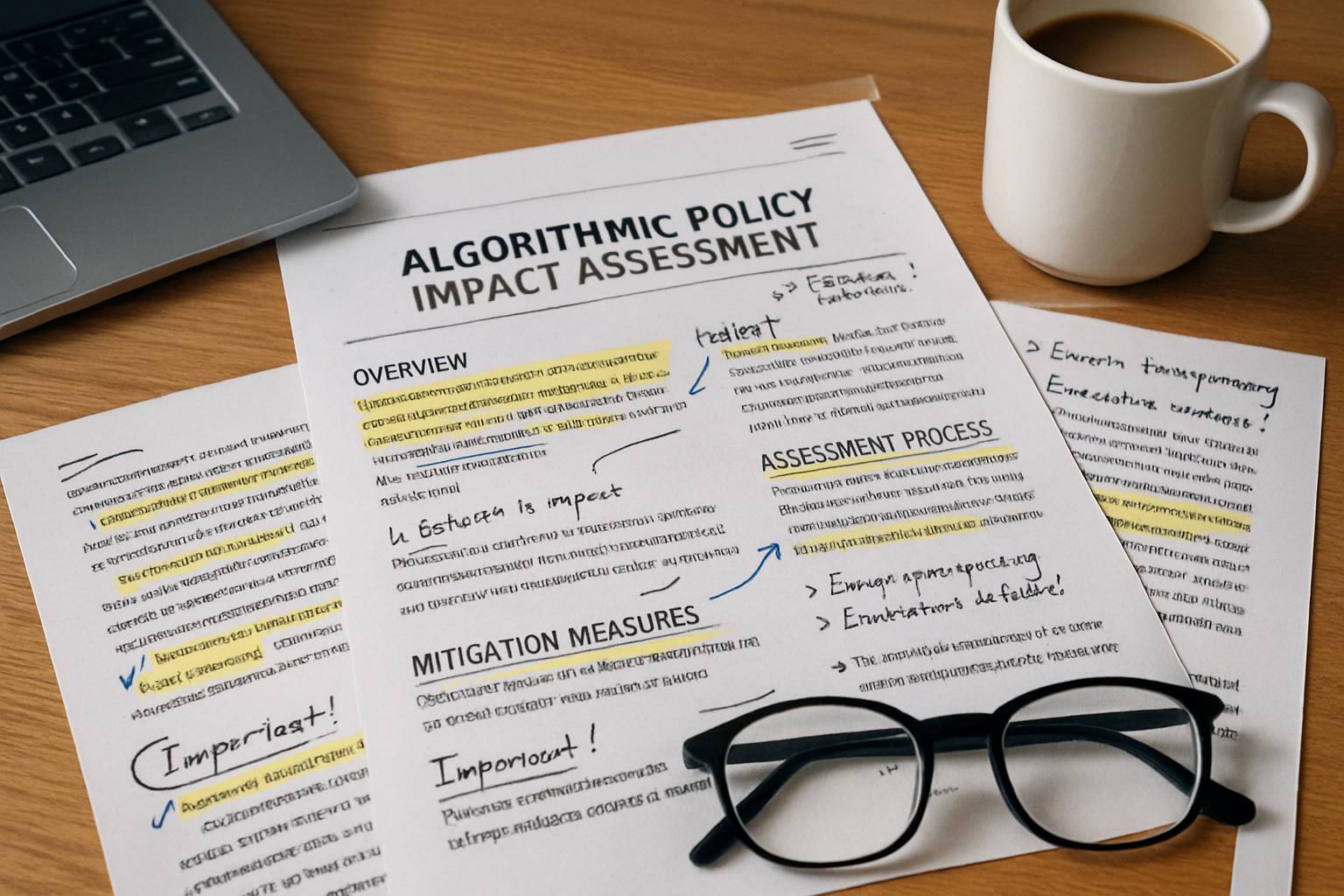
The policy arc shows rapid maturation of federal AI oversight. Requirements now bind agencies to measurable risk practices. Next, the inventories reveal how burdens scale across missions.
Inventory Data Highlights Demand
The consolidated inventory, published December 2024, listed more than 1,700 federal AI use cases. Moreover, 227 of those were flagged as safety or rights affecting, triggering automatic assessments. GAO discovered extensions for 206 entries, underscoring capacity gaps.
- >1,700 total AI cases reported across agencies.
- 227 classified as rights or safety impacting.
- Capacity doubled in sample agencies from 571 to 1,110 within a year.
- Generative AI use jumped ninefold, per GAO 2025 report.
Algorithmic policy impact assessors must triage this surge and prioritize high-risk reviews. Additionally, inventories now tag whether AI regulation tooling produced independent evaluations.
These numbers illustrate workload magnitude and resource urgency. Data point to expanding oversight complexity. Public sector compliance lags when staffing or templates fall short. Governance bodies consequently reshape internal roles, as the next section shows.
Roles And Governance Shift
CAIOs now chair agency AI governance boards and approve every high-impact determination. Moreover, offices recruit lawyers, data scientists, and civil rights experts to act as algorithmic policy impact assessors. Some departments embed these specialists within chief information offices; others create independent ethics units. In contrast, resource-strapped bureaus outsource reviews to academia or trusted vendors. Public sector compliance thus hinges on clear role definitions, sustained budgets, and access to model internals. Consequently, algorithmic policy impact assessors often negotiate contractual clauses granting evaluation data.
Centralizing authority accelerates decisions yet concentrates accountability risks. Boards must balance speed with transparency. Understanding the assessment workflow clarifies those pressures.
Assessment Process Deep Dive
Each AI Impact Assessment follows a template covering purpose, benefits, data lineage, testing, and mitigation plans. Additionally, agencies must document human oversight checkpoints and public feedback channels. OMB recommends NIST’s Risk Management Framework to align measures with industry-proven AI regulation tooling. Subsequently, algorithmic policy impact assessors coordinate independent testers who validate fairness metrics. They review disparate impact analyses, privacy safeguards, and monitoring logic. In contrast, proprietary models complicate evidence gathering because internal weights remain hidden. Therefore, some assessments rely on black-box probing and robust scenario testing. Public sector compliance improves when assessors publish executive summaries alongside inventory entries.
The workflow produces a traceable artifact linking design decisions to risk outcomes. However, collecting sufficient evidence demands time and funds. Stakeholders weigh those costs against expected gains.
Benefits And Ongoing Challenges
Documented assessments generate auditable trails that inspectors general and GAO can sample. Moreover, transparency builds public trust by clarifying algorithm objectives and fallback remedies. Consequently, algorithmic policy impact assessors help agencies defend deployment decisions during oversight hearings. Yet CDT found inconsistent thresholds and testing depth across agencies. Meanwhile, limited staffing slows public sector compliance, causing repeated extension requests. Vendor opacity further restricts independent evaluation, raising unresolved accountability questions.
Prospects for improved rigor hinge on better tools, shared metrics, and skills development. Agencies also need specialized talent pipelines. Emerging training options address that gap.
Tooling And Skills Pathways
Federal buyers increasingly request off-the-shelf AI regulation tooling that automates checklist creation and evidence collection. Moreover, platforms now integrate NIST controls and export machine-readable audit packages. Training providers meanwhile tailor courses for future algorithmic policy impact assessors and technical auditors. Professionals can enhance their expertise with the AI Learning Development™ certification. Consequently, agencies gain internal talent able to configure assessment workflows and write persuasive public summaries. Algorithmic policy impact assessors armed with practical tools accelerate documentation without sacrificing rigor.
Integrated tooling and certifications shrink compliance cycles and standardize evidence quality. However, policy evolution continues. The final section reviews future actions.
Conclusion And Next Steps
Federal AI governance shifted from broad guidance to enforceable routines within only eighteen months. Consequently, algorithmic policy impact assessors became essential translators between legal mandates and technical realities. Inventories, assessments, and CAIO oversight now form an accountability tripod. However, inconsistent resources and proprietary black boxes still threaten equal rigor across agencies. Moreover, staffing shortages slow public sector compliance despite expanding AI regulation tooling markets. Industry professionals should follow new guidance, adopt certified training, and join forthcoming public consultations. Act now to influence emerging standards and secure responsible AI outcomes for the public.


