

AI CERTs
5 months ago
Skill Gap Forecasting Engines Transform Workforce Training
Tight talent markets punish universities and employers that teach fading skills. Meanwhile, fresh capabilities emerge faster than many curriculum committees can convene. Consequently, planners are turning to skill gap forecasting engines that promise near-real-time visibility. These AI platforms monitor job postings, HR databases, and learning systems for shifting demand. Moreover, vendors now pair those insights with automated course and credential recommendations. The combination empowers leaders to act before graduates or workers feel disruption. In this guide, we unpack the market forces, technology design, vendor landscape, and governance playbooks. Readers will gain practical steps to evaluate solutions and avoid common pitfalls. We also connect you to the AI+ UX Designer™ certification for competitive advantage. The stakes are high, yet the opportunity is enormous.
Market Forces Accelerate Adoption
Demand volatility now beats previous records. World Economic Forum predicts 39% core skills turnover by 2030. Furthermore, Lightcast reports 32% of US job skills changed between 2021 and 2024. For the fastest changing roles, the figure reached 75%. Consequently, labor market AI feeds have become indispensable early-warning sensors.
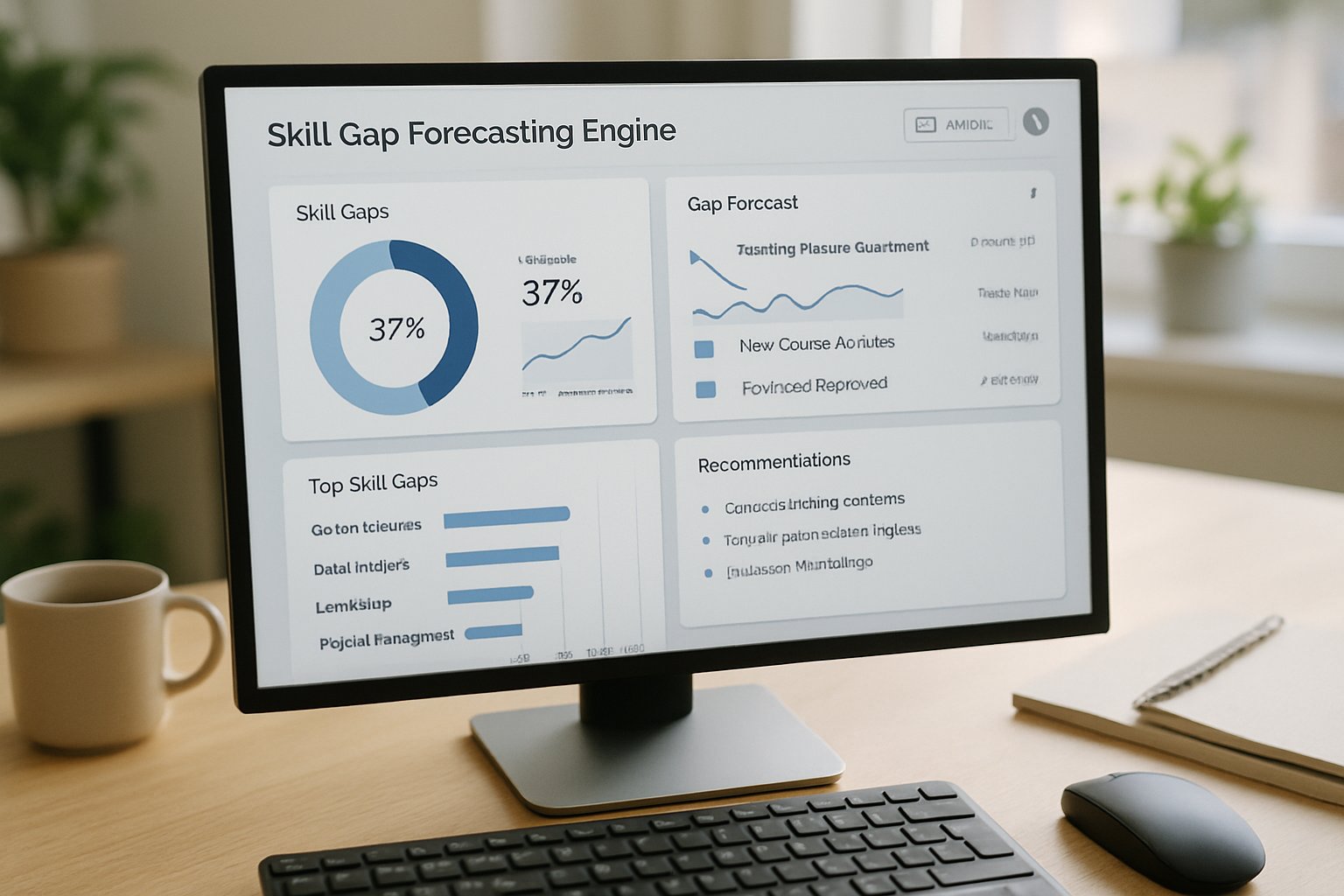
Education budgets feel parallel pressure. Nevertheless, board members demand concrete evidence that programs map to hiring needs. State subsidies and employer partnerships increasingly hinge on publishable alignment metrics. Therefore, many institutions pilot skill gap forecasting engines to defend relevance scores. Simultaneously, enterprises deploy the same tools to steer internal mobility and reskilling analytics.
These converging incentives accelerate adoption across academic, corporate, and public workforce agencies. However, understanding engine design remains vital before signing multi-year contracts.
In short, volatile demand and accountability mandates fuel the current buying wave. Next, we dissect how each engine works under the hood.
Engine Architecture Explained Clearly
Every engine follows a four-stage pipeline. First, web crawlers ingest millions of job postings alongside internal HR data. Subsequently, NLP modules normalize terms using comprehensive skill taxonomies. Third, time-series models perform nowcasting and forecasting on demand trajectories. Finally, prescriptive layers push course, hiring, or mobility actions to dashboards and APIs.
Lightcast’s Skillabi demonstrates the curriculum alignment tier vividly. The product maps course outcomes to occupation skill clusters and returns a 0–100 alignment score. Moreover, Burning Glass Institute offers standard taxonomies for 30 high-impact roles. Workday Skills Cloud embeds similar pipelines inside enterprise HCM systems. Consequently, HR leaders see supply versus demand gaps without exporting spreadsheets.
Effective engines also triangulate supply data using LinkedIn profiles and alumni records. In contrast, single-source models risk sector bias and duplicate postings inflation. Mature skill gap forecasting engines also benchmark peer institutions to spot unique differentiation opportunities.
Architecture choices dictate accuracy, bias, and actionability. We now compare leading vendors and their differentiators.
Leading Vendor Landscape Overview
Four players dominate data scale debates: Lightcast, Burning Glass, LinkedIn, and Workday. However, niche startups like TechWolf enrich enterprise stacks through specialized labor market AI connectors. Lightcast claims billions of postings plus the new Skillabi alignment module. St. Catherine University reports faster curriculum refresh cycles after the pilot. Most platforms explicitly market themselves as skill gap forecasting engines for both education and HR.
Burning Glass focuses on open, skills-first taxonomies and employer implementation playbooks. Meanwhile, LinkedIn harnesses its Economic Graph to surface global hiring velocity data. Workday partners with Skillsoft to link internal skills inventories to reskilling analytics dashboards. Additionally, partnerships promise seamless HR workflow integration, a major adoption driver. However, not all skill gap forecasting engines expose raw taxonomy mapping rules.
Pricing varies widely, from freemium dashboards to six-figure enterprise subscriptions. Therefore, procurement teams should demand transparent data coverage audits.
Each vendor presents unique data strengths and ecosystem partnerships. The following section balances benefits against notable risks.
Benefits And Drawbacks Balanced
The strongest advantage is speed. Institutions can refresh programs quarterly instead of enduring five-year review cycles. Moreover, data-driven signals reduce debate noise and sharpen faculty-employer conversations. Lightcast reports reduced misalignment after early adopters used its engine. Consequently, graduates secure roles faster and command higher wages.
Nevertheless, weaknesses persist. Online postings under-represent small employers, health care aides, and many trade occupations. Labor market AI still misses informal economies and emerging volunteer platforms. In contrast, privacy constraints limit access to internal HR skills inventories. Workday pilots reveal reskilling analytics can cut redeployment time by 30%. Duplicate postings and vague skill labels also confuse less mature models. Therefore, governance committees must review outputs before reshaping programs.
Taxonomy fragmentation causes vendor lock-in risk for public institutions. Rapid generative AI adoption might break historical trend projections overnight. Subsequently, scenario stress tests and human oversight remain essential. Yet, poorly tuned skill gap forecasting engines may amplify existing inequities.
SWOT Snapshot Summary Brief
- Strengths: Near-real-time insights, curriculum alignment, scalable taxonomies.
- Weaknesses: Data bias, duplicate postings, vendor interoperability gaps.
- Opportunities: Open data standards, micro-credential alignment, stronger employer partnerships.
- Threats: Lock-in, inequitable access, overreliance on opaque algorithms.
Overall, gains outweigh limitations when safeguards exist. Next, we outline a concrete implementation roadmap.
Implementation Playbook Steps Guide
Launching a pilot requires disciplined preparation. First, establish success metrics such as alignment scores and placement rate improvement. Secondly, inventory internal data sources across HRIS, LMS, and alumni networks. Subsequently, evaluate taxonomy options and map local labels to vendor IDs. Burning Glass recommends starting with three programs and comparing baseline versus forecast alignment. Many institutions treat the pilot as proof that skill gap forecasting engines can meet accreditation requirements.
During the pilot, convene faculty, HR, and employer reviewers every month. Consequently, they can validate surprising signals before curriculum drafts change. Moreover, incorporate reskilling analytics dashboards to monitor employee participation and course completions. Governance teams must also draft privacy and data-sharing agreements. Professionals can enhance their expertise with the AI+ UX Designer™ certification.
After three months, compare outcomes against the initial KPIs. If gains exceed thresholds, scale the engine across departments or geographies. Consistently tuned skill gap forecasting engines also feed annual strategic planning.
Structured pilots de-risk adoption and build stakeholder trust. Finally, we explore future trends shaping investment decisions.
Future Outlook And Action
Predictive accuracy will improve as synthetic job postings augment sparse sectors. Additionally, global open skills data standards could reduce taxonomy lock-in by 2028. However, governance pressure will intensify around explainability and bias mitigation. Vendors that expose transparent labor market AI pipelines may capture regulatory goodwill. Meanwhile, academic benchmarks like Job-SDF will raise the technical performance bar.
Generative AI skills themselves exemplify volatile demand curves. Consequently, continuous scenario testing inside skill gap forecasting engines becomes mandatory. Chief Learning Officers already budget for dual human-algorithm oversight committees. Moreover, integration with reskilling analytics will link predicted gaps to just-in-time microcredentials. Institutions that move now can gain significant enrollment and retention advantages.
Near-real-time insight from skill gap forecasting engines plus agile governance define the next competitive frontier. The conclusion distills key actions for immediate results.
Skill needs will never stop evolving. Nevertheless, leaders who deploy data-driven engines and robust governance can outpace change. This article traced market forces, architecture, vendors, and implementation tactics. Moreover, we highlighted benefits, limitations, and future trends. Acting on these insights positions institutions for resilient growth. Therefore, explore the AI+ UX Designer™ certification and start aligning learning with tomorrow’s opportunities today.
Disclaimer: Some content may be AI-generated or assisted and is provided ‘as is’ for informational purposes only, without warranties of accuracy or completeness, and does not imply endorsement or affiliation.


