

AI CERTs
3 months ago
Autonomous security response orchestration engines cut breaches
Attackers now move with startling speed, compressing defenders’ reaction windows. Consequently, security leaders are turning to automation to regain the initiative. The most ambitious tools are autonomous security response orchestration engines, systems that plan and act without manual clicks. These platforms combine SOAR automation, XDR telemetry, and large language models into adaptive playbooks. Unit 42 data shows exfiltration can occur within five hours in a quarter of cases. Moreover, dwell time fell to only seven days in 2024, intensifying pressure on fast containment. Vendor case studies claim minutes, not hours, to isolate hosts and block malicious access. Nevertheless, questions remain about governance, false positives, and integration debt. This article dissects evidence, benefits, and pitfalls, then offers practical guidance for adoption. Throughout, it assesses how autonomous security response orchestration engines cut breach time in real environments.
Window For Attackers Shrinks
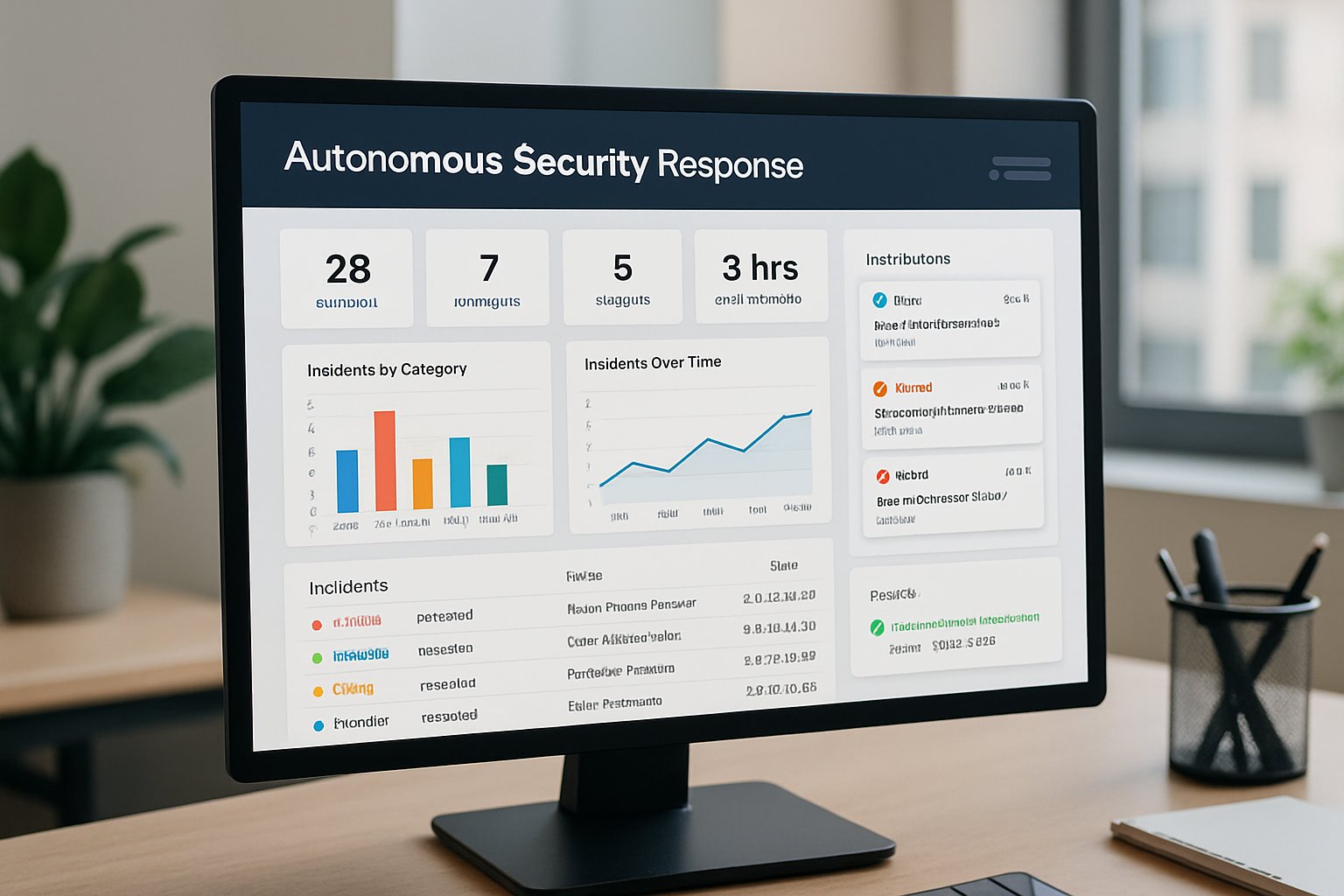
Recent incident-response reports quantify the shrinking gap between intrusion and impact. For example, Unit 42 tracked median exfiltration at two days, yet 19 percent occurred within one hour. Therefore, defenders no longer enjoy leisurely investigation cycles. In contrast, autonomous security response orchestration engines can start host isolation the moment telemetry fires. That capability accelerates incident containment and buys analysts breathing space.
Speed matters more than ever. Consequently, the next section reviews time savings reported by early adopters.
Engines Slash Response Time
Case studies provide concrete, albeit vendor-supplied, metrics. Sitecore automated 90 percent of alerts using Cortex XSOAR and averaged nine-minute resolution. Furthermore, Inspira cut mean time to resolve from 12 hours to around two hours. D3 Security’s Morpheus claims 95 percent of alerts triaged in under two minutes. These figures highlight the promise of autonomous security response orchestration engines when SOAR automation integrations run smoothly. Nevertheless, independent verification remains limited outside vendor narratives.
Early numbers suggest minutes, not hours, are achievable. However, the market wants broader, neutral evidence.
Market Demand Accelerates Rapidly
Market analysts echo the momentum seen in case studies. Grand View Research pegs the SOAR market at $1.72 billion in 2024, growing nearly 16 percent CAGR. Moreover, multiple firms forecast spending to exceed $4 billion by 2030. Investment focuses on platforms bundling XDR, SOAR automation, and large-language-model copilots. Consequently, vendors race to differentiate through deeper playbook libraries and autonomous security response orchestration engines powered by AI agents. Customers justify budgets by linking faster incident containment to lower breach costs highlighted by IBM studies. IBM’s Cost of a Data Breach study links faster containment to $1.76 million lower average costs. Therefore, budget committees increasingly frame purchases as financial risk mitigation rather than pure tooling.
Spending trajectories appear locked on upward paths. Further analysis now turns to tangible operational benefits.
Benefits Outweigh Manual Limits
Automation’s value extends beyond speed alone. Additionally, it reduces alert fatigue and frees analysts for proactive threat hunting. Autonomous security response orchestration engines perform repetitive enrichment steps without complaint or coffee breaks.
- Immediate incident containment through host isolation and IP blocking.
- Consistent compliance logging across all playbooks.
- Lower mean time to acknowledge and recover.
- Scalable SOAR automation without linear headcount growth.
Automated post-incident reports also satisfy auditor requests in seconds. Meanwhile, SOC morale improves because analysts handle creative investigations instead of click fatigue. IBM’s 2025 breach report states that automation shortens breach lifecycles by 108 days on average. Therefore, organizations may save millions in direct and indirect costs. Nevertheless, benefits depend on clean data, well-tested playbooks, and cross-team buy-in.
Evidence indicates meaningful ROI when implementations mature. Next, governance considerations address the risks that accompany such power.
Governance Demands Human Oversight
Power invites risk, especially when code locks users out of their own systems. Forbes contributors urge staged rollouts: read-only, guided, then conditional autonomous modes. Moreover, strict RBAC and audit logs remain non-negotiable safeguards. Many teams deploy autonomous security response orchestration engines only after tabletop exercises validate decision paths. In contrast, skipping testing can lead to costly outages or credential revocation errors. Consequently, continuous review cycles must trace every automated step back to business policy. Regulators may soon demand audit evidence for every autonomous action. Therefore, documentation pipelines must include immutable logs and cryptographic signatures.
Governance balances velocity with control. Subsequently, best practice guidance shapes practical deployment roadmaps.
Practical Deployment Best Practices
Implementation success often starts small. Additionally, teams pick low-risk phishing workflows and measure baseline metrics before automation. Autonomous security response orchestration engines then expand to privilege revocation and network isolation actions.
- Define measurable goals such as 50 percent incident containment within ten minutes.
- Integrate SIEM, IAM, and EDR data first.
- Enforce human approval gates for destructive commands.
- Document playbooks and store versions in source control.
- Upskill staff through the AI+ Cloud™ certification.
MSSPs recommend weekly playbook drills to sustain readiness. Subsequently, automated dashboards display MTTR trends and highlight regressions. Furthermore, regular post-mortems refine decision trees and eliminate false positives. Professionals can benchmark maturity using MITRE’s open-source DIR metrics. Therefore, incremental iteration sustains momentum and trust.
Disciplined execution converts theory into durable gains. Meanwhile, leaders must anticipate future capability shifts.
Future Outlook And Advice
Analysts predict broader adoption as LLM copilots mature. Consequently, autonomous security response orchestration engines will handle richer context and self-generate remediation logic. SOAR automation vendors already embed natural-language interfaces that explain playbook choices on demand. Nevertheless, real-world credibility depends on transparent metrics and independent validation. Edge devices and OT networks represent the next automation frontier. Nevertheless, vendors must address safety constraints unique to physical processes.
Rapid evolution promises both opportunity and risk. Subsequently, wise organizations prepare teams for constant change.
The evidence shows that well-integrated automation already shrinks breach windows from hours to minutes. Moreover, cost reductions and analyst satisfaction follow closely behind. Autonomous security response orchestration engines unlock these gains when paired with disciplined governance and continuous measurement. In contrast, rushed deployments risk outages and eroded trust. Consequently, start small, refine playbooks, and track metrics against attacker speed benchmarks. Professionals seeking deeper mastery can elevate skills through the AI+ Cloud™ certification. Take the next step today and accelerate secure outcomes.


