

AI CERTs
4 months ago
Deepfake Political Disinformation Erupts After Maduro Capture
Images of Nicolás Maduro in chains raced across social feeds minutes after U.S. forces announced his capture. That moment arrived on 3 January 2026. However, most of those dramatic visuals never existed in the real world. They belonged to Deepfake Political Disinformation, an expanding threat that outpaces traditional verification. Furthermore, conflicting videos of Venezuelan crowds celebrating flooded platforms, sowing doubt among journalists and policymakers. Consequently, newsrooms scrambled to separate fact from fabrication while audiences shared content millions of times. This article unpacks the surge, explains the tools involved, and outlines pragmatic countermeasures for professionals.
Chaotic Capture First Hours
Within sixty minutes of the raid, at least a dozen AI images claimed to depict Maduro under U.S. guard. Moreover, an X account named Ian Weber posted the “first photo” that reached 30,000 likes. Analysts quickly noticed wrong uniform badges and vanishing flag stars. Meanwhile, a video hosted by Wall Street Apes amassed 5.3 million views. It recycled footage from a TikTok creator outside Venezuela. Such speed illustrates how Misinformation exploits emotional peaks during breaking events. The confusion also widened because President Trump shared an unverified image on Truth Social.
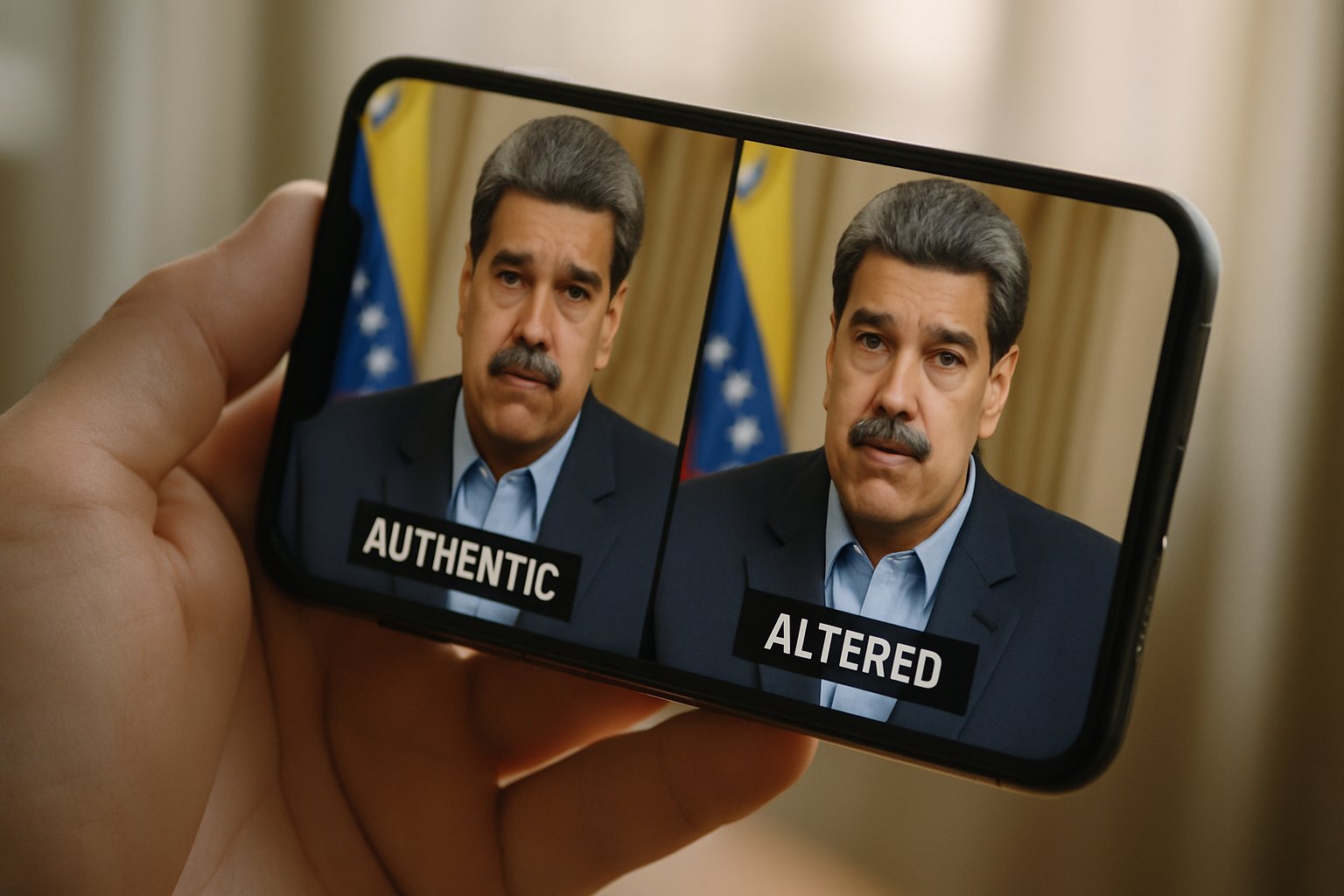
These early hours underscored rapid content fabrication and massive amplification. Consequently, professional verification teams faced immediate pressure. Next, we examine how investigators traced the viral source.
Tracking Viral Images
Open-source analysts moved fast, mapping post timestamps across platforms. Additionally, reverse-image searches confirmed that Weber’s upload predated every mainstream repost. In contrast, SynthID metadata embedded by Google revealed the Nano Banana Pro origin. Therefore, investigators matched the invisible watermark with Google’s public detector, proving AI creation. PolitiFact, AFP, and CBS published debunks on 5 January 2026, each citing the same chain of evidence. Venezuela appeared in headlines worldwide, yet clarity emerged only after these reports. Such coordinated analysis limited Misinformation lifespan from days to hours.
Timely attribution restored some public trust. Nevertheless, the next challenge involved understanding the technology itself. We turn to the tools powering the fakes.
Tools Powering Falsehoods
Google’s Nano Banana Pro, a Gemini 3 model, generated the custody portrait and several look-alikes. Moreover, the model produces photo-realistic faces from brief prompts, lowering skill barriers for creators. SynthID, an invisible watermark, attempts to flag outputs without altering visible pixels. However, detection survives only certain edits, and results vary between scanners. Consequently, fake creators can still crop or compress files to evade automatic labels.
- 5.3 million views: viral celebration video traced to TikTok.
- 30,000 likes: Weber’s original custody image before takedown.
- “Over 10 billion”: Google’s claim about SynthID watermarked assets.
These figures highlight the scale advantage enjoyed by Synthetic Media creators. Deepfake Political Disinformation therefore reaches audiences before traditional gatekeepers react.
Technical safeguards remain partial at best. Accordingly, human fact-checkers continue to play a decisive role. Their workflow during the Maduro episode shows important lessons.
Fact-Checkers Rapid Response
AFP debunked the custody image on 5 January, publishing annotated visuals that circled distorted handcuffs. Additionally, PolitiFact and CBS confirmed the SynthID match within hours. In contrast, several influencers continued reposting the fake through 7 January, prolonging confusion. Nevertheless, coordinated newsroom alerts reduced the lifespan of Deepfake Political Disinformation on mainstream channels. Misinformation still lingered in closed messaging groups, where automated moderation was weaker. Fact-checkers warned that future hoaxes may blend authentic and Synthetic Media, complicating detection.
Collaborative verification reduced public uncertainty quickly. However, scale challenges persist as fakes multiply. Attention now shifts to platform governance.
Platform Oversight Gaps
Meta labeled some posts as altered, yet X left others untouched during the critical 48-hour window. Moreover, TikTok waited until fact-check links appeared before throttling the 5.3-million-view clip. Consequently, Deepfake Political Disinformation continued trending despite partial interventions. In contrast, Google highlighted SynthID’s success but admitted it cannot compel platforms to display provenance. Sofia Rubinson of NewsGuard emphasized that visual trust is eroding faster than policy updates. Meanwhile, detection tools gave inconsistent scores, reminding teams to use multiple methods.
Platform policy delays create fertile ground for hoaxes. Therefore, professionals need independent verification skills. The next section details practical techniques and training.
Verification Skills Needed
Journalists and analysts employ a layered approach to confirm authenticity. Firstly, they run reverse-image searches across Google and TinEye. Additionally, they inspect SynthID reports when Google provenance is suspected. Metadata checks follow, comparing timestamps, camera models, and geolocation tags. Moreover, analysts scrutinize clothing details, flag patterns, and background inconsistencies that often betray Synthetic Media. Finally, they trace the earliest upload, contact the poster, and corroborate with local sources inside Venezuela.
Professionals can deepen these skills through the AI Executive Essentials™ certification, which covers synthetic media risk management. Such training equips teams to detect Deepfake Political Disinformation before it shapes public narratives.
Structured workflows and formal education create a robust defense. Nevertheless, leaders must evaluate future business implications. A strategic outlook clarifies those stakes.
Strategic Risk Outlook
Corporate communicators fear reputational crises triggered by convincing hoaxes. Moreover, stock prices can swing when markets react to fabricated leadership changes. During the Maduro incident, several energy traders briefly paused Venezuela-linked contracts, illustrating potential financial ripple effects. Consequently, boardrooms now include Deepfake Political Disinformation in enterprise risk registers.
Regulators may also mandate provenance labeling standards, raising compliance pressures. In contrast, proactive organizations are investing in monitoring tools and staff training. Deepfake Political Disinformation defense thus becomes both a legal and brand necessity.
Financial, legal, and reputational stakes keep rising. Therefore, leaders must build resilience before the next crisis. Finally, we recap essential insights and next actions.
Maduro’s capture revealed how swiftly Deepfake Political Disinformation can rewrite reality. Fact-checkers, watermark tools, and newsroom protocols contained the fallout, yet the incident warned of future escalations. Moreover, Synthetic Media technologies will grow stronger while platform policies lag. Professionals who master verification workflows and pursue the AI Executive Essentials™ certification strengthen organizational defenses. Consequently, business leaders should budget for monitoring solutions and crisis drills. Deepfake Political Disinformation will return in new forms; however, disciplined preparation can blunt its impact. Therefore, treating Deepfake Political Disinformation as a standing corporate threat is no longer optional. Act now to audit your processes, train your teams, and safeguard trust.
Disclaimer: Some content may be AI-generated or assisted and is provided ‘as is’ for informational purposes only, without warranties of accuracy or completeness, and does not imply endorsement or affiliation.


