

AI CERTs
3 months ago
AI Trust Scoring Frameworks: Enterprise Deployment Guide
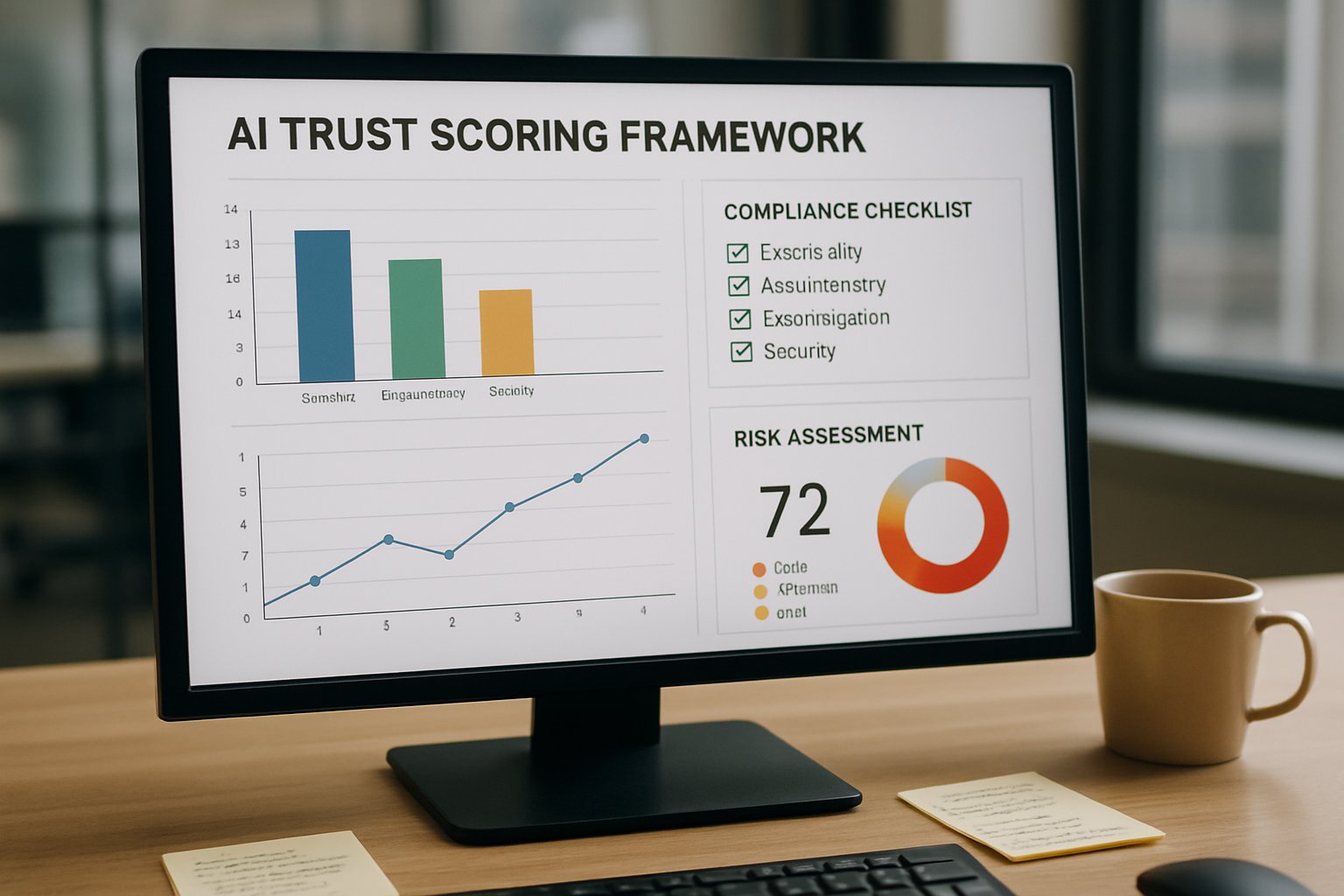
Enterprises are embracing generative models, yet trust questions still delay production rollouts. Consequently, boards are demanding quantified evidence that systems behave safely, fairly, and reliably. This urgency has propelled AI Trust Scoring Frameworks from research slides into daily procurement checklists. Moreover, regulators like the EU now require persistent documentation, making transparent scoring a compliance linchpin. Meanwhile, market analysts predict governance spending will multiply sixfold within four years. However, leaders report that only 42% fully trust AI insights, highlighting a glaring confidence deficit. Therefore, executives are searching for practical guides that translate principles into measurable, repeatable controls. These AI Trust Scoring Frameworks promise that bridge, yet their design choices carry trade-offs. The following analysis unpacks forces, standards, vendors, and implementation tactics shaping this fast-moving field.
Market Forces Accelerate Adoption
Investor pressure and public scrutiny create unprecedented momentum for trustworthy AI metrics. Global governance tools revenue could hit USD 5.78B by 2029, according to MarketsandMarkets. Additionally, venture funding continues flowing to governance startups despite broader tech slowdowns.
Regulatory developments amplify this demand. The EU AI Act mandates post-market monitoring and model documentation for high-risk deployments. Consequently, enterprises must present living audit trails rather than static policy statements.
NIST’s AI Risk Management Framework offers a voluntary yet influential reference for U.S. companies. Many organizations map internal scoring dashboards directly to its Govern, Map, Measure, Manage taxonomy. Therefore, alignment with NIST eases cross-department collaboration and vendor conversations.
Vendors respond by embedding AI Trust Scoring Frameworks within cloud dashboards and procurement portals. Market and regulatory forces jointly push scoring from nice-to-have to operational necessity. Next, we examine how frameworks actually work.
Framework Basics Explained Clearly
A trust score condenses multiple dimensions into one digestible signal. However, credible frameworks never hide the underlying evidence. Typical dimensions include capability, fairness, robustness, explainability, data quality, and operational stability.
Credo AI’s Model Trust Score illustrates a use-case approach. It applies non-negotiable filters for safety, then weights remaining metrics by business importance. In contrast, Qlik measures dataset readiness before modeling begins.
Both products exemplify AI Trust Scoring Frameworks using context-specific weights rather than generic averages. Moreover, they publish per-dimension sub-scores to discourage blind reliance on a single number. Such transparency supports responsible AI adoption by surfacing trade-offs early.
- Capability: benchmark performance and latency
- Safety: bias, toxicity, legal compliance
- Robustness: adversarial and out-of-distribution tests
- Explainability: interpretability and documentation presence
- Data Trust: lineage, diversity, freshness
These dimensions create a shared language between engineers, lawyers, and executives. Yet, scoring methods vary widely, warranting closer inspection of standards.
Standards Shape Control Measures
Standards bodies help tame fragmentation. NIST AI RMF 1.0 remains the go-to blueprint in North America. Meanwhile, OECD and ISO groups publish complementary guidance.
The framework divides work into Govern, Map, Measure, Manage. Consequently, many dashboards tag each metric to one of these functions. Microsoft’s Responsible AI Dashboard even labels widgets accordingly.
Regulations provide the legal stick. The EU AI Act requires providers to keep technical documentation for up to ten years. Therefore, AI Trust Scoring Frameworks must store versioned evidence and monitoring logs.
Enterprises also borrow from academic artifacts like model cards and IBM FactSheets. These templates satisfy transparency clauses while speeding internal risk assessment.
Standards and laws thus anchor scoring taxonomies. The next section surveys solution providers addressing those mandates.
Vendor Landscape Snapshot Today
Competition across vendors is intensifying. Credo AI leads with use-case leaderboards covering capability, safety, cost, and speed. Qlik attacks upstream data issues with its Trust Score for AI.
Open projects such as MetricsLM and TrustVector promote vendor-neutral benchmarks. Moreover, cloud giants embed scoring hooks directly into DevOps pipelines. AWS SageMaker Clarify and Google Vertex AI both offer bias and drift indicators.
However, interoperability remains elusive because each provider defines unique dimensions and thresholds. Consequently, procurement teams still demand raw evidence before green-lighting models. Many supplement vendor dashboards with independent risk assessment exercises.
Decision makers should compare AI Trust Scoring Frameworks based on transparency, evidence accessibility, and update cadence. The crowded landscape offers choice yet introduces evaluation burden. Practical implementation guidelines can reduce that friction.
Implementation Best Practices Guide
Teams should begin by defining the business objective and harm scenarios. Subsequently, map those scenarios to NIST functions for governance clarity. This upfront step anchors responsible AI adoption in concrete context.
Next, decide whether to score data, models, or the full system. Qlik demonstrates data-first scoring; Credo shows model-centric methods. Both layers matter, yet priorities differ by domain sensitivity.
Choose metrics, weights, and non-negotiable gates with legal, risk, and business owners. Moreover, publish per-dimension results alongside the aggregate score. This practice discourages gaming and supports ongoing risk assessment.
Instrument continuous monitoring for drift, fairness regression, and uptime. Therefore, scores remain current instead of decaying between audit cycles. Integrate alerts into existing incident management workflows for rapid remediation.
Well-governed AI Trust Scoring Frameworks also link to versioned model cards or FactSheets.
- Define use-case and risk tolerance
- Select scoring layer and metrics
- Set gating thresholds and weights
- Implement real-time monitoring hooks
- Document evidence and ownership
Following these steps embeds scoring deeply into engineering and compliance culture. We now weigh the tangible benefits against lingering drawbacks.
Key Benefits And Drawbacks
Quantified scores accelerate vendor comparisons, shrinking evaluation cycles from months to weeks. Furthermore, continuous metrics surface anomalies before headlines emerge and reputations suffer. Regulators appreciate structured evidence, easing conformity assessments and reducing fine exposure.
Nevertheless, pitfalls persist. There is no universal schema, so cross-vendor numbers rarely align. Moreover, numeric simplicity can mask nuanced fairness trade-offs.
Smaller teams may struggle to finance bias testing infrastructure required for credible scoring. Consequently, they risk overreliance on glossy vendor dashboards. Mitigations include open tooling, shared evaluation datasets, and independent audits.
Balanced AI Trust Scoring Frameworks therefore expose sub-scores, disclose methods, and mandate human review. Benefits clearly outweigh drawbacks when organizations adopt disciplined practices. Looking forward, several trends will further mature the space.
Future Outlook And Trends
Interoperability efforts are advancing within ISO and industry consortia. Additionally, procurement platforms plan to ingest score metadata automatically via APIs. Such automation will streamline responsible AI adoption for resource-constrained teams.
Analysts expect regulators to reference NIST mappings in forthcoming sector rules. Meanwhile, open indices like TrustVector may pressure vendors toward transparent methodologies. Consequently, organizations could soon compare scores across providers with increased confidence.
Tooling vendors will likely integrate real-time risk assessment triggers tied to dynamically updated thresholds. Moreover, explainable weighting dashboards will help executives justify decisions to auditors and boards.
Continued evolution will position AI Trust Scoring Frameworks as foundational compliance infrastructure, not optional add-ons. Enterprises that invest early will gain faster model deployment and stronger stakeholder confidence. The concluding section summarizes key actions to begin the journey.
AI Product Manager™ certification
Final Takeaway And Action
Trust metrics have shifted from theory to boardroom imperative. AI Trust Scoring Frameworks now unify standards, regulations, and vendor innovation. When implemented with transparency and continuous monitoring, they accelerate responsible AI adoption across sectors. However, organizations must remember that scores are guides, not guarantees. Consequently, human oversight and rigorous risk assessment remain essential companions.
Begin by mapping your highest-risk use-cases, selecting metrics, and piloting a lightweight dashboard. Moreover, share your lessons with industry forums to shape emerging standards and tooling. Stay informed with our future coverage and deepen expertise through upcoming certification resources. Our newsletter regularly reviews new AI Trust Scoring Frameworks and deployment case studies.


