

AI CERTs
5 months ago
AI Policy Impact Forecast Tools Redefine Legislative Strategy
Lobbying teams face a deluge of bills every session. Meanwhile, tight timelines demand quicker, data backed decisions. Consequently, AI Policy Impact Forecast Tools promise a decisive edge. These platforms combine natural language processing, predictive scoring, and social listening. Moreover, vendors have packaged once experimental models into mainstream subscriptions. Government affairs directors now triage proposals in minutes, not days. However, the same automation introduces fresh transparency and equity challenges. Understanding the technology and its governance context has become essential. Furthermore, upcoming standards will influence procurement, disclosure, and public trust. This article unpacks the mechanics, market momentum, benefits, and unresolved risks. It provides actionable guidance for teams shaping legislative strategy in 2026. Therefore, allocate a few focused minutes to absorb the insights ahead. Practical links, including a certification pathway, appear where relevant.
Key Market Momentum Drivers
FiscalNote, Quorum, and Plural each released upgraded predictive modules during 2024 and 2025. Additionally, brisk vendor marketing framed the features as must-have competitive assets. OpenSecrets data showed groups lobbying AI topics jumping almost 200 percent in 2023. Consequently, demand for AI guidance tools exploded.
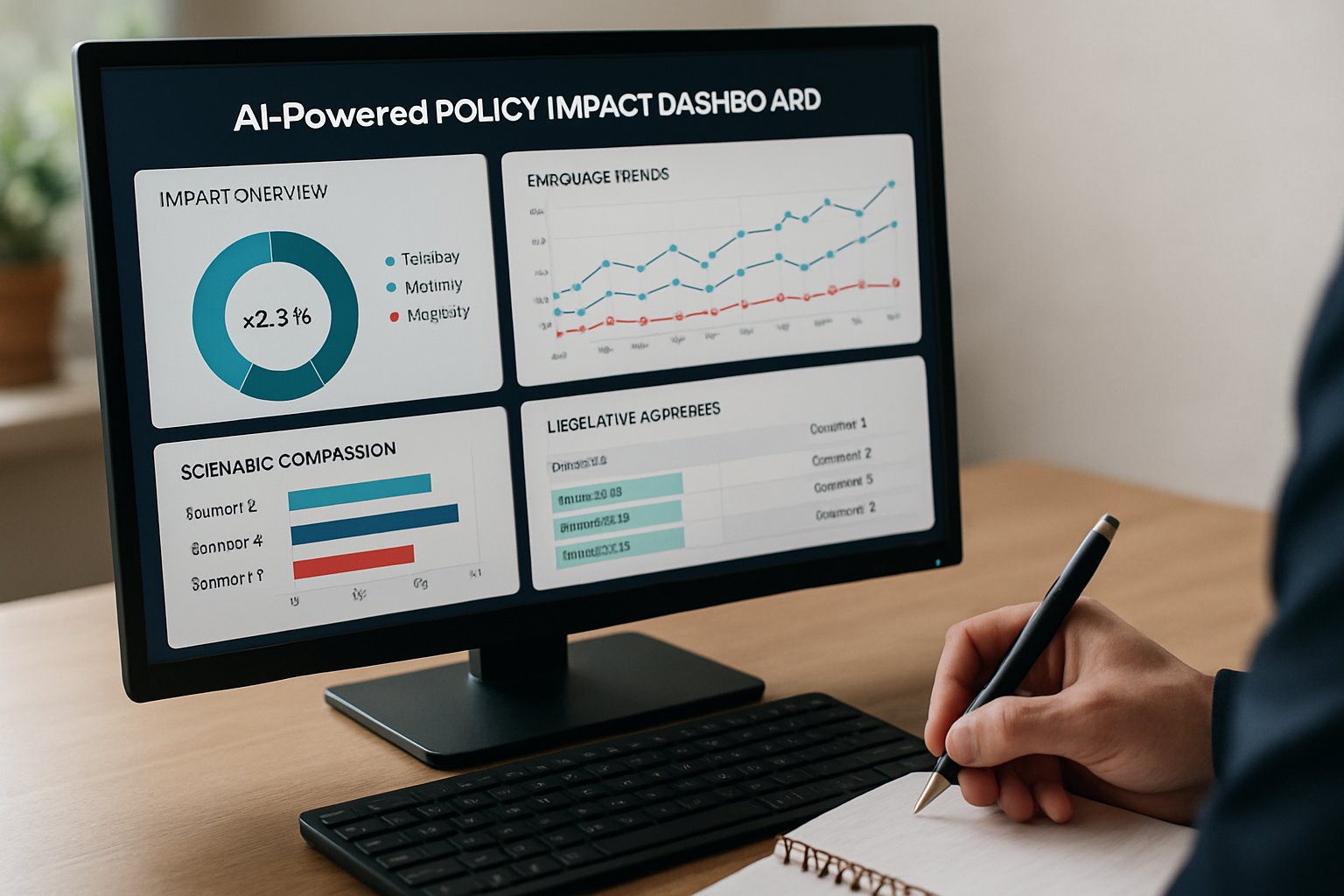
Most buyers cited AI Policy Impact Forecast Tools as central to managing the surge. Moreover, executive quotes claim thousands of customers already lean on live probability scores. These metrics accelerate internal prioritization and budget allocation decisions. Therefore, organizations unable to deploy AI Policy Impact Forecast Tools risk strategic blind spots.
Government activity also fuels adoption. In contrast, the 2023 White House AI Executive Order pushed agencies toward risk-managed procurement. Subsequently, vendors highlight NIST compliance alignment within brochures. These converging forces illustrate why the market expanded rapidly. Adoption rises because volume, competition, and regulation intersect. However, momentum alone does not explain tool architecture, which follows next.
Core Toolset Mechanics Explained
Every platform starts with automated bill ingestion and NLP summarization. Consequently, lengthy proposals reduce to digestible topic overviews within seconds. Furthermore, similarity detection flags companion language across jurisdictions.
Predictive engines then score passage odds using sponsor history, committee rhythm, and media sentiment. In contrast, older rule-based systems relied on static heuristics. Modern pipelines integrate continuous learning with event feeds.
Key functional pillars include:
- Forecast probability dashboards
- Scenario generation via regulatory modeling
- Stakeholder graphs powered by governance analytics
- LLM drafting assistants for amendments
Together, these modules form the backbone of AI Policy Impact Forecast Tools. Moreover, APIs connect scores directly into CRM and messaging software. Mechanics matter because accuracy and context drive trust. Subsequently, strategy workflows transform once data streams flow seamlessly.
Strategic Workflow Shifts Emerge
Teams previously reviewed hundreds of bills manually each week. Now, forecast scores rank items by expected impact within dashboards. Consequently, analysts reallocate time toward persuasion and coalition building.
Social listening modules surface narrative spikes, guiding punctual testimony submissions. Furthermore, governance analytics maps influential staffers to outreach lists. Organizations send tailored emails when probability curves cross internal thresholds.
Additionally, LLM drafting trims turnaround on amendments from days to hours. Therefore, language iterations occur before committees even convene. AI Policy Impact Forecast Tools underpin this new tempo. Workflow acceleration creates measurable efficiency gains. However, benefits carry counterpart risks explored next.
Benefits And Tangible Returns
Early adopters report substantial resource savings. FiscalNote claims hours freed per staffer each week. In contrast, manual methods scale poorly against 150,000 annual bills.
Key reported advantages include:
- Measurable ROI tracking through governance analytics dashboards
- Rapid detection of emerging model legislation
- More persuasive messaging aligned with predictive sentiment
- Cross-jurisdiction insights supporting regulatory modeling roadmaps
Moreover, AI Policy Impact Forecast Tools support transparent KPI measurement. Teams correlate outreach steps with subsequent amendments or vote shifts. Quantified gains justify continued investment. Nevertheless, unresolved risks demand equal attention.
Emerging Legislative Risks Landscape
Opaque proprietary models limit external auditability. Consequently, explainability gaps erode public confidence. Researchers warn outputs may encode historical biases favoring entrenched sponsors.
Governance analytics can enable microtargeting that undermines equitable voice. Meanwhile, privacy concerns surface when scraping constituent data at scale. Strategic actors might even game wording to exploit model features.
Bias, privacy, and democratic accountability issues intensify when AI Policy Impact Forecast Tools proliferate. Additionally, regulatory modeling scenarios can appear authoritative despite limited validation. Therefore, procurement teams now request model documentation, bias assessments, and stress tests. Subsequently, federal standards like the NIST AI RMF set emerging baselines. Risks are real yet manageable with structured oversight. The compliance outlook clarifies forthcoming obligations.
Compliance Outlook For 2026
Agencies will soon embed NIST profile references into procurement solicitations. Consequently, vendors must supply model cards, datasets lineage, and testing reports.
Regulatory modeling documentation will become a contract deliverable alongside security attestations. Meanwhile, Congress deliberates bills demanding disclosure of AI-authored legislative text.
Governance analytics deployments inside agencies may trigger Privacy Act evaluations. Therefore, early adopters should align internal audits with external expectations immediately.
AI Policy Impact Forecast Tools that demonstrate transparent metrics will gain procurement preference. Nevertheless, independent validation will remain critical for public legitimacy. Compliance shifts reward proactive preparation. Next, actionable next steps translate outlook into practice.
Actionable Next Steps Now
Begin by requesting back-tested accuracy reports from each vendor. Additionally, compare fairness audit summaries across jurisdictions. Set calibration benchmarks aligning with internal values.
Secondly, map critical bills, probability thresholds, and outreach triggers inside governance analytics dashboards.
Moreover, develop a regulatory modeling register describing assumptions, data sources, and validation frequency.
Professionals can validate skills through the AI Architect certification.
Finally, revisit risk registers quarterly and update mitigation plans. AI Policy Impact Forecast Tools thrive when governance keeps pace. Practical steps convert theory into advantage. Consequently, readers can lead rather than follow the next policy cycle.
AI Policy Impact Forecast Tools have shifted from novelty to necessity. Today’s policy battlefield rewards speed, evidence, and foresight. Consequently, predictive platforms now sit at the strategic core for many advocacy teams. Regulatory modeling and governance analytics enrich forecasts with scenario depth and stakeholder granularity. Nevertheless, opacity, bias, and compliance gaps demand vigilant oversight. Standards from NIST and forthcoming legislation will raise disclosure and documentation expectations. Therefore, organizations should combine technical audits, transparent processes, and skilled talent. Certification pathways, such as the AI Architect program, strengthen internal capability and external credibility. Take the initiative, evaluate your tooling, and position your team for informed, responsible influence.
Disclaimer: Some content may be AI-generated or assisted and is provided ‘as is’ for informational purposes only, without warranties of accuracy or completeness, and does not imply endorsement or affiliation.


