

AI CERTs
4 months ago
Autonomous Checkout Vision Systems Drive Retail’s Next Leap
Checkout lines remain one of retail’s most persistent friction points. Consequently, retailers are racing toward computer-vision solutions that erase delays at the register. Among the emerging options, Autonomous Checkout Vision Systems promise the boldest shift. These platforms blend cameras, sensors, and edge compute to identify items automatically. Moreover, they deliver a tap-and-go exit that rivals ecommerce convenience. Investment has moved from trial curiosities to scaled deployments across groceries, venues, and pharmacies. However, technical limits, rising shrink, and capital costs still shape winning strategies. This article maps the latest progress, risks, and pragmatic next steps for decision makers. Insights draw from global pilots, market forecasts, and retailer pivots over the past two years. Readers gain actionable guidance to navigate modernization without costly misfires.
Market Momentum Accelerates Rapidly
Global investment is no longer experimental. DataIntelo values the autonomous checkout market at roughly USD five billion for 2024. Moreover, forecasts show high-twenties compound growth through 2033. Market acceleration mirrors rapid deployment counts across continents. Amazon, Sensei, AiFi, and Trigo now claim hundreds of live sites combined. Meanwhile, failures like Grabango underscore brutal competitive pressure. In contrast, investors still pour capital into vendors demonstrating clear paths to profit. Autonomous Checkout Vision Systems therefore sit at an inflection point. Retail leaders must evaluate momentum objectively, beyond vendor headlines. These trends reveal substantial promise yet uneven readiness across formats. Investments signal confidence, but caution remains prudent. Consequently, strategy must balance speed with measured pilots, a theme explored next.
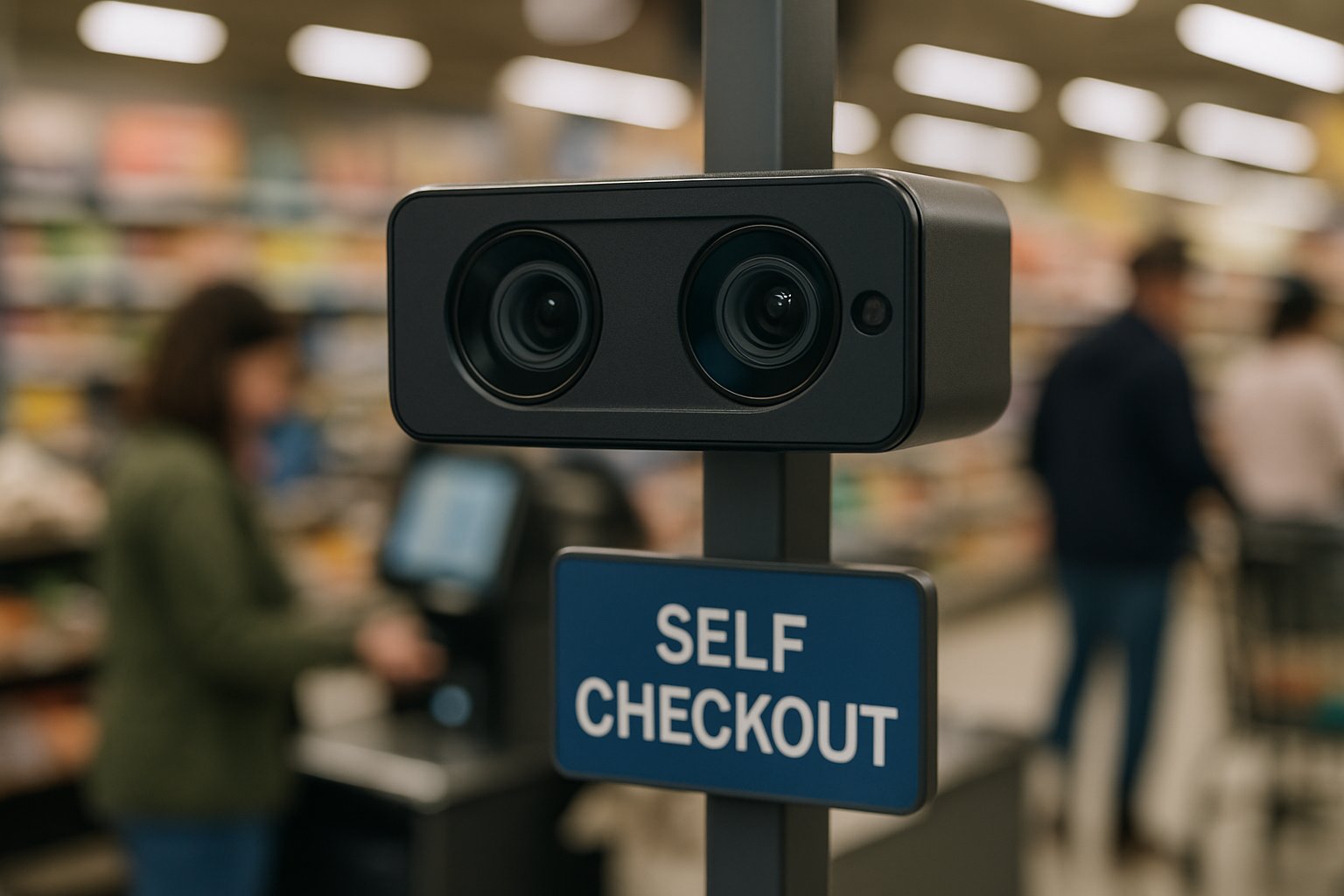
Hybrid Models Dominate Strategy
Pure camera walk-out stores attract headlines yet face practical roadblocks in large supermarkets. Therefore, most chains now mix cameras with smart carts, shelf sensors, or enhanced self-checkout. Amazon’s pivot toward Dash Cart exemplifies the shift. Additionally, Instacart’s Caper units spread across regional grocers that fear ceiling retrofits. Retailers like Kroger prefer incremental rollout with modular smart carts over storewide closures. Hybrid approaches also mitigate shrink by maintaining some verification touchpoints. Consequently, Autonomous Checkout Vision Systems increasingly anchor flexible, layered architectures. Computer vision retail teams integrate edge AI with existing POS to shorten learning curves. Nevertheless, hybrid complexity requires tight orchestration between IT, store operations, and vendors. Effective governance frameworks determine whether pilots scale or stall. Hybrid dominance proves format matters more than buzzwords. Next, venue success stories reveal where frictionless performance shines brightest.
Venue Deployments Prove Value
Stadiums represent near-perfect laboratories for frictionless commerce. Lines compress into halftime windows, so speed directly boosts per-fan revenue. Amazon will install Just Walk Out at forty concession markets in Nissan Stadium. Moreover, Lumen Field previously reported higher sales after adopting the model. AiFi and Zippin service festivals where backpack scanners would be impossible. Consequently, operators see tangible throughput, larger baskets, and improved fan experience. Frictionless payments integrate tightly with ticketing, loyalty, and age verification at turnstiles. Autonomous Checkout Vision Systems therefore deliver measurable ROI in controlled assortments. In contrast, full supermarkets hold thousands of SKUs demanding extra safeguards. Venue wins nonetheless build brand trust and vendor credibility for broader expansion. High-traffic venues reveal the clear revenue upside. However, loss prevention concerns still threaten margins, as the next section explains.
Loss Prevention Innovations Rise
Shrink eclipsed USD one hundred billion in the United States during 2022. Therefore, retailers hesitate to deploy new tech without robust theft deterrence. Vision vendors now overlay machine learning models that flag suspicious behavior in real time. Trigo markets such capability as an integrated module for existing clients. Moreover, these alerts route to mobile dashboards for immediate staff action. Computer vision retail teams also reuse ceiling cameras, lowering incremental capex. Smart carts add weight sensors, creating double verification for bulk produce. Consequently, Autonomous Checkout Vision Systems can now promise frictionless payments without magnifying shrink. Nevertheless, algorithms remain probabilistic and require human-in-the-loop escalation paths. Retailers must benchmark accuracy and false positives before green-lighting scale. Anti-shrink innovation strengthens the business case significantly. Subsequently, technical hurdles still dictate deployment choices, discussed in the following section.
Technical Barriers Persist Today
Tracking every SKU in a thirty-thousand-item supermarket challenges any vision model. Look-alike cereal boxes and loose produce confuse algorithms relying only on pixels. Therefore, vendors increasingly fuse cameras with shelf scales, RFID gates, or barcode fallback. Edge computing also matters; cloud latency can frustrate shoppers expecting instant receipts. Moreover, privacy regulations demand on-premise data handling in many jurisdictions. Computer vision retail leaders deploy hardened edge servers inside network closets. Battery life and weight remain limitations for smart carts using lidar and cameras. Consequently, Autonomous Checkout Vision Systems must align architecture with store size and basket complexity. In contrast, convenience stores succeed with simpler camera grids and smaller assortments. Technical diligence therefore precedes marketing hype during vendor selection processes. Matching technology to context prevents painful rework. The next section turns to concrete action plans for retailers.
Practical Steps For Retailers
Executives require a structured roadmap, not vendor theatrics. Therefore, the following steps synthesize best practices from active rollouts.
- Pilot one store per format and track checkout time, shrink, customer satisfaction.
- Blend cameras with sensors or smart carts to match SKU complexity.
- Deploy loss-prevention analytics and human escalation from day one.
- Upskill staff with the AI Product Manager™ certification to drive cross-functional alignment.
Moreover, teams should set quarterly KPIs covering shrink percentage and labor redeployment. Budget contingencies for edge servers, privacy audits, and ongoing model retraining. Consequently, Autonomous Checkout Vision Systems become sustainable, not experimental. Frictionless payments adoption then complements loyalty programs, boosting data-driven promotions. Nevertheless, leadership must revisit metrics monthly and recalibrate as baskets evolve. Disciplined execution unlocks measurable ROI quickly. Finally, understanding future trajectories positions innovators ahead of the pack.
Future Outlook And Actions
Analysts expect consolidation among mid-tier vendors within two years. Consequently, partnership stability should weigh heavily in procurement scoring. Moreover, sensor costs continue to drop, widening feasible store formats. Computer vision retail algorithms will approach ecommerce-like accuracy as training datasets expand. Autonomous Checkout Vision Systems may soon integrate seamlessly with generative AI assistants for voice shopping. Frictionless payments will likely merge with biometric identity, reducing wallet reliance. Nevertheless, regulation around data governance could tighten, requiring transparent consent flows. Retailers prepared with flexible architecture will adapt faster than those locked into proprietary stacks. Therefore, continual roadmap reviews remain essential even after go-live. Professionals can deepen strategic insight through the AI Product Manager™ certification. Autonomous Checkout Vision Systems will reward organizations that marry experimentation with disciplined governance. Consequently, early movers stand to capture outsized efficiency and loyalty gains. The stage is set for the next retail wave.
Retail modernization is accelerating, yet success demands balanced execution. Hybrid architectures, venue learnings, and anti-shrink tools illustrate the evolving playbook. Moreover, Autonomous Checkout Vision Systems now offer credible returns when matched to the right format. Computer vision retail capabilities will keep improving as edge chips advance and datasets grow. Consequently, retailers that pilot today gain operational insight impossible for laggards. Autonomous Checkout Vision Systems also enable frictionless payments and deeper omnichannel analytics. Nevertheless, governance, privacy, and workforce planning must remain front and center. Take the next step by assessing pilots and pursuing the linked AI certification for strategic leadership advantage.
Disclaimer: Some content may be AI-generated or assisted and is provided ‘as is’ for informational purposes only, without warranties of accuracy or completeness, and does not imply endorsement or affiliation.


