

AI CERTs
1 day ago
Enterprise Data Stack Recomposition: Snowflake’s AI-First Reset
Generative AI is forcing architecture change inside every data-driven enterprise. However, the most dramatic shift involves platforms that once only stored and queried data. Snowflake’s recent product blitz shows how quickly priorities pivot toward governed, in-place intelligence. Industry analysts now describe an enterprise data stack recomposition that merges storage, compute and models. Consequently, data leaders must understand why this consolidation matters and how to respond. This feature traces market drivers, evaluates pros and cons, and offers an adoption roadmap. Additionally, it benchmarks Snowflake’s AI revenue traction against broader sector signals. Read on to see where AI-native analytics and cloud data platforms converge next.
Market Forces Realign Rapidly
Enterprise data volumes keep exploding, reaching zettabyte scale according to IDC. Meanwhile, boards demand measurable AI outcomes within compliance boundaries. Therefore, bringing models to governed data becomes attractive.
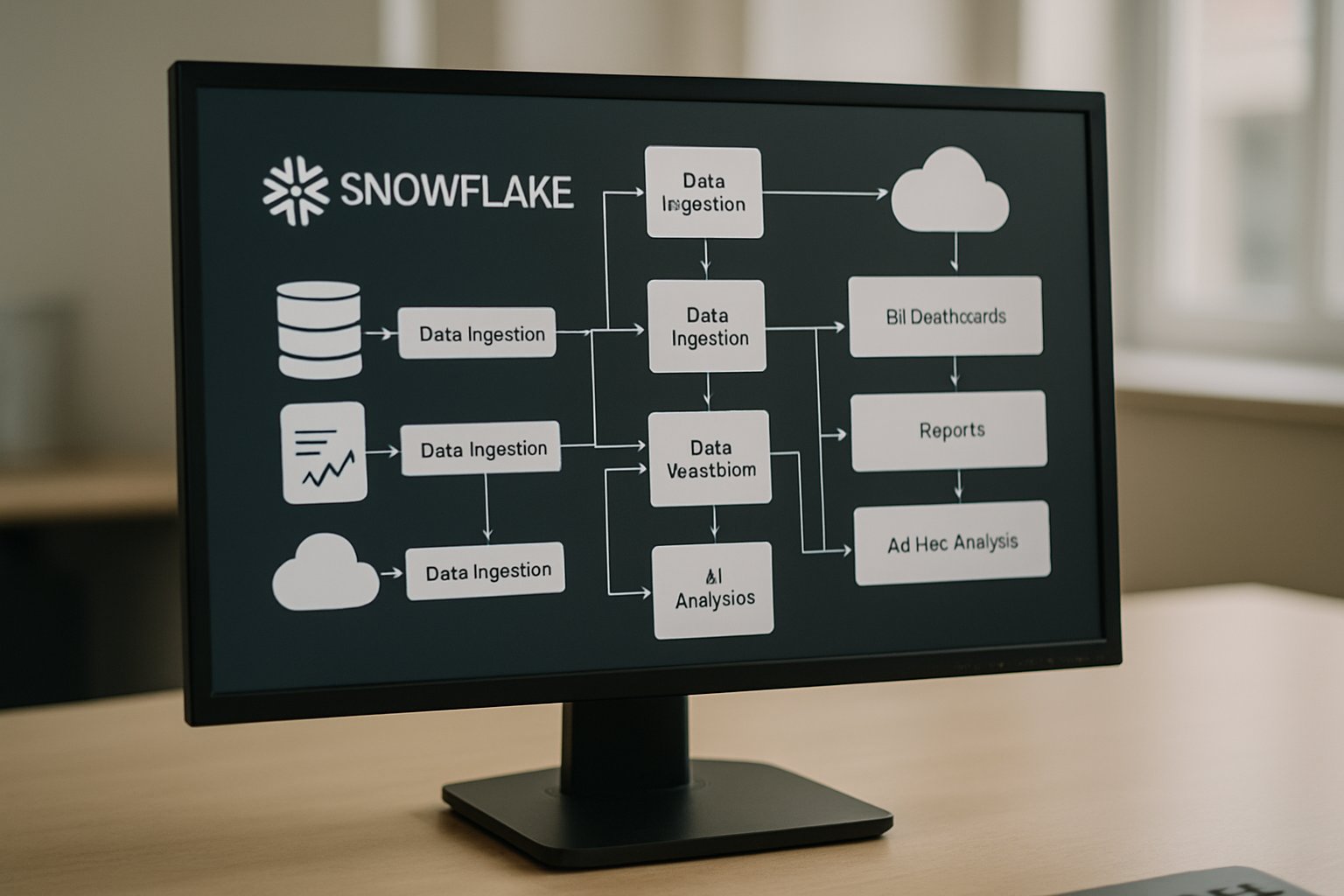
Snowflake reported $1.16 billion product revenue in Q3 FY26 and a $100 million AI run-rate. Moreover, half of new bookings were influenced by AI workloads. These numbers reveal early monetization for integrated inference services. Enterprise data stack recomposition has therefore become a board-level talking point.
IDC forecasts data and AI software spend growing 23% CAGR through 2028. Consequently, boardrooms reallocate budgets from legacy BI toward governed AI services. Moreover, venture funding now favors startups embedding retrieval and agents at inception. Therefore, supply chains and frontline apps will soon expect conversational intelligence by default.
Independent vendors observe similar trends across cloud data platforms, although metrics vary. Consequently, investors reward suppliers able to host retrieval, embeddings, and agents natively.
Demand for governed, in-platform AI is rewriting budget maps. However, deeper shifts appear inside Snowflake’s evolving architecture.
Snowflake AI Pivot Explained
April 2024 saw the release of Arctic, an open enterprise-grade LLM and embedding suite. Subsequently, November brought Snowflake Intelligence, which lets users build data agents through natural language. The June 2025 Summit added AISQL, OpenFlow ingestion, and AI observability features. Together, these launches position Snowflake as a single AI Data Cloud. This architectural reset epitomizes enterprise data stack recomposition in action.
In contrast, earlier modern stacks required separate vector stores, orchestration layers, and serving endpoints. Now, governance, retrieval, and decision logic sit within one consumption meter. Furthermore, Azure OpenAI integration extends model choice while keeping security controls intact.
CEO Sridhar Ramaswamy called this strategy a watershed moment for the firm. He stressed openness, citing Apache-2.0 weights for Arctic and Iceberg table formats. Nevertheless, lock-in concerns persist among architects evaluating long-term costs.
Cortex now supports vector search on trillion-row tables without manual sharding. Additionally, AISQL compiles natural language into optimized SQL plus Python UDF calls. Therefore, data engineers gain productivity while maintaining familiar governance controls.
Snowflake’s pivot clarifies the direction of enterprise data stack recomposition. Consequently, competitors must answer with equally coherent stories.
Shifting Enterprise Vendor Landscape
Databricks, Google BigQuery, and Microsoft Fabric push similar convergence narratives. However, each vendor optimizes for its own storage format and ML service layer. Therefore, multi-engine ecosystems will survive even under consolidation pressure.
Vector database specialists like Pinecone and Weaviate integrate tighter with these cloud data platforms to stay relevant. Moreover, governance vendors such as Collibra and Atlan market plug-ins for agent observability. These alliances illustrate market fluidity during enterprise data stack recomposition.
Gartner predicts increased spend on AI-native analytics, reinforcing the recomposition narrative. Consequently, platform buyers weigh time-to-value against openness.
AWS recently previewed Aurora Vector, moving semantic retrieval into its flagship database. Meanwhile, Google launched Gemini extensions for BigQuery to streamline predictive workflows. Nevertheless, open-source communities push Milvus and Chroma for portable embedding indexes. Consequently, multi-cloud orchestration tools gain traction to avoid single-provider dependence.
Competitive dynamics remain intense and unsettled. Meanwhile, benefits of a collapsed stack lure enterprise architects.
Pros Driving Stack Consolidation
Simpler workflows top the pro list. Developers can prototype RAG chatbots without exporting sensitive tables. Furthermore, unified governance reduces audit scope and regulatory risk.
- Consumption pricing aligns cost with agent usage, boosting supplier revenue potential.
- In-platform retrieval cuts latency, improving user satisfaction for AI-native analytics.
- Shared metadata model simplifies lineage across cloud data platforms.
- Enterprise data stack recomposition simplifies compliance reporting.
Additionally, Snowflake’s early $100 million AI run-rate validates the business upside. Consequently, finance leaders see faster payback periods than with fragmented tooling.
Internal surveys show teams onboarding new use cases within weeks, not quarters. Consequently, business units iterate faster on chatbots, summarization, and intelligent alerts. Moreover, centralized lineage eases audits under Europe’s upcoming AI Act.
Integrated platforms win on simplicity, governance, and margins. However, several obstacles still challenge universal adoption.
Challenges And Open Questions
Cost volatility remains the loudest concern. Inference and embedding workloads quickly burn credits during peak usage. Therefore, teams often benchmark external GPU services for price leverage.
Lock-in debates surface whenever proprietary functions outpace open standards. Nevertheless, Snowflake counters with open Arctic weights and Iceberg support. Still, buyers demand export paths for embeddings and agent state.
Operational risk also escalates as autonomous agents act on production systems. Subsequently, observability, evals, and guardrails become mandatory line items. Moreover, scarce AI talent hinders rollout schedules.
Regulators warn that opaque LLM reasoning can violate explainability clauses in banking rules. Therefore, organizations must log prompts, context, and decisions for each agent action. In contrast, conventional dashboards rarely captured such fine-grained traces.
These hurdles underscore that enterprise data stack recomposition is not automatic. Consequently, a phased roadmap is essential.
Implementation Roadmap For Enterprises
First, catalog sensitive datasets and determine existing vector storage locations. Then, pilot governed RAG inside your preferred cloud data platforms. Successful pilots provide evidence supporting enterprise data stack recomposition at scale.
During pilots, instrument cost dashboards and latency metrics. Additionally, mandate evaluation harnesses before releasing any agent to production users. Snowflake’s built-in observability features can help here.
Medium-term plans should revisit data contracts, metadata schemas, and developer interfaces like AISQL. In contrast, yesterday’s ETL pipelines may fade as OpenFlow ingestion matures.
Professionals can enhance understanding through the AI Foundation certification. Moreover, certified teams collaborate better during cross-functional analytics projects.
Allocate cross-functional tiger teams combining data, security, and legal stakeholders. Additionally, draft escalation runbooks for hallucination, bias, or performance regressions. Quarterly, revisit performance baselines against evolving model families like Arctic-Extract. Consequently, governance stays proportional to technical change.
Following these steps reduces technical debt while unlocking innovation. Subsequently, organizations position themselves for sustained advantage.
Strategic Takeaways And Actions
Enterprise data stack recomposition accelerates because AI value now depends on proximity to governed data. Snowflake’s AI-first pivot illustrates both opportunity and complexity. Meanwhile, rival cloud data platforms race to collapse layers and monetize inference. Pros include simpler workflows, stronger governance, and rising AI-native analytics revenue. Cons cover cost volatility, potential lock-in, and emerging operational risk. Nevertheless, a phased roadmap plus talent development mitigates those issues. Therefore, leaders should pilot in-platform RAG, instrument observability, and certify teams quickly. Explore certifications and stay ahead of enterprise data stack recomposition today. Additionally, early adopters lock in valuable operational insights before competitors replicate successes. Act decisively, and transformative ROI will follow. Furthermore, stakeholder alignment across IT, risk, and finance accelerates deployment velocity. Measure progress with week-over-week user adoption and cost trends. Subsequently, adjust strategies as observability datasets highlight new optimization levers. Finally, sustain momentum through continuous certification and community engagement.


