

AI CERTs
6 months ago
Alpamayo Self-Driving Tech Debuts: Nvidia’s Real-World Leap
Global attention at CES 2026 centered on a new pillar of autonomous mobility. Nvidia introduced Alpamayo Self-Driving Tech, promising reasoning capabilities beyond pattern matching.
Industry leaders immediately framed the launch as an inflection point in physical AI. Consequently, developers, regulators, and investors all want clarity on what the open ecosystem offers.
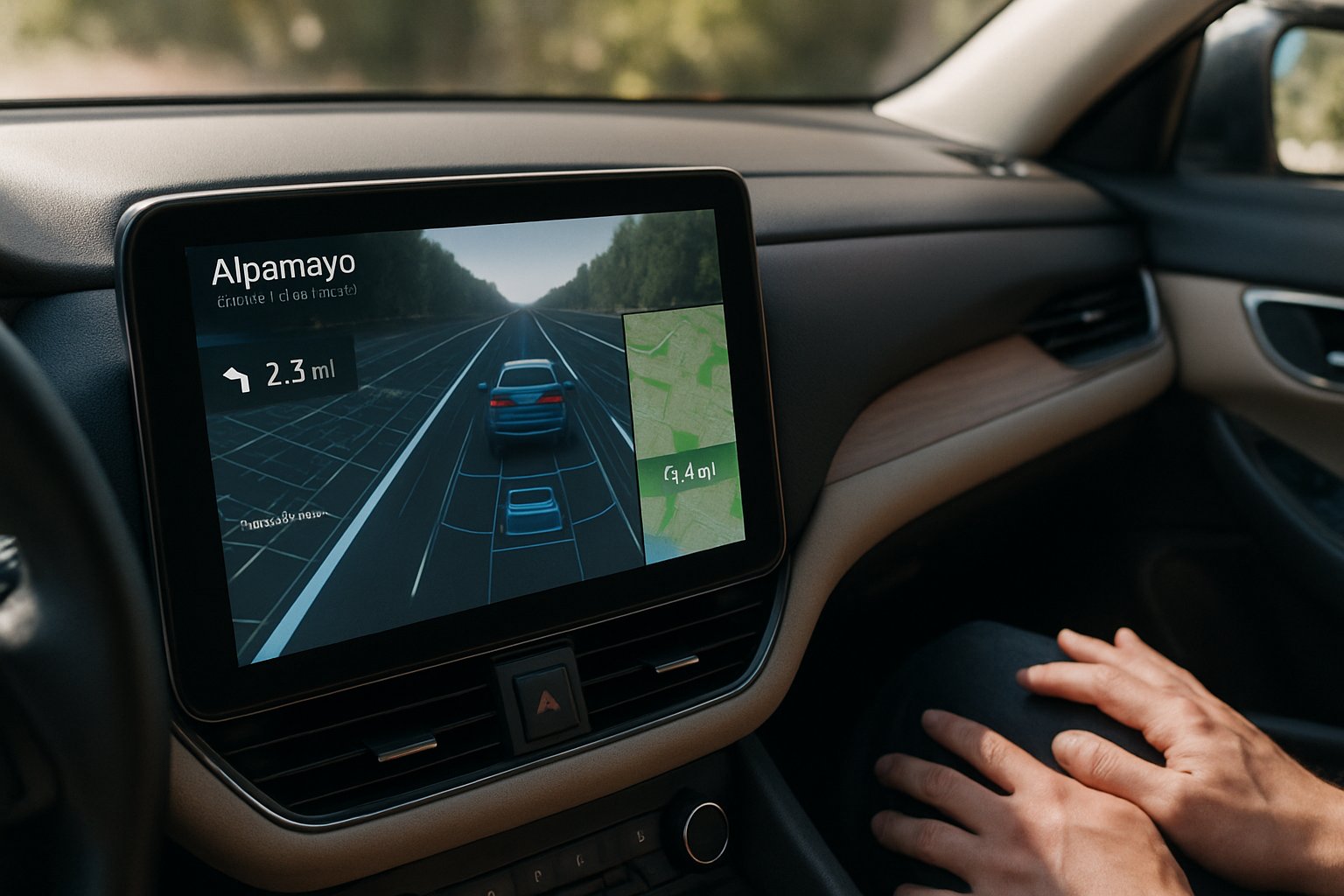
This article dissects Alpamayo’s models, data, hardware, and deployment timeline, focusing on technical impact. Along the way, we examine benefits, risks, and upskilling paths for professionals.
Stakeholders want specifics on datasets, hardware efficiency, and regulatory strategy before committing budgets. Therefore, a detailed look at confirmed numbers and timelines follows.
CES 2026 Reveal Impact
January fifth saw Jensen Huang proclaim a "ChatGPT moment for machines that move". Mercedes, Uber, and several OEMs shared stage time, spotlighting early use cases.
The press release framed Alpamayo as an open Vision-Language-Action stack with 10-billion parameters. Moreover, Nvidia released code and weights on Hugging Face the same day.
Media outlets praised the openness yet reminded readers of past autonomy delays. Nevertheless, the combination of public data, simulation, and teach-and-distill workflow felt different to analysts.
During the keynote, Alpamayo Self-Driving Tech appeared as the catalyst for Level-4 robotaxis. These highlights set the scene for deeper technical scrutiny.
Core Technical Advances Unpacked
At its heart sits Alpamayo 1, a 10-billion-parameter Vision-Language-Action model. It ingests synchronized camera, LiDAR, radar, and text, then outputs trajectories and a reasoning trace.
Chain-of-thought tracing matters because auditors can inspect every decision step. Therefore, safety teams gain visibility once reserved for offline analysis. High-resolution Computer Vision modules remain embedded inside the multimodal encoder to sharpen perception.
- 10B parameters with transformer planning head
- 360° sensor fusion running at 20 Hz
- Latency target of 40 ms on distilled models
- Compatible with Autonomous Vehicle Telemetry logging standards
Rubin Hardware Performance Context
Compute efficiency underpins deployment feasibility. Rubin GPUs promise ten-fold lower inference token cost versus Blackwell. Consequently, in-vehicle boards like DRIVE AGX Thor can run distilled models without thermal throttling.
Simulation clusters using Rubin NVL72 can replay months of Autonomous Vehicle Telemetry overnight. In contrast, prior generations required several days. These gains make Alpamayo Self-Driving Tech economically viable for fleet scale.
Open Data Advantages Explained
Nvidia dropped a 100-terabyte multi-sensor dataset under a permissive license. Meanwhile, 300,000 clips represent 25 countries and 2,500 cities.
Researchers gain reproducible baselines without negotiating private road-test agreements. Moreover, consistent Autonomous Vehicle Telemetry schemas simplify benchmarking across institutions.
Open simulation also matters. AlpaSim feeds model actions back into the environment, generating fresh sensor frames for stress testing.
These assets support Alpamayo Self-Driving Tech fine-tuning and validation by startups and universities. Computer Vision researchers can probe long-tail perception failures without mounting expensive sensor rigs.
Deployment Roadmap Moves Forward
Mercedes will ship the new CLA with MB.DRIVE ASSIST PRO in Q1 2026. Although initial operation remains Level-2+, Alpamayo models assist training and shadow evaluation.
Uber targets wide robotaxi rollouts in 2027, leveraging Hyperion reference designs. Furthermore, Lucid, JLR, and Stellantis have signaled pilot programs using the same stack.
Fleet managers value rich Autonomous Vehicle Telemetry captured by Nvida's sensor suite. Therefore, data from San Francisco pilots will close validation gaps rapidly. Alpamayo Self-Driving Tech underpins the teacher models running in cloud evaluation. Distilled Alpamayo Self-Driving Tech variants will eventually run on edge computers inside vehicles.
Explainability And Regulatory Oversight
Regulators increasingly demand clear evidence of autonomous reasoning. Consequently, chain-of-thought traces may streamline compliance with forthcoming UNECE software rules.
Independent labs, including Berkeley DeepDrive, plan audits of reasoning fidelity. Nevertheless, false or misleading traces could erode trust quickly. Computer Vision drift remains another concern regulators monitor through continuous telemetry. Open logs of Autonomous Vehicle Telemetry will support third-party safety assessments. Alpamayo Self-Driving Tech aims to furnish that transparency by design.
Risks And Pending Challenges
Open access invites forks that may skip rigorous validation. In contrast, proprietary programs tightly control change management.
Model distillation can degrade reasoning accuracy if not monitored. Therefore, companies must benchmark distilled output against the 10-billion-parameter teacher regularly.
Hardware roadmaps also create uncertainty. Rubin boards arrive late 2026, leaving a transition gap for early adopters. Maintaining Alpamayo Self-Driving Tech alignment across hardware generations will require meticulous regression testing. Meanwhile, Computer Vision adversarial attacks remain a known threat.
Certification Pathways For Professionals
Engineers must widen skills to match the new multimodal stack. Moreover, understanding chain-of-thought auditing, simulation, and Autonomous Vehicle Telemetry pipelines is now essential.
Professionals may deepen expertise through the AI Learning Development™ certification.
Curricula cover sensor fusion, Computer Vision, and safety engineering. Consequently, graduates can contribute to Alpamayo Self-Driving Tech integration projects immediately.
Hiring managers increasingly list Autonomous Vehicle Telemetry experience as a differentiator. Meanwhile, continuing education helps teams keep pace with Rubin hardware updates.
Alpamayo Self-Driving Tech blends open data, explainable AI, and efficient compute into a cohesive autonomous stack. Continued Alpamayo Self-Driving Tech iterations will reveal how well reasoning scales across continents. Early pilots with Mercedes and Uber will test whether reasoning traces truly tame the long tail. If successful, global mobility networks could leap from supervised assistance to scaled robotaxis within five years.
However, validation burdens, adversarial threats, and hardware timelines still demand disciplined engineering. Therefore, professionals who master Computer Vision, simulation, and Autonomous Vehicle Telemetry will shape that future. Start now by earning the AI Learning Development™ credential and contributing to future Alpamayo releases.
Disclaimer: Some content may be AI-generated or assisted and is provided ‘as is’ for informational purposes only, without warranties of accuracy or completeness, and does not imply endorsement or affiliation.


