

AI CERTS
4 hours ago
Space AI Drives Cislunar Infrastructure Boom
Moreover, the cislunar push aligns with strategic goals to secure supply chains, expand science, and create an off-planet Economy. Investors sense parallel opportunities, yet many technical unknowns remain. Latency, radiation, and repairability all complicate spreadsheets. Nevertheless, executives argue the learning curve mirrors early terrestrial cloud adoption. This article dissects the shifting landscape. Readers will see how LunaNet standards, CAPSTONE experiments, and Lonestar’s storage gambit intertwine. Additionally, it highlights funding trends, risk factors, and skill pathways. Professionals keen to lead in Space AI will find concrete insights and a certification resource to strengthen credibility.
Policy Sparks Market Growth
Government directives now anchor the Cislunar playbook. In 2025, the White House released the National Cislunar Science & Technology Strategy. Consequently, agencies must deliver shared communications, positioning, navigation, and timing standards. NASA’s LunaNet architecture supplies the technical blueprint. Moreover, planners emphasize interoperability so commercial operators can plug in quickly.
These actions shift risk calculations. Previously, entrepreneurs worried about missing infrastructure. Now predictable reference frames, spectrum allocations, and lunar time standards appear within reach. Therefore venture capital sees the outline of a durable Economy near the Moon.
Policy moves turn exploration into procurement. However, hardware builders still need concrete networks, addressed next. Together, these directives create a scaffold for Space AI services.
Infrastructure Pillars Are Emerging
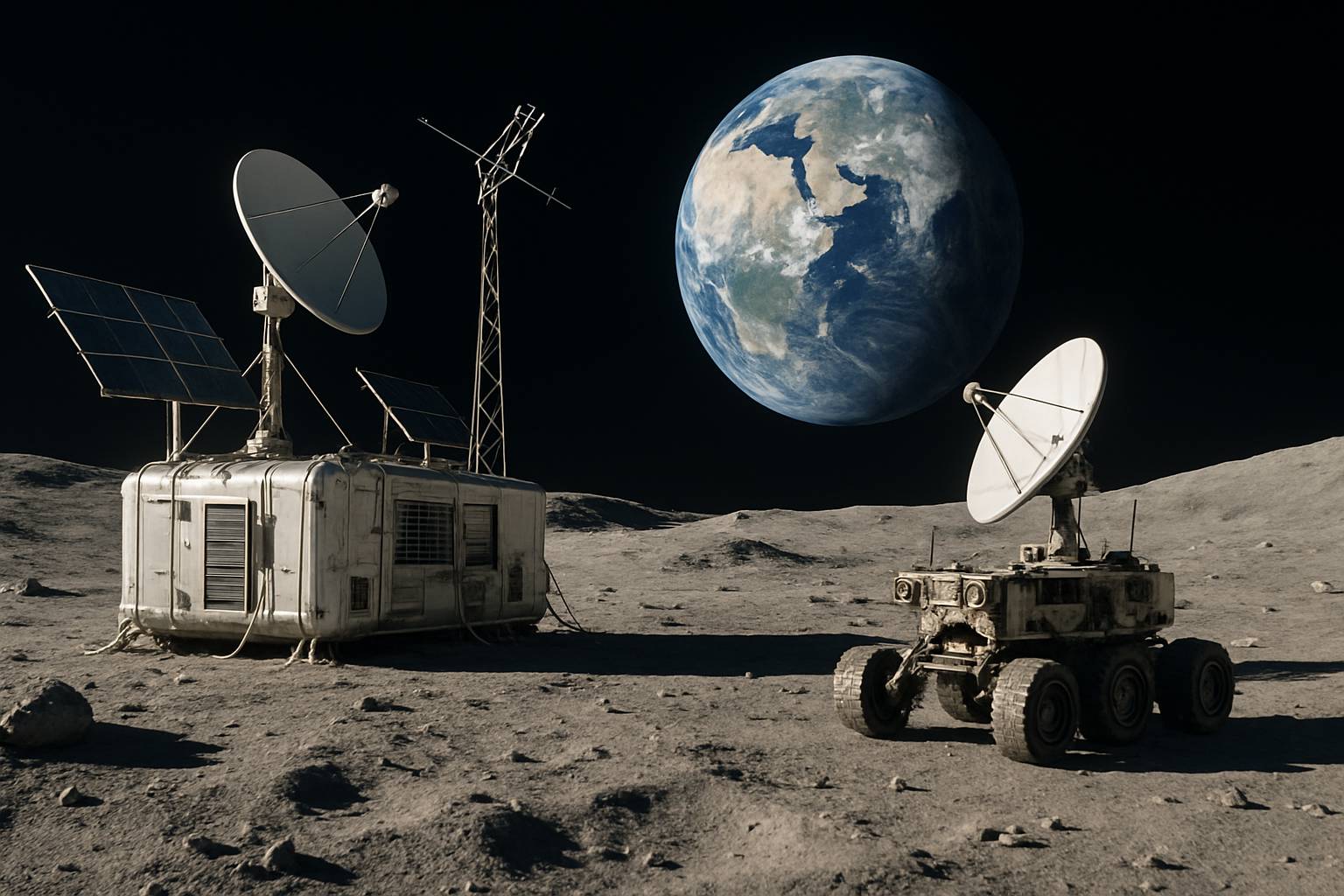
The backbone begins with LunaNet and the Lunar Communications Relay and Navigation Systems. Design principles adopt Delay/Disruption-Tolerant Networking, letting nodes cache packets during blackouts. Meanwhile, Johns Hopkins APL and Intuitive Machines prototype a secure backbone that supports autonomous operations.
Light-time latency averages 1.3 seconds one way. Consequently, certain workloads cannot depend on terrestrial control loops. Edge links must handle critical decisions locally. That reality explains the push for on-board accelerators and lightweight Space AI stacks.
Key infrastructure milestones expected before 2028 include:
- LunaNet interoperability draft finalized and published.
- First commercial navigation beacons at Earth–Moon Lagrange points.
- Dedicated relay satellites covering Lunar south-pole missions.
- Secure time synchronization standard, Coordinated Lunar Time, adopted by partners.
These milestones will underpin every future mission. Nevertheless, practical autonomy remains the decisive factor, as the next section explains.
Edge Autonomy Rapidly Advances
Advanced Space’s CAPSTONE cubesat offered a rare on-orbit laboratory for Space AI. The mission ran SigmaZero anomaly detection and Neural Network Enhanced Propulsion planning. Furthermore, the results impressed IARPA leadership, who called them a significant milestone.
Such demonstrations prove that Space AI can survive radiation and deliver actionable guidance with minimal power. In contrast, long round trips to Earth would stall maneuvers. Therefore, spacecraft must think for themselves during eclipses or solar storms.
CAPSTONE Testbed Key Lessons
Engineers note three findings. First, model compression techniques kept memory footprints under 10 megabytes. Second, resilient software watchdogs recovered processing after single-event upsets. Third, delayed ground intervention still validated decisions, showing trust paths for wider fleets.
The CAPSTONE data points now inform new missions from ispace and Astrobotic. Consequently, autonomy appears less experimental and more expected.
Data Centers Face Risks
Not every workload suits edge chips. Some investors imagine vast Lunar data centers selling archival storage and cool vacuum-assisted compute. Lonestar Data Holdings launched its “Freedom” payload in 2025 to test the thesis.
CEO Chris Stott framed the idea as disaster recovery insurance. However, critics like analyst Chris Quilty warn that a failed launch renders hardware irrecoverable. Moreover, repair crews cannot yet service Lunar electronics at scale.
- Launch failure probability currently hovers near 2% for commercial rideshares.
- Round-trip latency reaches 2.6 seconds, limiting interactive workloads.
- Initial capital raises stay below $30 million, far short of terrestrial peers.
Interactive Space AI analytics would stall under such delays. Professionals can enhance expertise with the Bitcoin Security Professional™ certification.
High cost and fragility temper near-term enthusiasm. Nevertheless, steady iteration could unlock niche markets as investment patterns evolve.
Investment And Forecasts Diverge
Market reports disagree on total addressable value. GII pegs Cislunar infrastructure at $12.78 billion in 2024 with an 8.4% CAGR. Meanwhile, other analysts publish baselines as low as $3.9 billion.
The gap reflects segmentation methods more than disagreement over momentum. Regardless of model, funding signals remain modest. Lumen Orbit raised just over $10 million, and Lonestar remains below a $30 million valuation.
Consequently, deep-pocketed aerospace primes may shape early supply. However, nimble startups still drive experimentation, especially around Space AI workloads. Investors question when Space AI revenue will outpace costs.
Capital remains exploratory rather than exponential. Therefore strategic patience seems prudent while infrastructure matures.
Roadmap For Space Professionals
Engineers and analysts eyeing cislunar roles should cultivate cross-disciplinary fluency. Autonomy demands knowledge of radiation-hardened hardware, DTN protocols, and Lunar environmental constraints. Additionally, mission planners must grasp economic levers such as launch insurance and power budgeting.
Recommended skill domains include:
- Real-time embedded machine learning pipelines.
- Cislunar communications and PNT standards.
- Risk modeling for off-Earth capital assets.
- Blockchain-based data integrity methods.
Space AI expertise stands out because it bridges software and orbital mechanics. Moreover, credentials like the linked Bitcoin Security certification signal rigor to hiring managers.
A focused learning strategy will place professionals ahead of the curve. Subsequently, graduates can influence design decisions as the Economy expands.
Cislunar activity no longer sits on PowerPoint wish lists. Policy blueprints, resilient networks, and real flight data combine to form a realistic foundation for Space AI. Meanwhile, startups accept calculated risk to test Lunar data concepts. Nevertheless, market size projections vary widely, and repair economics lag. Consequently, professionals who master autonomy, networking, and security will steer the emerging Economy. Engage now, pursue specialized credentials, and watch each mission update for new opportunities.


