

AI CERTS
3 months ago
Laptop AI Redefined: ASUS Zenbook Duo Elevates Multitasking
Moreover, Intel Core Ultra processors and Microsoft Copilot+ features promise smarter multitasking flows. This article unpacks the specs, market signals, and tradeoffs behind the new form factor. Professionals exploring Laptop AI ecosystems will find practical buying guidance and certification paths to stay competitive.
Dual Screen Trend Accelerates
Gartner expects AI PCs to reach 43 percent of global shipments during 2025. Consequently, OEMs rush to pair NPUs with compelling designs. Dual-screen notebooks fit that brief. Market Research Future values the niche at almost ten billion dollars today and projects 14 percent CAGR through 2035. Meanwhile, ASUS capitalized early, winning IDEA awards and museum placement for the dual-screen chassis. Reviewers from Wired and The Guardian call the setup a credible mobile dual-monitor alternative.
Therefore, the momentum behind two-panel productivity feels stronger than earlier experiments like the short-lived Lenovo Yoga Book. These factors indicate sustained developer attention. However, mass adoption still hinges on reliable Laptop AI experiences that justify higher prices.
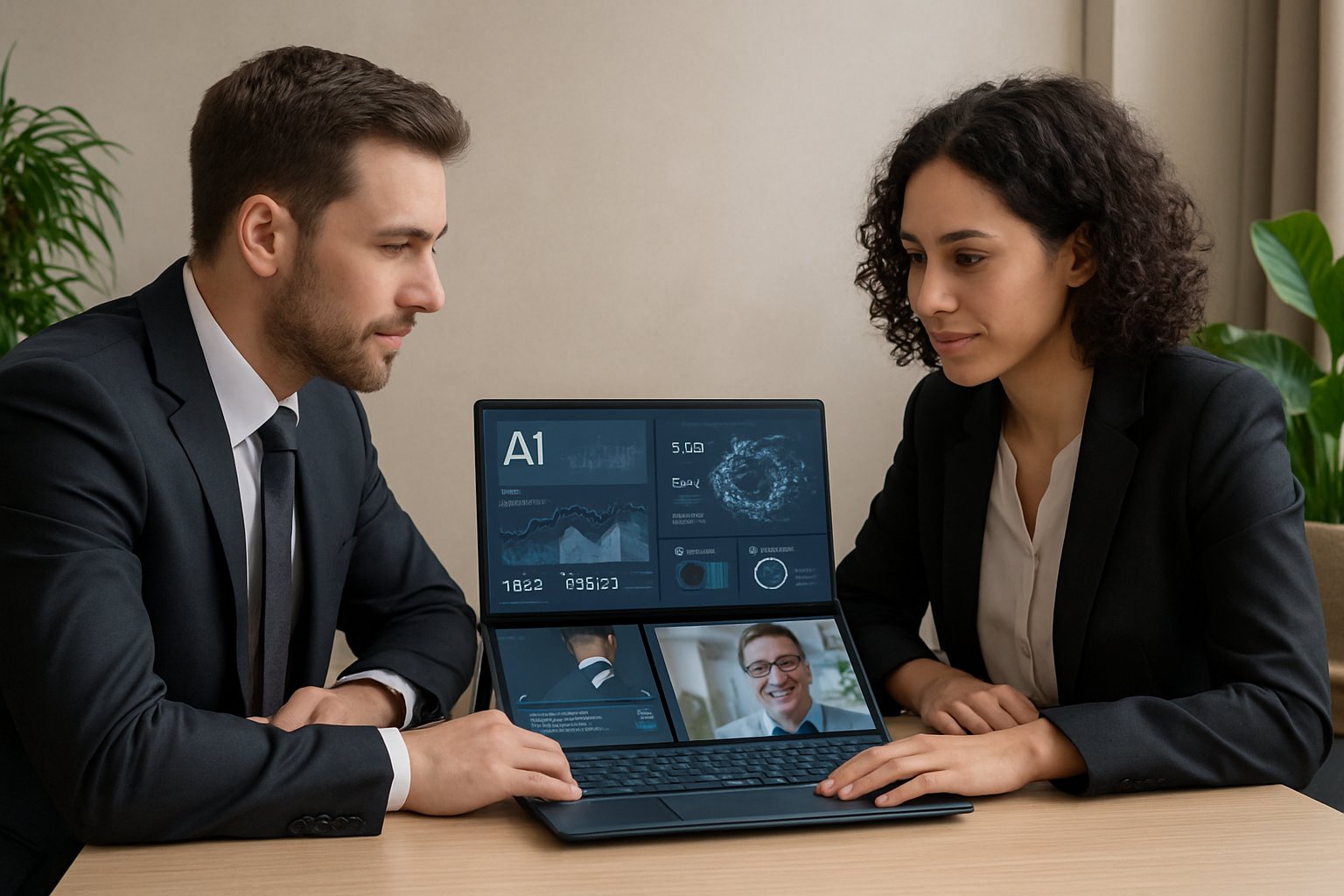
In short, hardware makers sense a lucrative frontier. Thus, understanding the Zenbook Duo’s internals becomes vital.
Inside Zenbook Duo Hardware
ASUS equips the machine with two 14-inch 3K OLED touch panels operating at 120 Hz. Together, they offer nearly twenty inches of workspace in ViewMax mode. A detachable Bluetooth keyboard covers the lower display when traditional clamshell work is preferred. Additionally, Thunderbolt 4 ports, HDMI 2.1, and a 75 Wh battery round out the chassis. Weight sits around 1.35 kilograms without the keyboard, roughly 3.6 pounds in total. Moreover, up to 32 GB LPDDR5x memory and 2 TB PCIe 4.0 storage support demanding projects. Zenbook branding remains understated, yet the hinge engineering impresses.
ScreenXpert software orchestrates windows across both OLEDs through gestures and preset task groups. Consequently, Multitasking scenarios, such as code plus preview or timeline plus preview, become seamless. Reviewers praise the drag-to-edge App Switcher, calling it intuitive. However, legacy software occasionally launches on the wrong screen until rules are configured.
- Intel Core Ultra 9 CPU with integrated NPU
- Two 14-inch 3K OLED touch displays
- Up to 32 GB LPDDR5x RAM
- Up to 2 TB PCIe 4.0 SSD
- 75 Wh battery, 1.35 kg base weight
These specifications showcase premium parts tuned for Laptop AI workloads. Next, the integrated NPU merits deeper inspection.
Hardware alone never guarantees speed. Therefore, silicon accelerators carry serious weight in AI discussions.
Laptop AI Engine NPUs
Intel’s Core Ultra Series 2 includes an upgraded NPU branded AI Boost. The block reaches 45 TOPS according to Intel product briefs. Consequently, many Copilot+ features, including Recall and Cocreator, run locally without cloud latency. Microsoft calls Copilot+ PCs the fastest and most secure Windows machines. Meanwhile, ASUS claims the Duo meets all Copilot+ thresholds.
Real benefits surface when the NPU tackles voice transcription, background blur, or small language models during travel. Users avoid battery-draining cloud round-trips. Moreover, privacy improves because data stays on device. Laptop AI integration, therefore, shifts from marketing slogan to tangible workflow speed.
Nevertheless, not every AI task fits within NPU limits. Large generative models will still offload to GPU or cloud endpoints. These caveats shape realistic performance expectations.
In essence, the silicon enables fast, quiet inference for many office tasks. Next, we examine how that power translates to daily Multitasking.
Real World Productivity Gains
Journalists testing preview units highlighted frictionless research workflows. For instance, one screen hosted reference PDFs while the other displayed a draft. Copilot summarized sources in a side panel without masking key paragraphs. Furthermore, video editors placed the timeline below while previewing 4K footage on the top panel. Laptop AI responded quickly when generating B-roll suggestions via Cocreator.
Vendor demo sessions showed hybrid meeting layouts that kept notes visible beside shared slides. Additionally, ScreenXpert Task Groups reopened entire project setups with one tap. Consequently, session ramp-up time dropped materially during press reviews.
- Drag apps between screens with 120 Hz smoothness
- Use Copilot on secondary display for instant summaries
- Pin chat clients below gaming streams without overlap
Reviewers echoed similar praise across Wired, The Guardian, and LaptopMag coverage. However, they also measured shorter battery life when both OLEDs and the NPU stayed active.
Clearly, workflow flexibility defines the device experience. Yet, market dynamics determine whether such advantages reach broad audiences.
Therefore, analyst forecasts warrant attention.
Market And Analyst Outlook
Gartner projects AI PC shipments to jump from 29 million in 2024 to 83 million in 2025. Consequently, component demand, especially LPDDR5x and OLED panels, will tighten. IDC warns that rising DRAM pricing may contract premium notebook sales by up to nine percent during 2026. In contrast, ASUS banks on differentiation to shield margins. The company positions the Zenbook Duo as a flagship within its Copilot+ lineup.
Market Research Future’s dual-screen forecast suggests steady double-digit growth through the next decade. Nevertheless, the segment remains small compared to mainstream clamshell shipments. Therefore, volume discounts may lag, keeping prices at a premium.
Overall, analysts see upside for vendors who balance innovation with supply resilience. Next, we consider the risks buyers must weigh.
Known Limits And Tradeoffs
Running two OLEDs taxes the 75 Wh battery heavily during field tests. LaptopMag recorded under six hours with both panels at 200 nits. Meanwhile, thermals climbed above 40 °C under AI image generation loops. Users should expect audible fan noise during sustained workloads.
Weight also challenges frequent flyers. At roughly 1.6 kg with charger, the package rivals some 16-inch productivity laptops. Moreover, certain Copilot+ features remain in gradual rollout, depending on Windows builds and NPU firmware. Consequently, early adopters must track updates closely.
These downsides underscore the importance of clear expectations. However, careful procurement can mitigate many concerns.
So, how should professionals proceed?
Buying Advice And Certifications
Assess workloads before choosing configurations. Writers and analysts can select Core Ultra 7 models with 16 GB RAM to balance cost. Conversely, video producers benefit from the Core Ultra 9 SKU and maximum memory. Additionally, consider secondary monitor habits; if you already dual-screen at home, the device’s value climbs. Laptop AI capabilities warrant firmware updates, so enable MyASUS auto updates immediately.
Price remains around seventeen hundred dollars for high-spec versions in the United States. Sales events often shave two hundred dollars. Therefore, monitoring retailer promotions reduces acquisition pain.
Professionals aiming to maximize competitive edge should pair hardware with formal training. You can deepen applied research skills through the AI Researcher™ certification. Moreover, the course complements Laptop AI workflows by teaching prompt design and model evaluation.
In sum, targeted purchases plus education deliver long-term productivity returns. Subsequently, organizations can scale Dual-screen strategies with confidence.
Careful planning magnifies these advantages. Consequently, the following conclusion distills core lessons.
Zenbook Duo signals a maturing intersection of dual screens and Laptop AI for mobile professionals. Furthermore, the vendor packs premium displays, fast silicon, and thoughtful software into a three-pound wedge. Analyst forecasts suggest AI PCs will dominate shipments within two years, validating the strategy. Nevertheless, battery draw, rollout uncertainty, and price command careful evaluation. Therefore, buyers should align feature needs, budgets, and certification goals before ordering. Ready practitioners can harness Laptop AI potential today by adopting Zenbook Duo and completing the linked training.


