

AI CERTS
3 months ago
Voice AI Gets Automated QA With Retell Assure
Assure, announced in December 2025, tackles that pain with automated quality assurance for every call. The feature monitors performance, flags failures, and even tunes models without manual intervention. This article examines why Assure matters, how it works, and what it means for the broader market. Readers will learn key statistics, deployment tips, and potential risks before adopting similar solutions. Furthermore, we compare competing offerings and identify future trends shaping automated governance. By the end, you will know whether automated Voice AI QA fits your Enterprise roadmap.
Global Market Demand Surge
Global call-center AI spending was nearly USD 2 billion last year, according to Grand View Research. Moreover, analysts project a 23.8% compound annual growth rate through 2030. Drivers include rising labor costs, customer expectations for instant service, and regulatory pressure for accurate disclosures. Consequently, organisations view Voice AI as a direct path to scale service without ballooning headcount.
Yet scale amplifies governance challenges. In contrast, traditional QA teams can only review a sliver of daily traffic. A Fortune 500 insurer told SiliconANGLE its analysts covered fewer than 5,000 Calls from a monthly volume exceeding 300,000. Therefore, automated monitoring has become a board-level priority for Enterprise transformation.
Market forecasts confirm explosive investment in conversational automation. However, quality constraints threaten adoption unless monitoring evolves.
Inside Assure Product Launch
Assure unveiled on December 17, 2025, calling itself the first automated QA for Voice AI. Early access opened January 1, 2026, through the company’s support channel. Furthermore, Retell claims its platform already powers over 40 million Calls each month. Assure monitors every interaction for latency, interruptions, hallucinations, sentiment swings, and tool-call errors. Subsequently, the system can fine-tune prompts or model parameters automatically.
Co-founder Bing Wu said, “Automated quality assurance was the #1 request of our enterprise customers.” Meanwhile, CMO Evie Wang highlighted the cost of spreadsheets and manual calibration. Their remarks underscore a clear pain point that spans many Enterprise environments.
Assure positions itself as a built-in safety net. Consequently, buyers can scale Voice AI without adding headcount.
How Automation Really Works
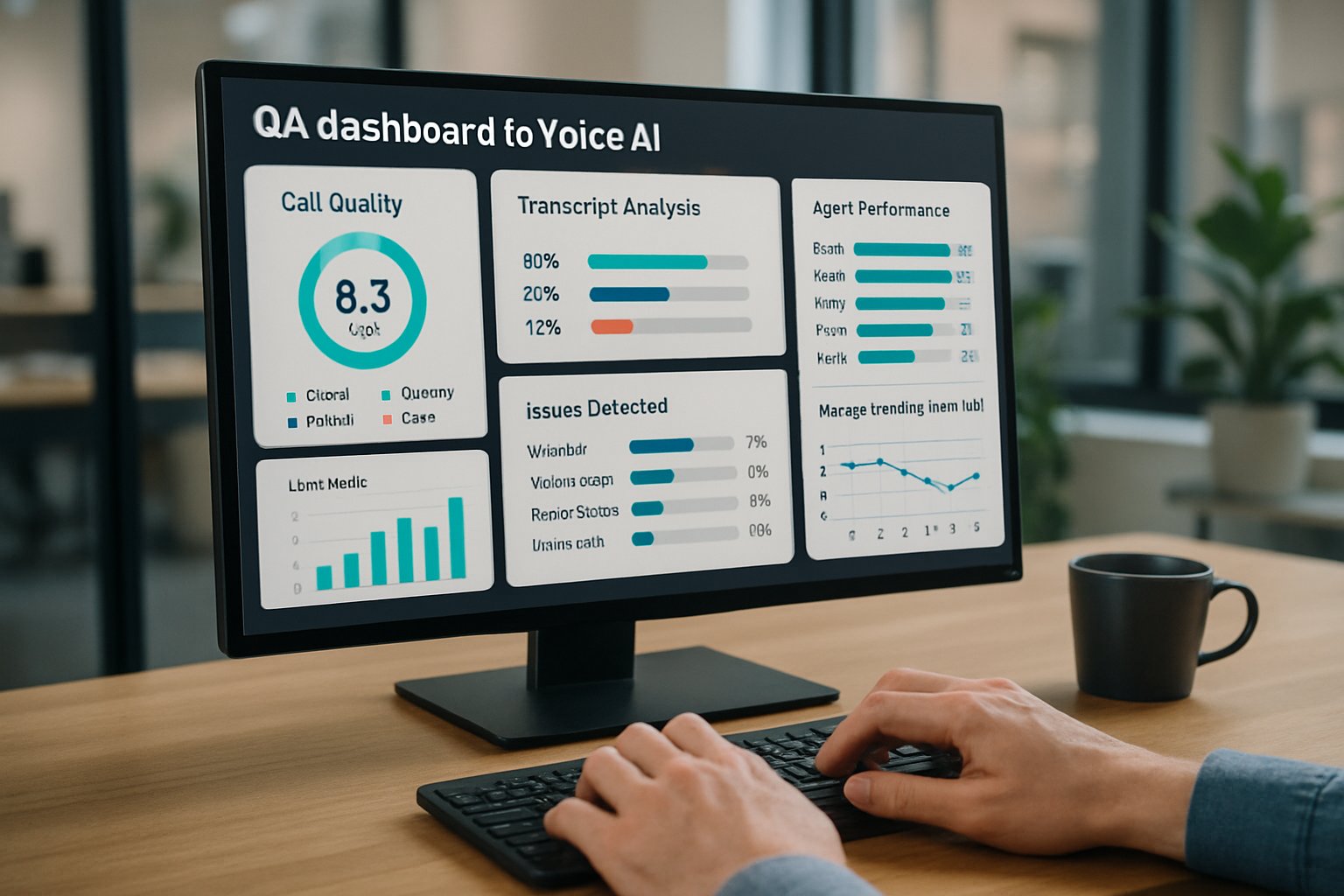
Assure pipes every audio stream through speech-to-text and intent parsers in near real time. Additionally, scoring engines evaluate policy compliance, sentiment shifts, and conversation outcomes. If thresholds fail, flags trigger webhook alerts or automatic prompt adjustments. Nevertheless, human reviewers remain available for high-severity incidents.
Assure tracks model drift by comparing current transcripts with historical baselines. In contrast, sample-based QA would miss slow degradation until customers complain. Retell says corrective loops reduced hallucination frequency by 22% in pilot studies. Moreover, dynamic tuning improved function-call success to 97%.
Assure currently scores several categories:
- Latency exceeding 600 ms round trip
- User interruptions after long response
- Hallucinated facts or policy breaches
- Negative sentiment longer than 10 seconds
- Failed external API Calls
These checkpoints deliver continuous visibility across every interaction. Therefore, engineers gain actionable data without drowning in noise.
Key Benefits And Limitations
Automated QA offers compelling advantages beyond scale. Firstly, Retell reports up to 80% cost reduction compared with outsourced review teams. Secondly, coverage reaches 100%, eliminating unmonitored edge cases. Moreover, Assure helps meet HIPAA and SOC2 evidence requirements through immutable logs.
Nevertheless, automation is not infallible. False positives can waste engineering time if thresholds are poorly calibrated. Consequently, successful deployments still allocate human auditors for spot checks and calibration sessions. Security researchers also warn that deepfake attackers could exploit telephony gaps before detectors mature.
Benefits clearly outweigh current drawbacks for many Enterprise adopters. However, balanced governance remains essential.
Emerging Competitive Landscape Shift
Observe.AI, Google Cloud, and Dialpad also tout 100% interaction scoring. However, few rivals claim automatic model retuning inside the same pipeline. In contrast, Retell integrates tuning, QA, and telephony routing under one subscription. Analysts expect consolidation as buyers favor unified control planes.
Pricing dynamics will influence adoption. Retell’s pay-as-you-go rates start at seven cents per minute, with Assure likely priced as an add-on. Meanwhile, Observe.AI offers volume discounts for Enterprises running both human and AI QA. Therefore, contract terms will become a key differentiator.
Competition validates the automated monitoring thesis. Consequently, Enterprise buyers can leverage multiple options.
Vital Deployment Considerations Checklist
Successful rollouts begin with data mapping and access reviews. Firstly, confirm SIP connectivity and CPaaS compatibility with Twilio or Vonage trunks. Secondly, integrate webhook endpoints for flag delivery into existing incident queues. Moreover, establish calibration cycles every fortnight to adjust scoring thresholds.
Compliance teams should validate redaction, encryption, and retention settings before handling protected health information. Professionals can enhance skills through industry accreditation. Consider the AI+ UX Designer™ certification for design-driven governance. Additionally, document fallback logic for Calls that exceed latency or fail external tools. Nevertheless, keep humans available for escalations requiring empathy.
Robust planning prevents expensive surprises later. Therefore, disciplined onboarding accelerates Voice AI time-to-value.
Strategic Future Outlook Trends
Voice AI governance will likely converge with broader observability stacks. Subsequently, real-time dashboards may blend human and automated agent metrics. Researchers also expect multimodal cues, such as facial analysis in video Calls, to feed the same monitoring engines. Moreover, regulators are drafting guidance that could mandate continuous oversight for autonomous agents.
Assure’s automatic prompt tuning hints at self-healing agents that learn from every error. Nevertheless, transparency and rollback controls will remain crucial safeguards. Industry watchers predict pilot results will surface by mid-2026, clarifying ROI and best practices.
The roadmap points toward tighter feedback loops and richer analytics. Consequently, early adopters may secure a durable competitive edge.
Automated oversight has shifted from aspiration to operational reality. Assure exemplifies how Voice AI can police itself while serving demanding customers. Moreover, enterprises gain 100% visibility, faster remediation, and documented compliance without ballooning costs. Limitations persist, especially around calibration and security, yet human-machine collaboration addresses most concerns. The competitive field will broaden, but early movers will define benchmarks and shape governance standards. Therefore, leaders evaluating Voice AI should pilot automated assurance now and iterate quickly. Meanwhile, upskilling teams through specialized certifications strengthens internal expertise and design rigour. Explore program options today and position your organization for the next generation of Voice AI success.


