

AI CERTS
4 months ago
Genesis-1 Orbit AI Pushes Satellite Compute Into Orbit
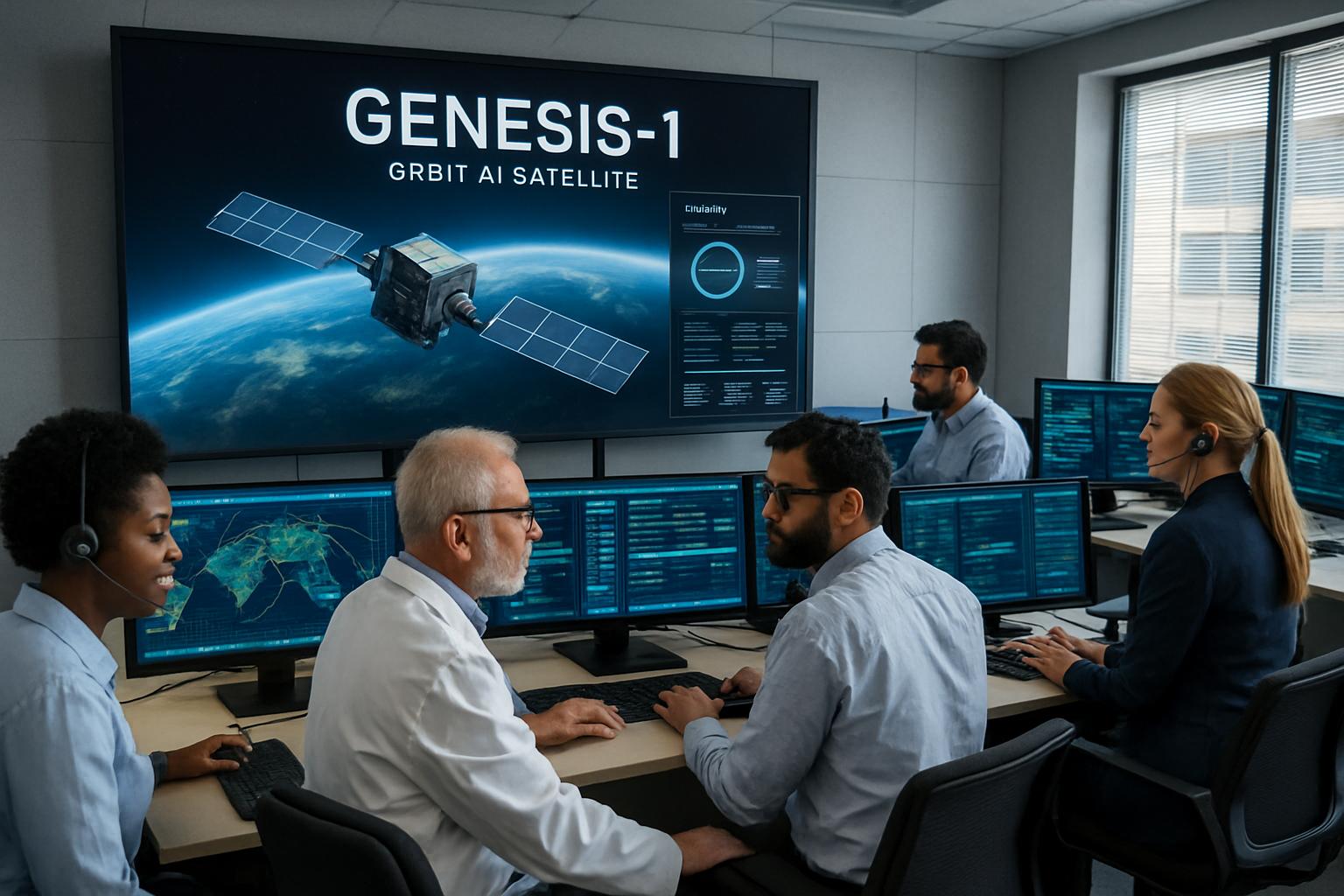
Industry experts remain divided. Nevertheless, the potential business stakes appear enormous.
This article unpacks the vision, verifies the limited evidence, and evaluates opportunities and obstacles surrounding Genesis-1 Orbit AI.
Orbital Cloud Project Vision
Orbit AI markets the initiative as an "Orbital Cloud" marrying connectivity, satellite compute, and blockchain verification above geopolitical borders.
Consequently, the firm envisions a lattice of low Earth nodes offering continuous solar power and radiative cooling advantages.
Genesis-1 Orbit AI serves as the proof-of-concept, hosting initial AI inference alongside an Ethereum wallet.
Moreover, partner Intellistake plans to validate on-orbit transactions, reinforcing the decentralized narrative.
These ambitions position Orbit AI among a small group, including Axiom and Starcloud, chasing orbital compute leadership.
The vision promises borderless infrastructure and resilient services. However, ambition still outweighs independent verification.
Against that backdrop, launch details reveal how far the prototype has advanced.
Launch And Early Operations
PowerBank reported the launch onboard an undisclosed rocket on 10 December 2025, inserting the satellite into low Earth orbit.
Furthermore, releases claim solar arrays deployed correctly and began powering the AI payload within hours.
Nevertheless, independent trackers have not yet published a cataloged object matching Genesis-1 Orbit AI.
Consequently, analysts urge caution until NORAD identifiers appear or telemetry is shared openly.
- Solar power generation reported at 1.2 kW peak.
- Onboard Ethereum wallet initialized with seed funds.
- Optical downlink tested at 100 Mbps, according to PowerBank.
These bullet points illustrate promising signals. However, third-party confirmation remains outstanding.
Technical advantages and looming obstacles emerge when the design is examined in detail.
Technical Benefits And Challenges
Supporters argue that constant solar exposure and vacuum radiative cooling make satellite compute energy-efficient compared with terrestrial centers.
Moreover, proximity to observational sensors could cut raw data transfer costs before downlink.
Meanwhile, thermal loads dissipate quickly into space, reducing reliance on mechanical cooling loops.
In contrast, critics highlight launch pricing, radiation damage, and limited repair routes that threaten uptime.
Radiation Mitigation Design Strategies
Genesis-1 Orbit AI reportedly relies on commercial GPUs with shielding, error-correcting memory, and watchdog reboots.
Nevertheless, single-event upsets grow likelier as nodes age, demanding periodic hardware refresh plans.
Bandwidth And Latency Limits
Orbit AI expects optical inter-satellite links to knit a cluster capable of parallel AI inference.
However, ground round-trip remains higher than terrestrial fiber, restricting real-time data workloads.
Consequently, early clients may limit tasks to preprocessing, compression, or batch analytics before downlink.
Benefits center on energy and physical vantage points. Yet technical hurdles could stall mainstream adoption.
Economic signals provide another lens for assessing viability.
Market Outlook And Competition
BIS Research projects orbital data center revenue exceeding $300 billion by 2035, though estimates vary widely.
Similarly, PowerBank touted a $700 billion addressable opportunity when announcing Genesis-1 Orbit AI partnerships.
Moreover, competitors such as Axiom Space, Starcloud, and OrbitsEdge pursue differentiated satellite compute architectures.
In contrast, hyperscalers consider modular hardware on future commercial stations, preferring easier servicing and higher bandwidth.
- Launch cost trajectory after heavy-lift competition.
- Regulatory clarity on orbital debris mitigation.
- GPU upgrade cadence versus satellite lifespan.
The market narrative remains bullish despite technical unknowns. However, incumbents and regulators will shape eventual winners.
Understanding future milestones clarifies what observers should monitor next.
Roadmap And Next Steps
Orbit AI targets five to eight nodes during 2026, scaling toward a commercial mesh by 2028.
Subsequently, 2029 and 2030 would see autonomous governance controlling scheduling, billing, and blockchain reconciliation.
Therefore, each additional Genesis-1 Orbit AI successor must integrate optical links, radiation shields, and serviceable modules.
Meanwhile, professionals can enhance their expertise with the AI Educator™ certification to prepare for orbital AI career paths.
If the firm delivers, low Earth coverage for specialized satellite compute could materialize within five years.
The roadmap offers clear public checkpoints. Nevertheless, execution risk remains high until independent launch data appears.
Key Takeaways
Genesis-1 Orbit AI encapsulates a bold attempt to fuse satellite compute, blockchain, and AI services beyond terrestrial control.
The project touts energy efficiency, continuous coverage, and sovereign resilience, yet confirmation gaps persist.
Moreover, radiation, bandwidth, and hardware obsolescence challenge sustained performance in low Earth environments.
Consequently, stakeholders should monitor NORAD listings, payload specifications, and funding milestones during 2026.
Professionals eager to contribute can strengthen domain knowledge through the earlier linked AI Educator™ program.
Explore certifications, follow upcoming flight manifests, and stay informed as Genesis-1 Orbit AI evolves.
Your next analysis could determine whether Genesis-1 Orbit AI becomes a market catalyst or a cautionary tale.
Disclaimer: Some content may be AI-generated or assisted and is provided ‘as is’ for informational purposes only, without warranties of accuracy or completeness, and does not imply endorsement or affiliation.


