

AI CERTS
5 hours ago
Geekom AI PC Leads Compact AI Speed Race
However, claims alone never seal purchasing decisions. Therefore, we examine verified specifications, published tests, and reviewer feedback. Additionally, we explore the broader ecosystem shaping small-form AI powerhouses through 2025. By the end, readers will know where the Geekom AI PC stands, why RTX 5090M options matter, and which risks warrant caution.
AI Mini PC Surge
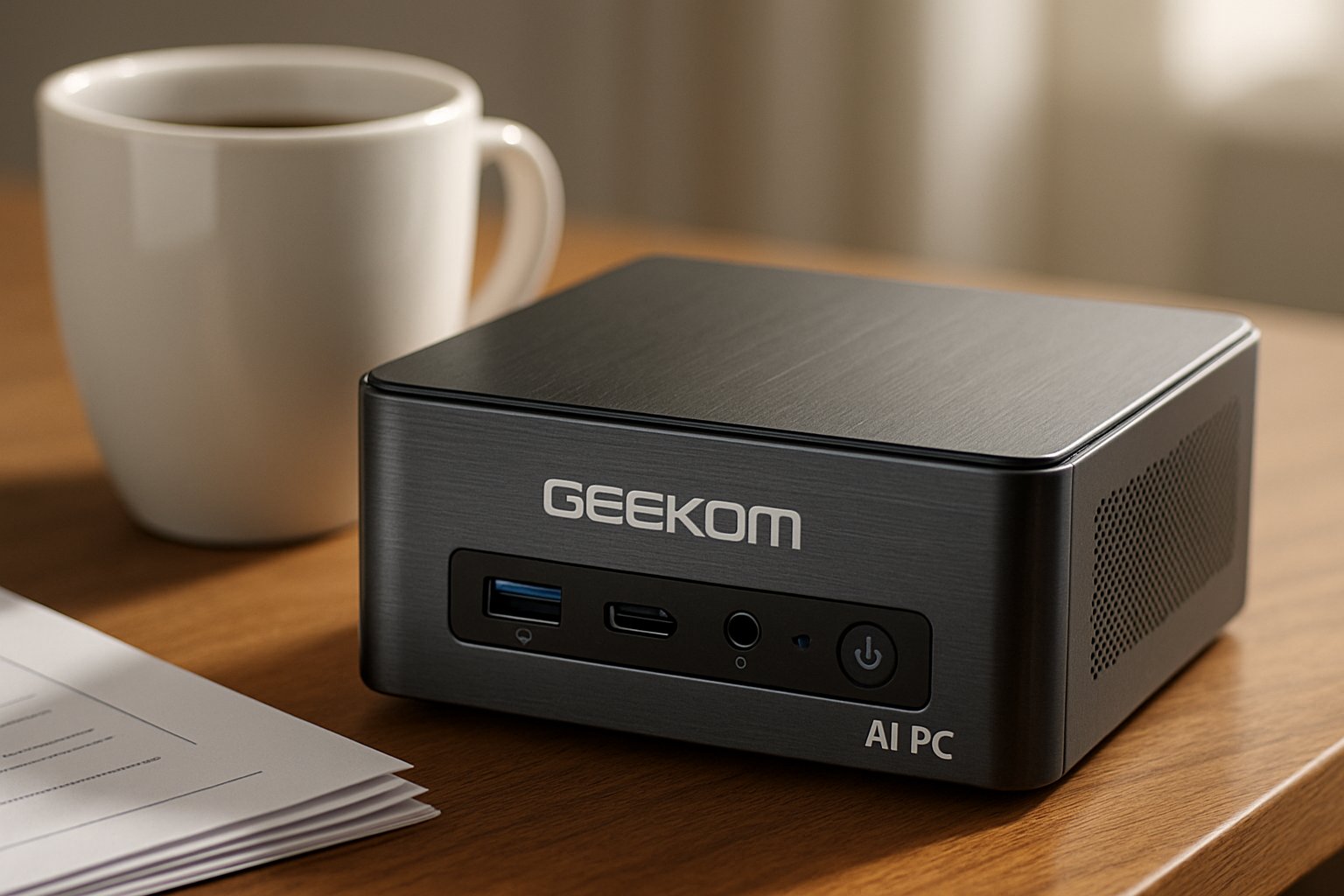
Global demand for AI edge compute has soared since late 2024. Moreover, AMD and Intel both launched processor families featuring on-chip NPUs for fast inference. Vendors quickly packaged those chips into palm-sized enclosures. Geekom AI PC headlines multiplied after its A9 Mega debut at IFA 2025. Similarly, GMKtec, Acemagic, Minisforum, and Olares pitched competing flagships.
Reviewers noted impressive speed in LM Studio token tests despite the machines’ compact frames. Additionally, market researchers forecast continued double-digit growth for this niche. Consequently, suppliers race to claim “world’s fastest” branding.
These trends reveal explosive momentum. Nevertheless, silicon progress alone does not crown a champion. The next section dives into architectural shifts underlying the performance leap.
Core Silicon Power Shifts
AMD’s Ryzen AI Max+ 395 integrates 16 CPU cores, a 40-CU Radeon iGPU, and a 50 TOPS XDNA 2 NPU. Furthermore, unified LPDDR5X memory up to 128 GB removes copy penalties between engines. Intel counters with Core Ultra 9 275HX plus a discrete RTX 5090M in devices like Olares One. Consequently, total throughput rises above 140 TOPS when CPU, GPU, and NPU contributions are combined.
Geekom AI PC models rely on the Ryzen platform, citing 126 TOPS marketing figures. In contrast, RTX 5090M hybrids push raw GPU tensor power higher, yet thermals become harder to tame inside compact cases. Moreover, Windows and Linux toolchains now offload tasks intelligently across heterogeneous hardware.
Architectural gains underpin record speed. However, vendor cherry-picks can distort perception. The following subsection compares hype with independent reality.
Vendor Claims Versus Reality
Marketing sheets spotlight dazzling TOPS numbers. Nevertheless, reviewers emphasize that TOPS alone rarely predicts real tokens-per-second. Notebookcheck measured the GMKtec EVO-X2 at 35 tokens/s on a quantized 70 B model. Meanwhile, early Olares One samples allegedly exceeded 40 tokens/s but lacked long-run thermal data.
Geekom AI PC press releases trumpet support for 235 B-parameter models. However, heavy quantization and low batch sizes were required. Furthermore, soldered memory caps can bottleneck larger networks despite high compute units.
Claims clearly need context. Still, objective numbers show impressive progress. These observations set the stage for hard performance statistics.
The evidence dispels selective marketing. Consequently, readers deserve concrete benchmarks, addressed next.
Performance Numbers In Context
Below is a condensed snapshot of verified results from late-2025 reviews:
- GMKtec EVO-X2: 35 tokens/s, Geekbench AI score ≈ 180,000.
- Geekom AI PC A9 Mega: 34 tokens/s, similar Geekbench AI figure.
- Acemagic Tank M1A Pro+: 33 tokens/s, minor variance due to cooling.
- Olares One (RTX 5090M): 40 tokens/s in vendor demo; independent data pending.
Furthermore, 3DMark Time Spy scores confirm Radeon 8060S graphics outperform many laptop GPUs, though RTX 5090M still wins ray-tracing tasks. Additionally, sustained power draw averaged 110 W on Ryzen systems, while the RTX 5090M combo peaked near 150 W, stressing small fans.
These metrics illustrate a tight race. Nevertheless, workload diversity means supremacy can shift by task type. The summary underscores why professionals must align needs with measured strengths before purchasing.
Numbers clarify relative speed. However, benefits beyond raw performance also influence buying decisions, discussed next.
Benefits For Pro Users
Local inference offers several tangible advantages:
- Lower recurring cloud costs for stable workloads.
- Reduced latency during creative iteration or private data analysis.
- Greater control over sensitive intellectual property.
- Portability for field deployments and edge experiments.
- Freedom to benchmark emerging models without provider limits.
Geekom AI PC devices ship with pre-installed toolchains, enabling rapid setup. Moreover, Ryzen unified memory keeps datasets close to compute engines, boosting speed and efficiency. Compact enclosures also free valuable desk space without sacrificing hardware muscle.
These benefits strengthen the ownership case. Nevertheless, certain limitations warrant caution, explored in the next section.
Positive factors abound. Consequently, a balanced view demands addressing remaining risks.
Lingering Challenges And Risks
First, many mini PCs use soldered LPDDR5X. Consequently, future memory upgrades are impossible. Furthermore, long inference sessions can trigger thermal throttling because tiny coolers struggle at 120 W loads. In contrast, larger desktops dissipate heat more easily.
Software maturity remains uneven. Windows Copilot+, Linux ROCm, and bespoke Olares OS each provide different CUDA, DirectML, or ROCm paths. Additionally, driver updates may lag, reducing speed until patches arrive.
Kickstarter units such as Olares One carry fulfillment uncertainty. Moreover, global warranty networks for smaller brands can be limited. Price volatility also looms; RAM prices and GPU availability affect RTX 5090M builds sharply.
Challenges signal due diligence is essential. Nevertheless, informed buyers can mitigate most pitfalls. The final section offers actionable guidance.
Risks highlight evaluation needs. Therefore, strategic purchasing advice follows.
Buying Guidance And Outlook
Professionals should map workloads to available silicon. For text generation, Ryzen APUs inside a Geekom AI PC often deliver ample speed while consuming less power than RTX 5090M hybrids. Conversely, stable diffusion with advanced upscalers may favor the GPU-rich Olares One.
Additionally, verify sustained benchmarks rather than peak screenshots. Therefore, request thermal plots or independent reviews before sending payment. Moreover, prioritize models offering 128 GB memory if planning to run 70 B parameters unquantized.
Prospective owners can enhance governance with the AI Legal Strategist™ certification. Consequently, teams will navigate compliance while building local inference pipelines.
Looking forward, AMD roadmaps hint at 80 TOPS NPUs by 2026, while NVIDIA eyes mini PCIe GPU modules. Geekom AI PC updates are expected each CES, keeping pressure on rivals.
Guidance empowers smart choices. Accordingly, we conclude with key takeaways and next steps.
Conclusion
AI mini PCs now rival desktops thanks to rapid silicon advances. Moreover, Geekom AI PC models consistently rank near the front of benchmark charts. Meanwhile, RTX 5090M hybrids promise unmatched graphics acceleration at the cost of heat and noise. Consequently, workload fit should dictate selection. Furthermore, independent testing remains the best shield against inflated marketing. Professionals ready to secure an advantage should compare sustained performance, memory capacity, and ecosystem support.
Nevertheless, knowledge alone seldom wins budgets. Therefore, explore certifications like AI Legal Strategist™ to pair technical mastery with governance expertise. Act now, evaluate devices, and future-proof your local AI stack.


