

AI CERTS
5 hours ago
Fayetteville’s AI Engineering Research Momentum
Therefore, decision-makers monitor each experiment closely. They insist on methodological consistency and strict validation before green-lighting industrial pilots. However, fresh grants, endowed chairs, and hackathons keep new ideas flowing. This backdrop frames the city’s mounting reputation as a Mid-South powerhouse for progressive engineering inquiry. AI Engineering Research now shapes both policy and practice across campus and industry.
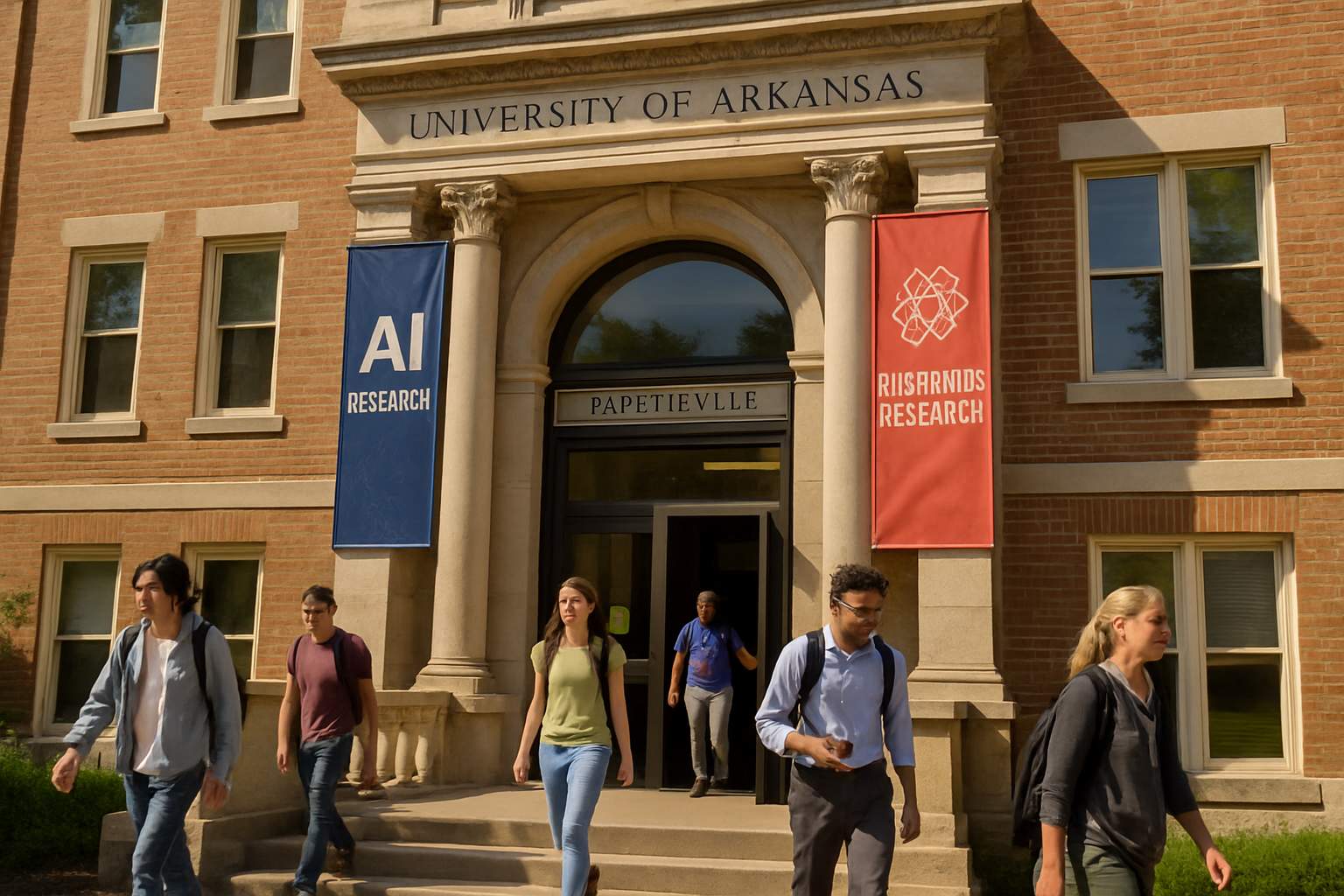
Fayetteville Research Ecosystem
Local facilities give researchers rare horsepower. The Arkansas High Performance Computing Center supplies large GPU clusters that shorten simulation turnarounds. Additionally, the Computational Mechanics Laboratory, led by Professor R. Panneer Selvam, integrates finite-element solvers with data-driven surrogates. That lab produces repeatable benchmarks, boosting confidence in results.
Moreover, regional startup Xtremis chose the nearby SEFOR site for an AI sensor plant. Executives cited close access to domain experts and reliable infrastructure. Consequently, knowledge flows freely between faculty and entrepreneurs. These collaborations embed AI Engineering Research in real supply chains.
Key takeaways: Fayetteville holds robust compute power and collaborative culture. Subsequently, the stage is set for wider adoption of hybrid simulation workflows.
Market Forces Driving Demand
Global simulation software revenue reached roughly USD 19.95 billion last year. MarketsandMarkets forecasts nearly USD 36 billion by 2030. Consequently, vendors accelerate feature releases to capture share. Ansys 2025 R1 adds SimAI, GPU solvers, and Omniverse integration.
Furthermore, rising cloud accessibility lowers entry barriers for small engineering teams. Fayetteville firms exploit usage-based licensing to test thousands of designs overnight. AI Engineering Research underpins these rapid loops, turning raw data into actionable insight.
Section summary: Expanding budgets and flexible clouds intensify competition. In contrast, teams lacking automation struggle to keep pace. The next section examines scientific breakthroughs answering that pressure.
Academic Advances And Challenges
PINNs Potential Explained
Physics-Informed Neural Networks embed governing equations within loss functions. Consequently, solutions respect physical laws without dense meshes. University of Arkansas scholars now evaluate PINNs on structural vibration cases. Preliminary results indicate 72% cost cuts versus classical solvers.
However, reviewers note limited consistency when sharp discontinuities arise. Therefore, many groups couple PINNs with domain decomposition and adaptive sampling. These Generalized models improve robustness across parameter spaces.
Summary: Hybrid learning closes several performance gaps. Nevertheless, unresolved training instabilities motivate toolchain innovation discussed next.
Industry Toolchain Evolution
Surrogate Models Rapid Surge
Commercial platforms automate surrogate creation from historical data. Ansys SimAI guides engineers through workflow steps, enforcing data quality checks for consistency. Moreover, NVIDIA Modulus provides code templates for Generalized models targeting fluid problems.
Consequently, Fayetteville researchers build light surrogates that deliver millisecond predictions. These assets feed digital twins, enabling near real-time monitoring. AI Engineering Research appears eight times in partner case reports, underlining momentum.
Key insight: Tool vendors now remove many setup hurdles. Subsequently, attention shifts toward balancing speed with physical fidelity, a theme explored below.
Opportunities And Limitations
Benefits of hybrid workflows include:
- Up to 5× faster design iterations
- Reduced prototype spending by 30–50%
- Greater exploration of extreme operating regimes
Moreover, embedding governing laws maintains physical realism, even with sparse measurements. Yet, challenges persist. Generalized models sometimes overfit narrow datasets. Interpretability remains limited, complicating certification.
Therefore, verification protocols must evolve. Consistency metrics, uncertainty quantification, and rigorous cross-validation become mandatory gatekeepers. AI Engineering Research teams at Arkansas now publish error bounds alongside results.
These challenges highlight critical gaps. However, strategic training initiatives aim to close them, as the following section shows.
Building Future Workforce
Certification Paths For Engineers
Curricula at the College of Engineering now blend data science, material science, and computational methods. Additionally, student hackathons encourage cross-disciplinary teams to prototype Generalized models within weekend sprints.
Professionals can enhance their expertise with the AI Architect™ certification. That program teaches cloud scaling, model deployment, and rigorous consistency audits. Furthermore, it emphasizes maintaining physical constraints during inference.
Consequently, graduates secure roles that merge domain knowledge with algorithmic skill. AI Engineering Research becomes the lingua franca of design offices. Mechanics innovators, HPC administrators, and software integrators now share aligned vocabulary.
Takeaway: Training investments reduce skill gaps. Subsequently, regional companies can adopt advanced tools faster and safer.
Strategic Takeaways Ahead
Fayetteville blends compute capacity, academic rigor, and commercial appetite. Global market growth further amplifies local relevance. Moreover, tool vendors simplify adoption while educators produce agile talent pipelines.
Nevertheless, sustained success demands unrelenting attention to verification and physical realism. Teams must document consistency, monitor surrogate drift, and validate across edge cases. AI Engineering Research will continue shaping competitive advantage as these controls mature.
Consequently, stakeholders who invest today position themselves for tomorrow’s high-value projects.
In conclusion, Fayetteville offers fertile ground for forward thinkers. Moreover, advancing toolchains and certification pathways drive rapid skill development. Engineers should engage university labs, explore vendor betas, and pursue credentials that prove mastery. Start your journey now; the next breakthrough could bear your name.


