

AI CERTS
6 months ago
FTAI Turbines Disrupting Data Center Power
Furthermore, it claims production starts in 2026, delivering more than 100 units yearly. This announcement sends a clear message. Rapid, modular power can arrive quicker than new utility lines.
Surging Market Demand Spike
Skyrocketing AI workloads create relentless load curves. Moreover, reports from the Financial Times show interconnection queues lasting up to seven years. Operators therefore chase alternatives. On-site generation fills the gap, and Data Center Power strategies now center on flexibility. GE Vernova has already shipped almost one gigawatt of turbines to single campuses. In contrast, FTAI targets smaller 25-megawatt blocks. Each unit can be sited quickly, scaled incrementally, and synchronized with local grid constraints. Notably, the company holds more than 1,000 CFM56 cores, giving it a deep parts pipeline.
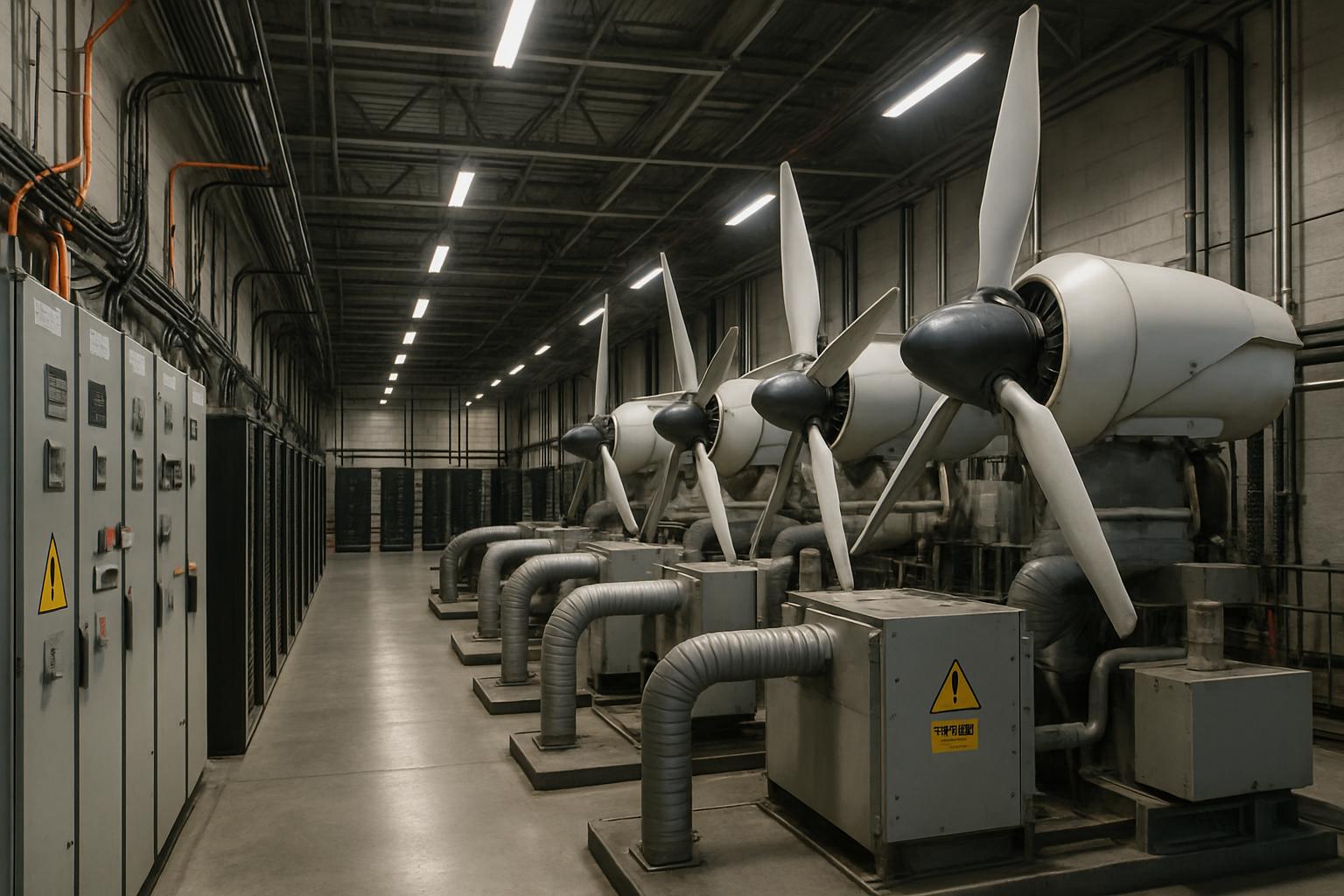
These market factors highlight an urgent opportunity. However, supply chain depth alone will not guarantee success. Stakeholders still need efficiency, emissions clarity, and financing options. Nevertheless, hunger for immediate capacity remains undeniable.
These dynamics favour nimble suppliers. Consequently, FTAI sees fertile ground for converted engines.
FTAI Power Growth Strategy
FTAI Power intends to stand out on speed. Additionally, existing MRO facilities totalling one million square feet shorten the industrial ramp. Joe Adams, CEO, stated, “The CFM56 engine market is the largest and most reliable in the world.” That pedigree eases investor concerns about reliability. Furthermore, the firm projects output exceeding 100 turbines annually after launch. If achieved, that equals 2.5 gigawatts of fresh Data Center Power each year.
Financial press reacted swiftly. Subsequently, FTAI stock jumped on December 31, 2025. Analysts cited strong inventory advantages and rising AI infrastructure budgets. Yet critics noted missing efficiency figures. Without those numbers, lifetime energy costs remain uncertain.
In summary, FTAI’s plan hinges on rapid conversions and volume scale. However, execution risks could still slow momentum. The next section explains how the hardware will be transformed.
Engine Conversion Process Details
The Engine conversion process starts with stripping flight-rated hardware. Technicians then rebuild hot sections for continuous duty. Moreover, dual-fuel combustors enable natural gas or diesel operations. Auxiliary skids add filtration, controls, and acoustic enclosures. Consequently, the former airliner core becomes an industrial generator set.
Key process stages include:
- Core tear-down and inspection to verify turbine health
- Material upgrades for thermal durability in stationary service
- Integration of a 25-megawatt generator and digital governor
- Package assembly into ISO containers for quick site installation
Each step leverages FTAI’s MRO expertise. Nevertheless, certification for stationary emissions remains pending. Therefore, prospective buyers will demand verified NOx and CO₂ metrics.
This technical path demonstrates feasibility. Additionally, modular containers streamline microgrid deployment. The following section details why aeroderivatives excel in such roles.
Aeroderivative Turbine Core Basics
Aeroderivative machines share DNA with jet engines. Consequently, they ramp from cold to full load within minutes. That agility benefits campuses balancing variable AI workloads and renewable energy inputs. In contrast, heavy industrial turbines require longer startup windows.
Furthermore, aeroderivatives weigh far less per megawatt than frame units. Transport trucks or rail cars handle them with ease. Therefore, operators can relocate assets as demand shifts. However, open-cycle efficiency lags combined-cycle alternatives, raising fuel burn per megawatt-hour.
Despite that drawback, many hyperscalers accept higher fuel bills. Immediate Data Center Power often outweighs cost efficiency. Nevertheless, vendors must still mitigate emissions to satisfy community concerns.
These fundamentals clarify aeroderivative appeal. Subsequently, we examine how microgrids weave these turbines into integrated power fabrics.
Emerging Microgrid Deployment Trend
Large campuses now build self-contained microgrids. Batteries, solar arrays, and gas turbines operate behind the meter. Moreover, microgrids bypass congested grid infrastructure, granting construction schedules greater certainty. Parker Hannifin recently supplied equipment for over one gigawatt at an OpenAI Stargate site. Consequently, the model gains mainstream acceptance.
FTAI’s 25-megawatt modules fit this architecture neatly. Operators can stage units as clusters, matching phased server hall openings. Additionally, fast ramping supports frequency regulation services, generating extra revenue.
However, regulatory scrutiny is intensifying. Communities worry about noise, air quality, and methane leaks. Therefore, robust environmental reporting will become mandatory for every turbine yard.
Microgrid adoption underscores flexible design imperatives. The competitive landscape now shapes those choices, as the next section shows.
Operational Risks And Challenges
Several hurdles could hamper FTAI progress. First, fuel price volatility impacts long-term energy budgets. Moreover, aeroderivatives emit notable CO₂ and NOx, potentially triggering carbon penalties. Financial Times reporters warn regulators may tighten generator permits.
Second, established OEMs like GE Vernova and Mitsubishi Power already offer proven packages. Consequently, customers may favour incumbents unless FTAI demonstrates superior economics. Third, continuous duty stresses aviation cores differently than flight cycles. Therefore, warranty terms and maintenance intervals must convince cautious buyers.
Finally, community opposition can stall projects. Noise abatement and exhaust stack placement require local approvals. Nevertheless, early engagement and transparent metrics can ease tensions.
These risks demand proactive mitigation. However, strategic partnerships and credible certifications can improve confidence.
Future Outlook And Actions
Market momentum appears strong. Hyperscalers keep announcing multi-giga-watt campuses. Consequently, modular Data Center Power solutions will stay in demand. FTAI’s inventory gives it a unique supply hedge. Additionally, circular reuse aligns with corporate sustainability narratives.
Professionals can sharpen project oversight skills through the AI Project Manager™ certification. Moreover, certified managers gain fluency in cost analysis, permitting pathways, and risk governance for on-site generation.
Stakeholders should monitor three indicators:
- Published heat-rate and emissions figures for converted units
- First commercial deployments and runtime data
- Regulatory shifts affecting microgrid permissions and grid service revenues
Consequently, visibility into these markers will guide procurement decisions. Nevertheless, early movers may lock favorable supply slots before demand surges.
This outlook underlines the strategic stakes. The final section distills the discussion and urges timely action.
Conclusion
AI workloads keep soaring, and Data Center Power must keep pace. Aeroderivative turbines, enabled by clever Engine conversion, offer rapid capacity. Furthermore, FTAI’s vast CFM56 inventory positions it as a potential disruptor. However, efficiency, emissions, and community acceptance remain critical variables. Nevertheless, proactive planning, certified expertise, and vigilant monitoring can unlock significant advantages. Therefore, decision-makers should explore turbine options now and consider gaining the linked certification to lead forthcoming deployments.
Disclaimer: Some content may be AI-generated or assisted and is provided ‘as is’ for informational purposes only, without warranties of accuracy or completeness, and does not imply endorsement or affiliation.


