

AI CERTS
3 months ago
Hitem3D 2.0 Pushes AI 3D Generation Into Production
Moreover, Math Magic targets both indie creators and industrial manufacturers by promising printable, realistic outputs without marathon cleanup.
Professionals evaluating next-gen pipelines should note one more point. The platform’s founders openly frame Hitem3D 2.0 as a “grown-in texture” milestone that pushes AI 3D Generation from demo novelty into dependable production infrastructure.
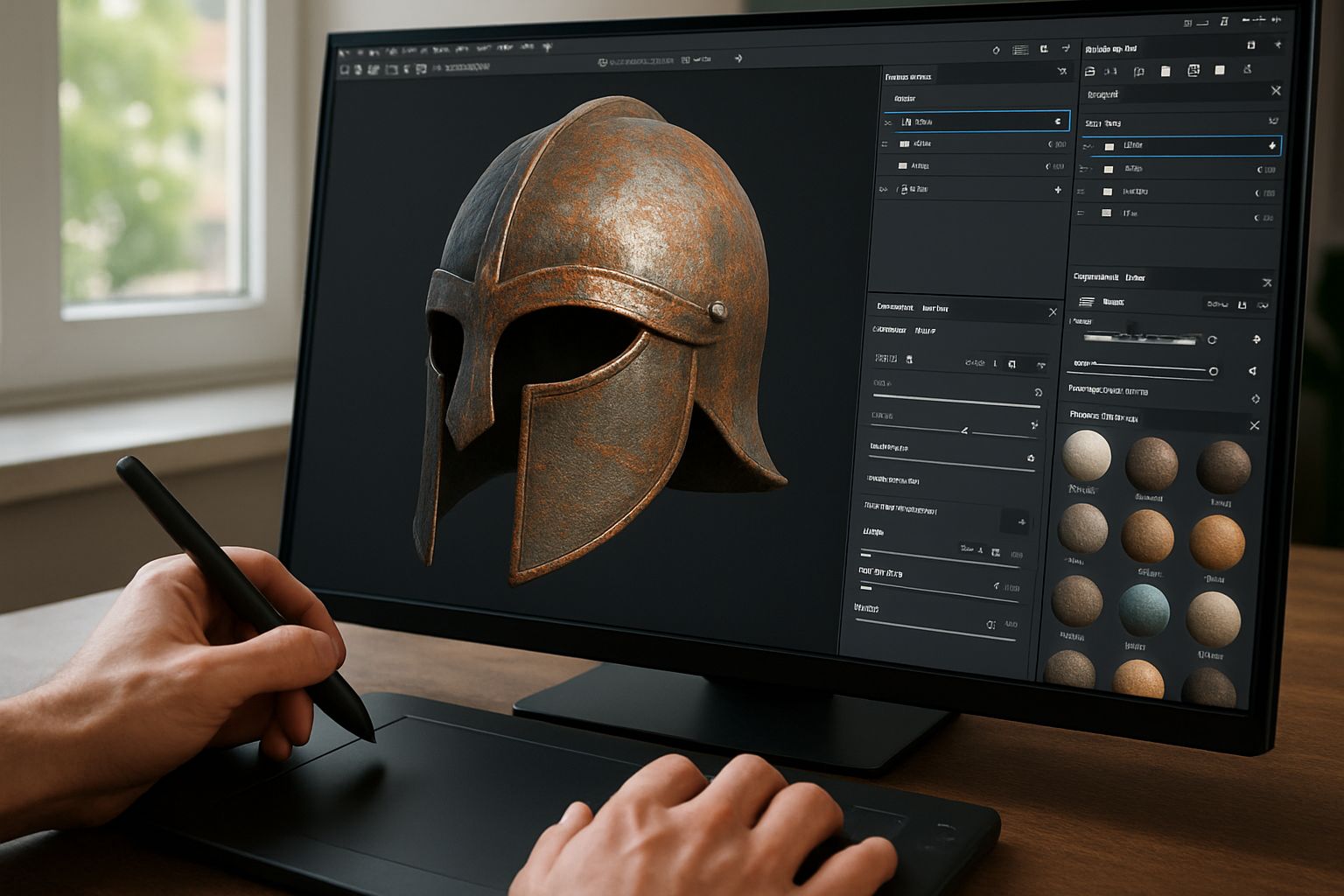
Integrated Texturing Finally Arrives
Traditional generators project 2D textures after sculpting forms. In contrast, Hitem3D 2.0 grows textures while creating geometry. Consequently, surfaces maintain color continuity across occluded regions. Furthermore, the pipeline remains Illumination-aware, separating light from albedo to produce Physically Based Rendering ready maps. Independent reviewers highlight fewer projection seams and cleaner normal maps, even on complex meshes.
Bo Zhang, the product lead, states, “We focused on coherent structure and texture, because printing failures equal rework.” Automated semantic segmentation tags parts during generation, while de-lighting recovers neutral base color. Additionally, the system exports multi-material STL, GLB, FBX, OBJ, and USDZ files in one pass.
The shift toward integrated texturing reduces manual repaint cycles and accelerates approval stages. However, real-world stress tests will confirm long-term reliability.
These capabilities signal a meaningful workflow advance. Meanwhile, higher resolutions amplify their impact.
Higher Resolution Boost Details
Hitem3D originally surprised the market with 15363 volumetric outputs. Subsequently, version 2.0 adds a “15363 Pro” tier aimed at final production. Moreover, the flagship setting preserves micro-displacement detail that smaller voxels miss. Each 1536 Pro run consumes roughly 70 credits, or US $1.40, according to official pricing.
Sparc3D research underpins the upgrade through sparse convolution networks and the Sparcubes representation. Consequently, generated meshes retain thin wall fidelity and strand-level hair. Independent labs note file sizes reaching several hundred megabytes, yet automated retopology can reduce that density for engines.
The resolution bump matters for industrial printing, where nozzle limitations exaggerate surface errors. Moreover, large-format printers benefit from the newfound voxel granularity, producing smoother finishes with minimal sanding.
Higher resolution raises expectations for asset readiness. Therefore, downstream pipeline features must deliver matching efficiency.
New Production Pipeline Features
Beyond pixels and polygons, Math Magic integrated several workflow tools.
- Automatic retopology converts high-density triangulation into quad-friendly topology.
- Semantic segmentation labels parts for rigging, collision, or material assignments.
- Portrait mode preserves strand-level hair, supporting lifelike figurine prints.
- Multi-material exports package up to four discrete material shells.
Furthermore, the API enables geometry-only previews at 5123 before committing to textured 1536 Pro runs. Consequently, artists iterate cheaply, then upscale when directors approve. The Illumination-aware texture pass remains available in all-in-one mode or as a second stage.
Professionals can enhance their governance skills with the AI Ethics Certification, ensuring responsible deployment of AI 3D Generation across regulated sectors.
These pipeline additions reduce handoffs and tooling costs. However, users still examine pricing before volume adoption.
Pricing And API Breakdown
The service operates on a credit model where one credit equals two cents. Therefore, a 10243 textured model costs about US $1.00, while 5123 previews run just US $0.40. Moreover, subscription bundles at US $20 or US $40 per month provide discounted credits and priority queues.
Developers interact through REST endpoints supporting image-to-3D and multi-view uploads. Consequently, pipeline automation within Blender, Unity, or ComfyUI nodes requires minimal scripting. Rate limits apply, yet enterprise plans negotiate higher throughput.
Additionally, exported meshes carry full commercial licenses, though legal teams should review specific indemnities. In contrast, open checkpoints remain unavailable, sparking ongoing community debate.
Transparent pricing encourages experimentation. Nevertheless, market positioning depends on integrations and competitive context.
Broader Market And Ecosystem
Competitors like Tripo, Meshy, and 3DAI Studio focus on speed or stylization. However, Hitem3D emphasizes realistic fidelity and industrial print readiness. Community developers already published ComfyUI nodes, Hugging Face demos, and GitHub connectors, facilitating prompt-driven AI 3D Generation workflows.
Nevertheless, the Sparc3D open-source community criticizes the paywall around trained weights. Consequently, some creators explore alternative repositories to balance cost and openness. Meanwhile, studios appreciate USDZ exports that slot into Apple Vision Pro prototypes without conversion.
Third-party benchmarks remain scarce, yet early adopters report reduced seam repairs and faster approvals. Moreover, TechBullion notes that integrated texturing could shift AI assets from “demo” to “deploy” status across entertainment pipelines.
The ecosystem buzz suggests rising adoption potential. Still, decision makers must weigh caveats and risks.
Future Prospects And Caveats
Every generator occasionally hallucinates geometry or internal cavities. Consequently, Hitem3D’s documentation advises mesh integrity checks before manufacturing. Automated retopology helps, yet extremely dense meshes may still require manual optimization for real-time engines.
Furthermore, high-volume studios could incur material expenses despite low unit costs. Queue latency under peak loads also requires verification. In contrast, the credit model simplifies small-batch experimentation.
Legal clarity matters for regulated industrial sectors. Therefore, counsel should confirm asset ownership clauses and indemnity coverage. Moreover, long-term roadmap disclosure around open checkpoints will influence community trust.
These cautions remind teams to test before committing budgets. Consequently, an informed rollout plan is essential.
Conclusion And Next Steps
Hitem3D 2.0 extends AI 3D Generation beyond prototype novelty by integrating textures, boosting resolution, and embedding production utilities. Moreover, Illumination-aware maps, automated retopology, and credit-based pricing align with industrial realities. Nevertheless, dense meshes, community openness debates, and throughput limits demand careful evaluation.
Consequently, studios should pilot the API, print sample parts, and benchmark against legacy workflows. Meanwhile, professionals can future-proof leadership credentials through the linked AI ethics certification. Embrace these advances, iterate responsibly, and position your pipeline for the coming decade of AI 3D Generation.


