

AI CERTS
3 months ago
AI Orbital Compute Takes Flight with Genesis-1 LEO Satellite
Skeptics, however, question business economics and technical reliability in radiation-heavy space. Nevertheless, investor interest surged after press releases circulated across PR Newswire and financial feeds. Professional audiences now need a clear, balanced analysis. This article examines Genesis-1 claims, technology stack, market projections, and verification gaps. Along the way, it tracks how AI Orbital Compute may reshape edge processing strategies. Maintain caution, yet watch closely, because space computing startups rarely fade quietly. Stakeholders wonder how regulation will adapt when compute leaves national borders.
Orbit Cloud Vision Explained
Orbit AI brands the combined system DeStarlink Orbital Cloud. DeStarlink refers to a decentralized LEO communications mesh supporting broadband links among nodes. DeStarAI represents the on-board GPU package that executes AI Orbital Compute workloads near data sources. Additionally, each satellite hosts an Ethereum wallet acting as a blockchain validator. Consequently, proponents pitch tamper-resistant compute, storage, and connectivity outside earthbound jurisdiction.
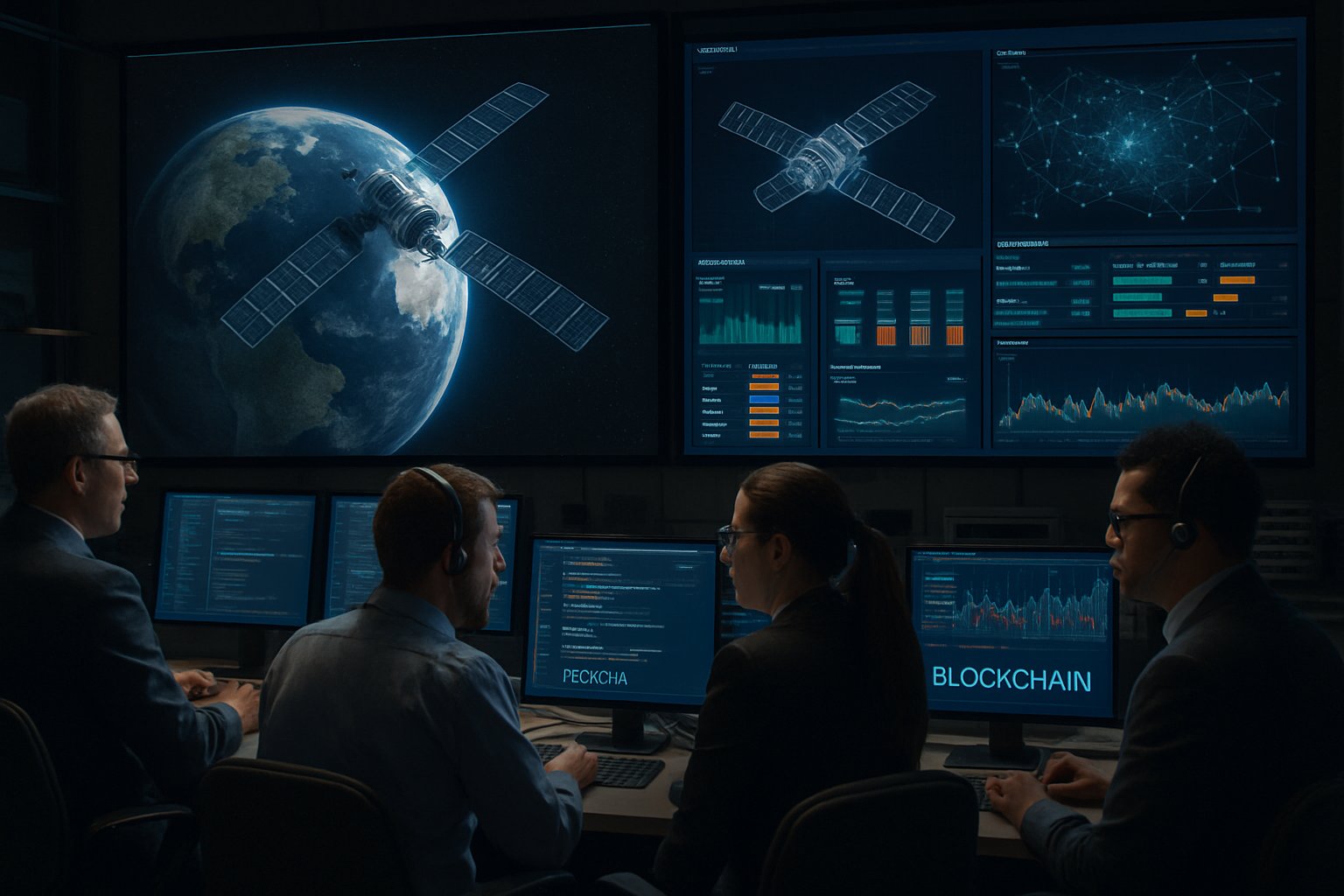
PowerBank contributes solar arrays and radiator panels, aiming for continuous power in sun-synchronous orbit. Moreover, radiative cooling in vacuum reduces energy consumed by terrestrial cloud chillers. Supporters claim these physics advantages translate into lower operating cost per inference task. In contrast, ground data centers battle rising electricity prices and strict emissions policies.
The vision unifies communications, compute, and consensus in one lightweight bus. However, declaring victory before independent confirmation remains premature. Therefore, the next section dissects the Genesis-1 launch narrative.
Genesis-1 Launch Claims Overview
Press releases state Genesis-1 rode to LEO on 10 December 2025. SparkX Satellite is listed as the builder, while the unnamed launcher provided rideshare capacity. PowerBank, Intellistake, and Orbit AI published coordinated announcements within hours. Furthermore, executives Richard Lu and Gus Liu issued optimistic quotes regarding operational status. Subsequently, investor outlets echoed those claims, lifting PowerBank’s stock price temporarily.
Independent catalogs, however, have not yet assigned a NORAD ID to the spacecraft. Jonathan McDowell, an established tracker, advised caution, citing limited publicly available telemetry. Meanwhile, mainstream space trade media still await manifest confirmation from launch providers. Consequently, verification remains largely press-release dependent today.
Genesis-1 publicity is strong, yet documentary evidence is thin. The following section inspects the technical stack powering AI Orbital Compute.
Technical Stack Details Unpacked
Company materials mention NVIDIA GPUs hardened for radiation using proprietary shielding. Additionally, custom controllers allegedly manage thermal throttling through deployable radiator fins. Power budgets reportedly reach 800 watts, sourced from high-efficiency gallium-arsenide panels. Moreover, software stacks feature Kubernetes variants adapted for intermittent connectivity.
AI Orbital Compute workloads include image segmentation for Earth observation and maritime vessel detection. Edge inference reduces downlink volumes, thus lowering bandwidth expenses. In contrast, training complete foundation models in LEO appears unlikely given power limits. Blockchain duties focus on light client verification rather than heavy proof-of-work calculations.
- DeStarlink radio mesh operating in Ku-band
- DeStarAI GPU module with 512 tensor cores
- Ethereum wallet running proof-of-stake validator
- Onboard secure element for key storage
Latency budgets target thirty milliseconds inter-satellite and under one-hundred-fifty milliseconds to ground. Nevertheless, suppliers named in PRs have not universally confirmed their participation. Therefore, technical specifics remain provisional pending third-party audits.
Hardware promises appear cutting edge yet need evidence. Next, we evaluate commercial upside projections supporting the orbital cloud storyline.
Market Opportunity Forecasts Ahead
BIS Research forecasts a $615-billion global satellite market by 2032. Moreover, analysts expect in-orbit data centers to reach tens of billions by 2035. Orbit AI extrapolates those numbers, predicting multiyear revenues through AI Orbital Compute services. Additionally, partners cite a combined $700-billion opportunity across connectivity, compute, and blockchain.
However, projections assume sustained launch cost declines and reliable hardware lifetimes. Launch costs fell recently, yet heavy GPU payloads still incur significant fees per kilogram. Consequently, break-even timelines could stretch beyond typical venture horizons.
- Launch cost per kilogram trajectory
- Radiation shielding mass penalties
- Ground latency versus terrestrial cloud regions
- Regulatory environment for blockchain in space
Industry coalitions also lobby for clearer insurance frameworks to cover orbital data centers. In contrast, certain niche segments could adopt early. Earth observation firms already pay premiums for near-real-time analytics.
Market forecasts look tantalizing but hinge on many variables. Therefore, risk assessment is essential, as discussed in the next section.
Feasibility And Key Risks
Radiation remains the foremost technical threat. Commercial GPUs suffer bit flips unless shielded or error-corrected aggressively. Additionally, orbital debris increases collision probability, demanding fuel for avoidance burns. Regulators are intensifying scrutiny after several megaconstellation incidents.
From a business view, capital intensity challenges subscription pricing models. Moreover, ground latency may deter social media or gaming customers. Nevertheless, applications like disaster response tolerate extra milliseconds if insights arrive faster than traditional downlinks. Energy economics offer a partial hedge because orbital cloud nodes avoid many utility bills.
Expert skepticism persists. Jonathan McDowell cautions that many ventures start from excitement rather than necessity. Consequently, rigorous verification and realistic roadmaps determine survival.
Risks span physics, finance, and regulation. Next, we outline concrete steps for independent validation.
Next Verification Steps Forward
Industry professionals should begin with authoritative catalogs. Space-Track listings, NORAD IDs, and TLEs will confirm orbital presence. Additionally, contacting launch providers can validate rideshare manifests. Observers may request telemetry images or beacon signals from Genesis-1 ground passes.
Furthermore, supplier confirmation letters will clarify GPU models and shielding techniques. FCC and ITU filings can reveal ground station architecture. Moreover, open source amateur observations often surface on X and specialized forums. Crowdsourced photos using telescopes can offer visual confirmation of panel deployment.
Professionals can enhance their expertise with the AI Prompt Engineer™ certification. Credentialed analysts add credibility when questioning ambitious AI Orbital Compute disclosures.
Structured verification will separate marketing from measurable reality. Subsequently, the final section distills strategic takeaways.
Strategic Takeaways
Genesis-1 illustrates how innovators mix connectivity, compute, and consensus above the atmosphere. Early excitement around AI Orbital Compute is justified by potential edge acceleration. However, sustainable revenues depend on transparent verification, robust hardware, and disciplined cost control. Investors should treat AI Orbital Compute as an iterative experiment, not a guaranteed windfall.
Meanwhile, enterprises exploring sovereign data solutions may pilot workloads on future space nodes. For engineers, AI Orbital Compute opens challenging careers in radiation-aware software and satellite systems. Therefore, now is the moment to upskill and engage. Take the next step by securing specialized credentials and joining the orbital innovation dialogue. Continuous monitoring will decide whether aspirations translate into durable infrastructure gains.


