

AI CERTS
3 months ago
Infragistics AI outlook: 2026 Software Intelligence Trends
Consequently, vendors feel pressure to deliver faster, smarter Software without sacrificing governance safeguards. Meanwhile, analysts expect the low-code market to approach $50 billion by 2028. These converging signals demand careful decoding for enterprise architects. Therefore, this article unpacks the core findings, risks, and strategic moves outlined. Readers will learn why SaaS builders must embed intelligence across the full product lifecycle. They will also see how certifications can sharpen individual readiness for the coming future.
Key Market Forces 2026
Market momentum frames every technology decision. Forrester estimates low-code and DPA reached $13.2 billion in 2023. Moreover, projections suggest steep double-digit growth through 2026. Embedded analytics shows similar acceleration, with some researchers valuing the segment near $70 billion today. Consequently, investors see fertile soil for intelligent platforms that collapse analytics and delivery silos.
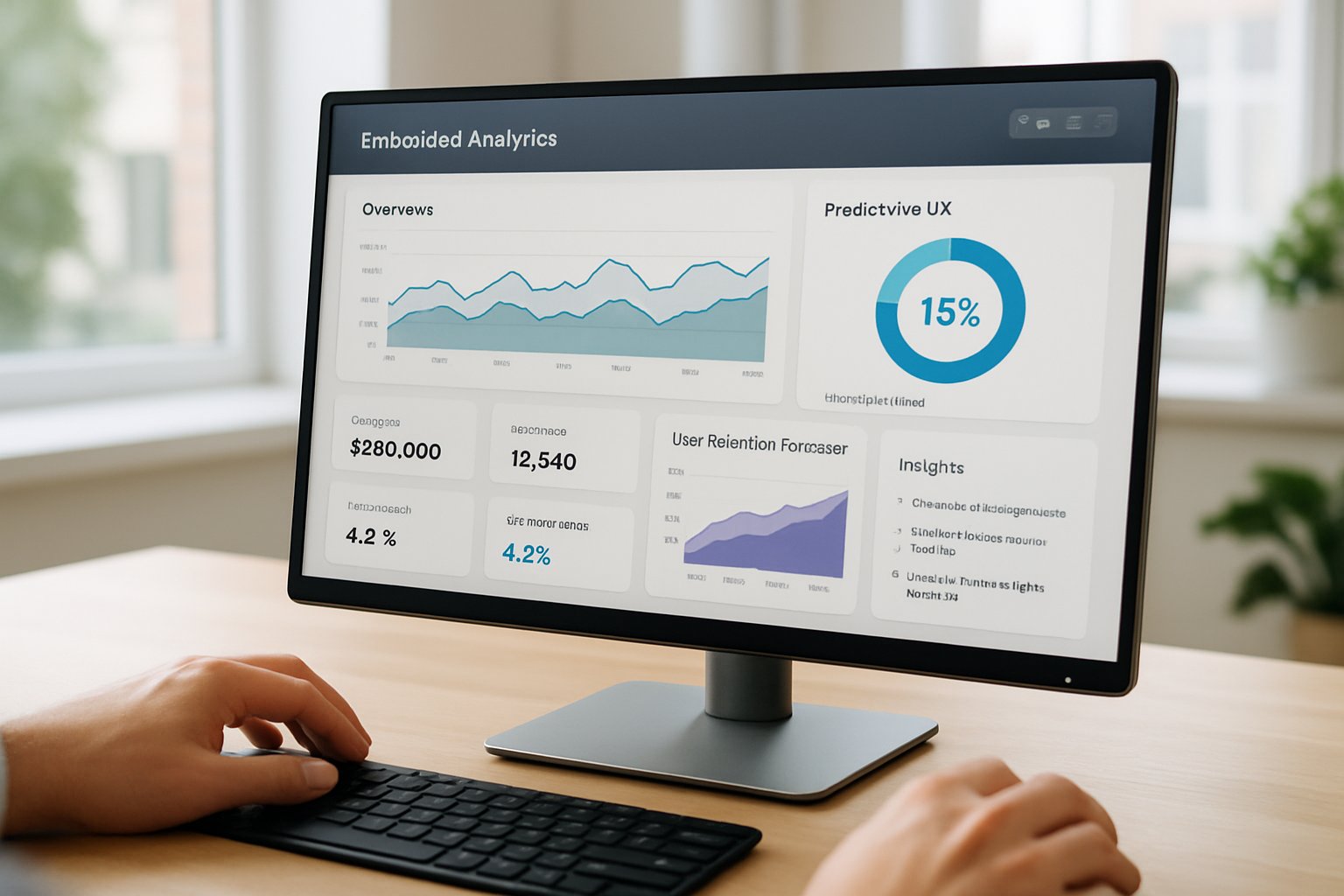
The Infragistics AI outlook aligns its portfolio against those expanding pools of capital. App Builder targets the low-code boom, while Reveal pursues embedded analytics budgets. Additionally, Ignite UI positions components as reusable assets amid growing design-system adoption. Such alignment matters because enterprises increasingly demand integrated toolchains rather than piecemeal solutions. Therefore, understanding macro forces clarifies why the outlook emphasizes holistic Software intelligence.
These economic signals underline sizable opportunities. However, technology trends sharpen competitive urgency, as the next section explores.
AI Trends Redefine UX
Predictive user experiences represent the report’s boldest claim. In contrast, past generations reacted to user clicks; tomorrow’s interfaces will anticipate intent. Reveal already surfaces contextual insights inside operational screens, reducing swivel-chair analytics. Furthermore, App Builder roadmaps include telemetry hooks feeding models that fine-tune component behavior. The Infragistics AI outlook calls this evolution “adaptive design systems” that learn continuously.
Survey evidence supports the thesis. 55% of companies adopting AI reported net job creation, not elimination. Moreover, 63% of those firms added up to 25 new roles, often data scientists. Consequently, staff can focus on higher-value architecture while models automate routine UX polish. Such predictive capabilities, however, amplify privacy stakes discussed later.
In short, AI-driven UX promises efficiency and differentiation. Subsequently, design-to-code momentum becomes the logical conduit.
Design to Code Momentum
Build what you design now feels obligatory. Jonathon Rosshirt notes, “Build what you design isn’t just a slogan.” App Builder imports Figma files and exports clean Angular, Blazor, or Web Components code. Moreover, generated code can enter existing pipelines without heavy rewrites, according to marketing demos. Therefore, delivery speed improves while UX consistency stays intact.
Critics still flag vendor lock-in. Nevertheless, App Builder allows full source export, easing migration worries. Governance features include role-based access, audit logs, and policy templates for sensitive data. Additionally, upcoming releases will embed security scanning during generation. The Infragistics AI outlook frames these safeguards as table stakes for enterprise SaaS adoption.
Design-to-code thrives when governance joins velocity. Consequently, embedded analytics enters the spotlight next.
Embedded Analytics Advantage Rises
Embedded analytics integrates insights directly into workflows. Reveal exemplifies this model, exposing dashboards through simple JavaScript or .NET snippets. Furthermore, conversational interfaces let non-technical users ask questions using natural language. Such convenience increases product stickiness and lowers dependency on central BI teams. In contrast, standalone dashboards force disruptive context switching.
Market research from ExpertMarketResearch projects the segment to sustain double-digit growth this decade. Consequently, vendors racing toward embedded models enjoy wealthy budgets. The Infragistics AI outlook positions Reveal as a bridge between raw telemetry and predictive action. Moreover, tighter integration with App Builder ensures analytics appear early in prototypes. That approach de-risks later retrofits and aligns with agile principles.
Integrated insights thus create durable competitive moats. However, governance risks cannot be ignored.
Governance Risks And Remedies
Security, privacy, and reliability dominate obstacle lists. Reveal’s 2025 survey ranks security first at 51%. Additionally, the Infragistics AI outlook lists AI code reliability worrying 45% of respondents. Data privacy follows at 41%, underscoring regulatory pressure. Therefore, governance features must embed within each platform layer.
Jason Beres stresses transparency and user control in the press release. Meanwhile, audit capabilities inside App Builder aim to document every generated line. Moreover, external scanners can review exported source, reducing black-box fears. Nevertheless, organizations should evaluate portability clauses to avoid future vendor lock-in. Adopting secure design patterns early mitigates most SaaS compliance headaches.
Rigorous governance transforms risk into differentiator. Subsequently, the competitive arena demands a broader view.
Competitive Landscape Insights 2026
The landscape spans observability, low-code, and embedded analytics players. Dynatrace, Datadog, and New Relic dominate software intelligence monitoring. Meanwhile, Microsoft Power Apps and Mendix contest low-code mindshare. Moreover, Tableau and Salesforce embed BI across their SaaS suites. Consequently, differentiation hinges on unified design, code, and analytics pipelines.
In contrast, the Infragistics AI outlook claims its portfolio already spans those layers natively. Ignite UI provides the UI toolkit, App Builder supplies code, and Reveal injects insights. Additionally, Slingshot offers collaboration features augmenting delivery workflows. This integrated stack targets mid-market ISVs seeking rapid productization. Therefore, buyers should benchmark cross-vendor integration depth when planning future migrations.
Competitive stakes will escalate as budgets grow. The next section moves from strategy to action.
Certification Path Forward Now
Skilled practitioners remain essential despite automation gains. Furthermore, the Infragistics AI outlook indicates 55% of firms created new AI roles. Professionals can boost expertise through the AI+ UX Designer™ certification. Moreover, continuous learning ensures teams exploit Software intelligence responsibly. Consequently, organizations should map talent plans to emerging predictive disciplines.
Leaders can apply three practical steps:
- Assess current pipelines against design-to-code maturity benchmarks.
- Embed governance controls at every SaaS integration point.
- Invest in certification paths that align with future product roadmaps.
These actions accelerate readiness while minimizing surprises. Therefore, teams position themselves for the next innovation wave.
The Infragistics AI outlook crystallizes 2026 imperatives with data, product roadmaps, and sober risk warnings. Moreover, converging market forces show intelligence baked into Software will soon define customer loyalty. Low-code, embedded analytics, and predictive UX now operate as a single strategic axis. However, success requires disciplined governance, transparent models, and certified talent. Consequently, leaders should revisit architectures, upskill teams, and benchmark vendor roadmaps before budgets lock. Professionals motivated by the Infragistics AI outlook can secure relevance through continuous certification and experimentation. Therefore, act now, evaluate integrated platforms, and transform ideas into resilient SaaS products.


