

AI CERTS
6 months ago
Delphyne AI model: New Transformer Boosts Quant Forecasting
However, foundation ambitions collide with cost, data access, and negative transfer effects. Therefore, understanding design choices behind the Delphyne AI model is essential before any adoption. The following sections provide a concise technical and strategic walkthrough.
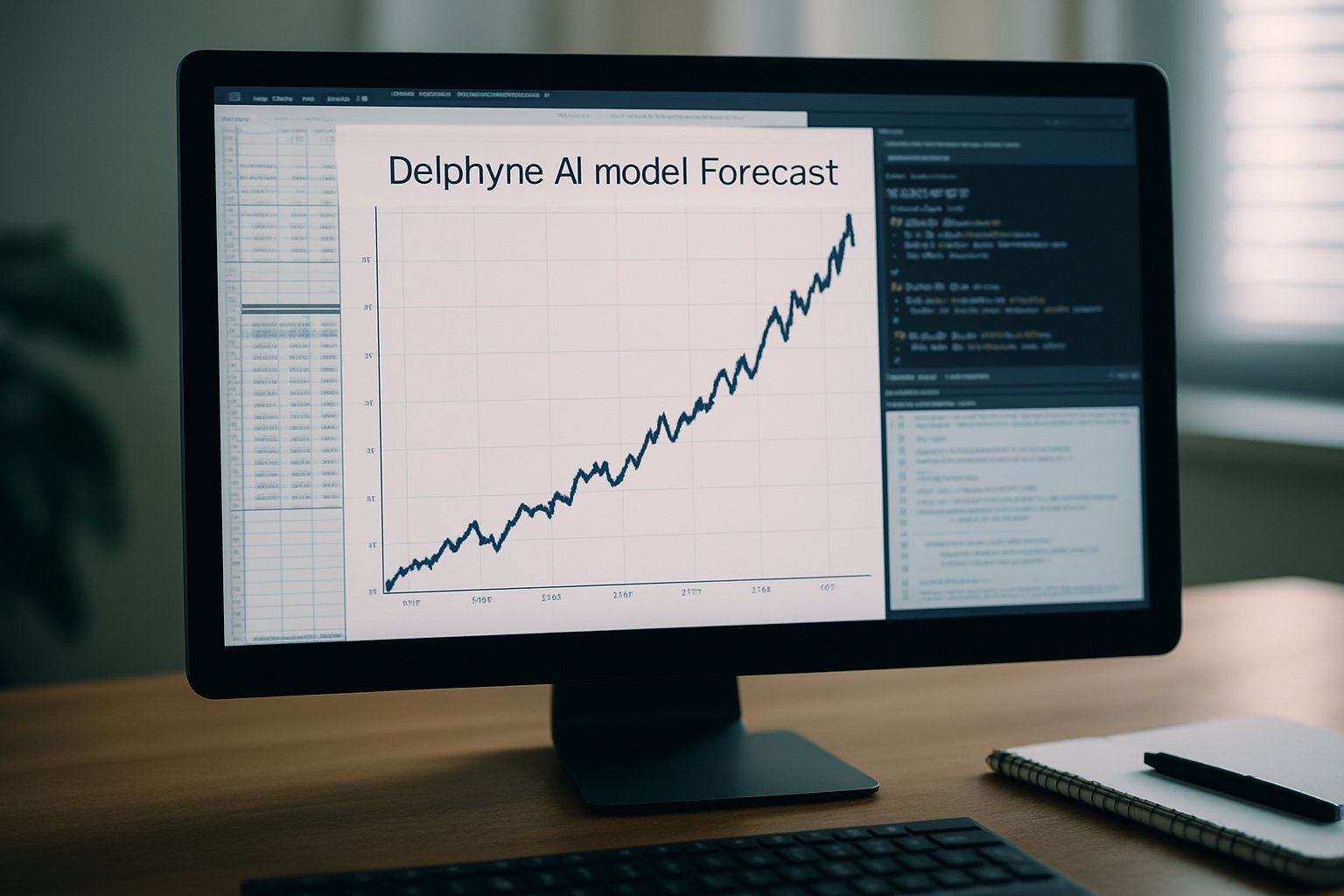
Finance Data Pain Points
Financial series rarely behave like stable physical signals. Intraday feeds present missing ticks, holiday closures, and bursts of volatility. Moreover, multivariate feeds grow quickly, challenging classic univariate forecasting tools. Consequently, quants often juggle many bespoke models for volume, risk, and revenue guidance. These pain points motivated researchers to craft the Delphyne AI model for cross-frequency robustness.
Finance complexity demands adaptable architectures and realistic distributions. Subsequently, the next section traces Delphyne’s transformer lineage.
Transformer Roots Fully Explained
Transformers revolutionised language by capturing long-range context with attention. Similarly, the Delphyne AI model adopts an encoder stack with any-variate attention. Any-variate attention flattens variables yet preserves channel identity through bias tokens. Furthermore, the model applies a distinct mask for missing data, improving cross-frequency consistency. Probabilistic heads output Student-T mixtures, acknowledging heavy tails common in finance.
These innovations translate the language transformer recipe to numeric signals. However, architecture alone cannot guarantee superior performance; evidence lies in benchmarks ahead.
Architecture Tailored For Markets
Design choices align closely with practitioner workflows. LOTSA supplies 231 billion public observations, while Bloomberg adds diverse proprietary streams. Authors sampled 85 percent public data and 15 percent finance records to balance generalization. Meanwhile, pretraining lasted one million iterations on eight H100 GPUs for four days. Mixed precision kept memory manageable, yet the compute budget still challenges smaller Quant teams.
Negative transfer emerged when domains mixed excessively, lowering zero-shot accuracy until fine-tuning resumed. The Delphyne AI model demonstrates this balance by outperforming finance-only baselines after adaptation. Consequently, fine-tuning remains non-negotiable for sensitive forecasting tasks. The upcoming section reviews comparative metrics across standard tasks.
Performance Versus Competing Models
Benchmarks cover returns, volume, and corporate revenue. Moreover, experiments pit Delphyne variants against MOIRAI, PatchTST, and classical econometric models.
- Stock returns NLL: 1.741 after fine-tuning, beating MOIRAI zero-shot 1.750.
- Next-day variance MSE: 37.59 versus MOIRAI 41.43.
- Intraday volume MSE drops from 0.728 to 0.551 post fine-tuning.
- Revenue nowcasting MAE: 0.071, surpassing baseline 0.100.
Additionally, aggregated Monash numbers show consistent advantage after targeted training. Therefore, the Delphyne AI model excels where statistical baselines struggle with high-frequency noise. Yet, zero-shot gaps remind teams about negative transfer costs.
Empirical wins validate architectural hypotheses and data strategy. Nevertheless, execution cost and reproducibility still matter for deployment, as next section details.
Practical Deployment Trade Offs
Running eight H100 cards for four days is expensive outside large institutions. In contrast, fine-tuning needs fewer steps, but still depends on private Bloomberg data. Compute, licensing, and compliance teams must collaborate before production rollouts. Furthermore, the proprietary pretraining split complicates peer review and external audits.
Professionals can enhance their expertise with the AI Marketing Strategist™ certification. This credential covers ethical AI deployment, governance, and measurement, complementing Quant skill sets. Consequently, trained staff can justify Delphyne integration with clearer ROI arguments. Budget holders always ask why the Delphyne AI model warrants additional GPU reservations.
Deployment success intertwines hardware budgets, governance, and talent. Subsequently, we explore future research and open access prospects.
Future Research And Access
Authors promise code releases yet have not shared checkpoints publicly. Meanwhile, proprietary finance datasets remain gated to protect client confidentiality. Community interest could pressure a limited open-source drop of the general weights only. Moreover, lighter student models distilled from the Delphyne AI model may democratise experimentation.
Researchers also plan to explore reinforcement learning objectives for trading policy simulation. Consequently, iterative releases might ease reproducibility concerns over time.
Access decisions will shape impact and industry trust. Therefore, quants need clear timelines, addressed in the final section.
Key Takeaways For Quants
Delphyne showcases that broad pretraining plus focused fine-tuning boosts difficult forecasting tasks. However, negative transfer limits zero-shot utility, reinforcing the value of domain expertise. Moreover, cost and data licensing remain critical, despite headline performance. Successful adoption demands interdisciplinary collaboration across research, engineering, and risk teams. Ultimately, the Delphyne AI model offers a compelling template for next-generation financial transformers.
These insights prepare leaders for implementation conversations. Subsequently, the conclusion summarises actionable steps.
In summary, the study proves targeted design can unlock foundation value for volatile markets. Fine-tuned Student-T outputs, any-variate attention, and balanced corpora drive measurable gains over rival models. Nevertheless, heavy compute and limited data release call for prudent planning. Therefore, quants should audit resource needs, pursue upskilling, and track forthcoming code announcements. The Delphyne AI model stands ready for teams willing to invest in disciplined experimentation. Explore certification pathways, validate internal benchmarks, and join the conversation shaping responsible financial AI.
Disclaimer: Some content may be AI-generated or assisted and is provided ‘as is’ for informational purposes only, without warranties of accuracy or completeness, and does not imply endorsement or affiliation.


