

AI CERTS
5 hours ago
AI Job Enhancement Boosts Productivity in Advanced Economies
Moreover, international institutions estimate that roughly sixty percent of roles face some AI exposure in wealthy countries. Workers in augmented positions report shorter task cycles, faster onboarding, and fewer repetitive chores. Meanwhile, firms observe revenue per employee climbing three-fold in heavily exposed sectors. Nevertheless, leaders also confront widening inequality, fragile entry pathways, and mounting regulatory pressure. Therefore, the following analysis synthesizes fresh evidence on productivity, wages, skills, and labor dynamics. It offers a practical playbook for organizations navigating AI-powered transformation.
Productivity Gains Accelerate Rapidly
PwC’s 2025 Global AI Jobs Barometer recorded a fourfold jump in sector productivity where generative tools dominate. Consequently, revenue per employee now grows three times faster in AI-exposed industries than elsewhere.
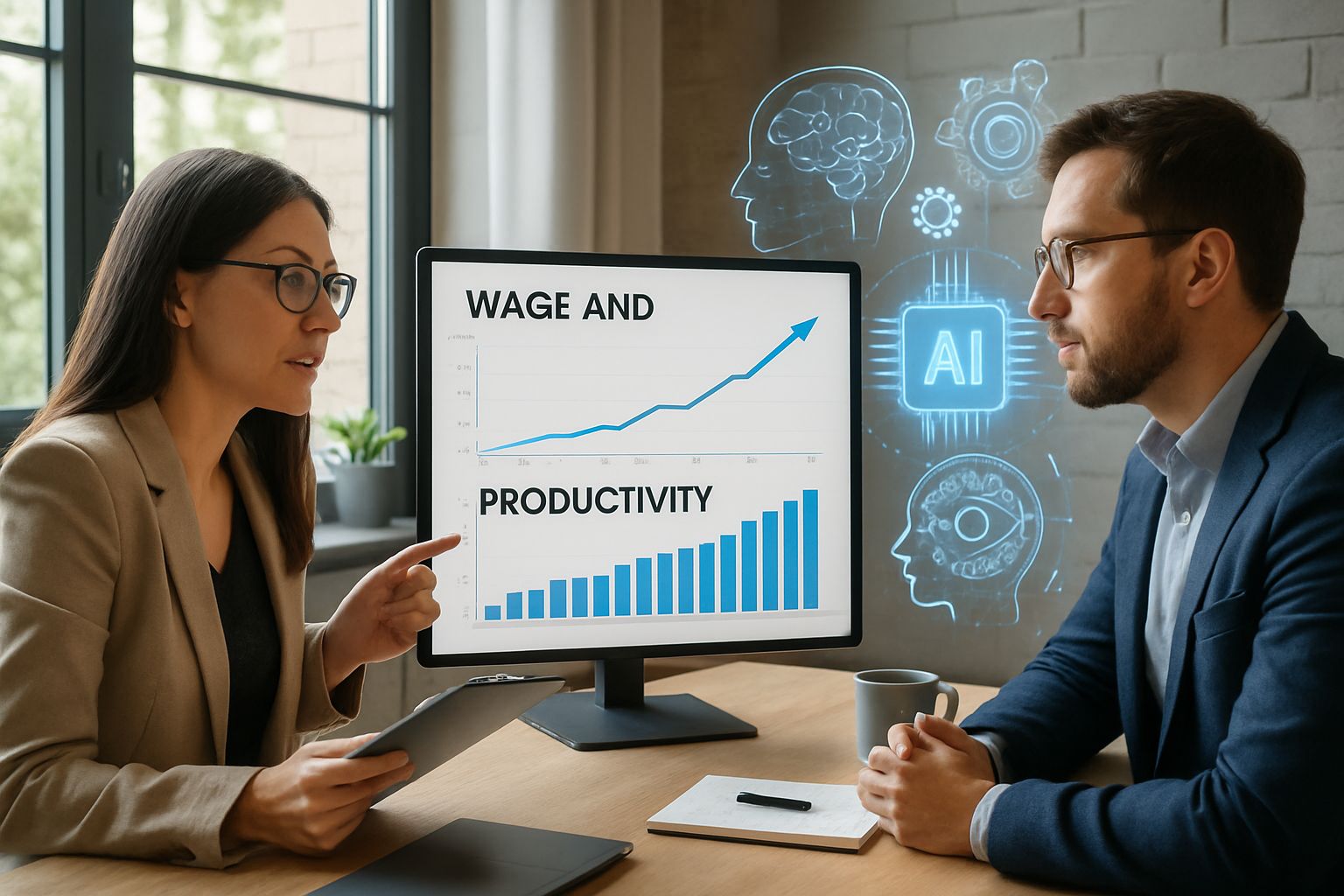
McKinsey’s latest modeling suggests agentic systems could unlock 4.4 trillion dollars in annual value. However, that upside depends on thoughtful workflow redesign and decisive AI job enhancement strategies.
Microsoft’s internal Copilot pilots found employees completed drafting tasks 55% faster, although independent reviewers urge caution. Nevertheless, the trend line across multiple audits points toward sustained productivity acceleration.
Therefore, comprehensive AI job enhancement plans prove pivotal for enduring efficiency.
Productivity is rising wherever human and machine collaborate effectively. Nevertheless, wage dynamics deserve equal scrutiny before firms declare victory.
Wage Premiums Expand Quickly
PwC identified a 56% average wage premium for AI-skilled professionals during 2024. Moreover, job postings requiring prompt engineering or agent oversight grew at double-digit monthly rates.
Such rewards stem from AI job enhancement that shifts workers from routine production toward higher-value judgment tasks.
Consequently, HR leaders in technology, finance, and healthcare now struggle to secure scarce AI supervision talent. Labor economists warn that bidding wars could deepen inequality if training pipelines lag.
Meanwhile, entry-level candidates see fewer apprenticeship roles as automation tackles basic drafting. Therefore, early career wage growth remains uncertain.
High premiums highlight market confidence in advanced capabilities. However, widening gaps underscore the urgent need to close the skills divide.
Skills Gap Widens Fast
OECD surveying of 5,000 SMEs shows managers desperate for data literacy, model governance, and prompt design know-how. Additionally, 70% reported delaying deployments because teams lacked relevant skills.
Progressive employers anchor training budgets around AI job enhancement, blending technical modules with domain mentoring.
World Economic Forum forecasts list analytical thinking, creativity, and system evaluation as fastest-growing competencies. In contrast, clerical activities continue their steady decline.
Consequently, workforce planners must map task exposure and design laddered learning journeys. Such models pair foundational digital skills with specialist credentials like the AI Legal™ certification.
Closing the skills gap sustains inclusive productivity growth. Next, attention turns to unfolding regulatory obligations.
Policy Responses Take Shape
The EU AI Act now bans unacceptable systems and labels many HR tools as high risk. Moreover, staged obligations will demand human oversight, bias testing, and detailed documentation.
California, New York, and other states pursue parallel rules, creating fragmented compliance burdens. Nevertheless, early conformity promises reputational advantages.
Government grants also encourage AI job enhancement aligned with worker protection. For example, Germany offers tax credits for certified training completed during working hours.
IMF leaders urge portable learning accounts and stronger safety nets to counter potential labor shocks. Therefore, collaboration between firms and policymakers remains vital.
Regulation sets guardrails for trustworthy deployment. Subsequently, attention shifts to smaller enterprises adopting generative tools at speed.
SMEs Adopt Generative AI
OECD data reveal 37% of surveyed SMEs already deploy chatbots or code assistants. Furthermore, 59% use generative design for marketing collateral.
Resource-constrained teams praise AI job enhancement for offsetting talent shortages and improving customer response times.
- Average productivity gain: 23% within six months
- Cost saving on labor: 18% annualized
- Upskilling uptake: 42% of employees enrolled
Nevertheless, cash flow limitations hinder sustained investment in advanced infrastructure. Consequently, public cloud credits and simplified compliance toolkits are essential.
Small firms gain agility through early adoption. Yet, they remain vulnerable to volatile compute pricing and evolving workforce expectations.
Future Workforce Scenarios Emerging
McKinsey’s midpoint scenario suggests 30% of present work hours may automate by 2030. In contrast, proactive augmentation could lift productivity without steep job losses.
Success hinges on deliberate AI job enhancement, robust social policies, and relentless upskilling.
Kristalina Georgieva warns that inequality will surge if the wage premium accrues only to elite specialists. Meanwhile, Geoffrey Hinton fears a jobless boom absent swift redistribution.
Therefore, executives should map exposure, retrain proactively, and measure labor outcomes using transparent metrics. Such discipline builds trust across the workforce.
Divergent scenarios illustrate both risk and promise. Companies that lead on skills and governance will capture sustainable advantage.
Generative and agentic systems have shifted the centre of gravity in advanced economies. Moreover, evidence shows AI job enhancement raises productivity, boosts wages, and stimulates new roles when paired with reskilling. Nevertheless, unequal gains and regulatory complexity demand vigilance. Organizations should integrate AI job enhancement into strategic planning. They must invest in continuous skills programs and monitor labor outcomes using transparent metrics. By doing so, leaders protect their workforce, meet compliance standards, and unlock sustained value. Ready to act? Explore credentials such as the AI Legal™ certification to deepen governance expertise and accelerate responsible deployment.


