

AI CERTS
3 months ago
Nvidia Groq licensing deal reshapes inference market
Groq insists the license remains non-exclusive and that GroqCloud will continue operating. Nevertheless, Ross, Madra, and key engineers are joining Nvidia. Consequently, many observers view the move as a talent acqui-hire wrapped in intellectual-property paperwork. In contrast, Nvidia frames the partnership as a fast path to lower inference latency across its platform. Overall, the agreement signals that the real battle for AI dominance now centers on deployment speed, not just model size.
Deal Overview And Impact
Groq’s press release highlights a simple structure: non-exclusive rights, staff transfers, and continued independence. Meanwhile, Nvidia gains immediate access to Groq’s deterministic compiler flow and low-latency architecture. Reuters noted that financial terms remain undisclosed, yet the media fixation on the $20 billion figure persists. Additionally, investors remember Groq’s September $750 million raise, which set expectations far below the rumored price. Therefore, many question whether the payment involves milestone-based royalties rather than a lump sum.
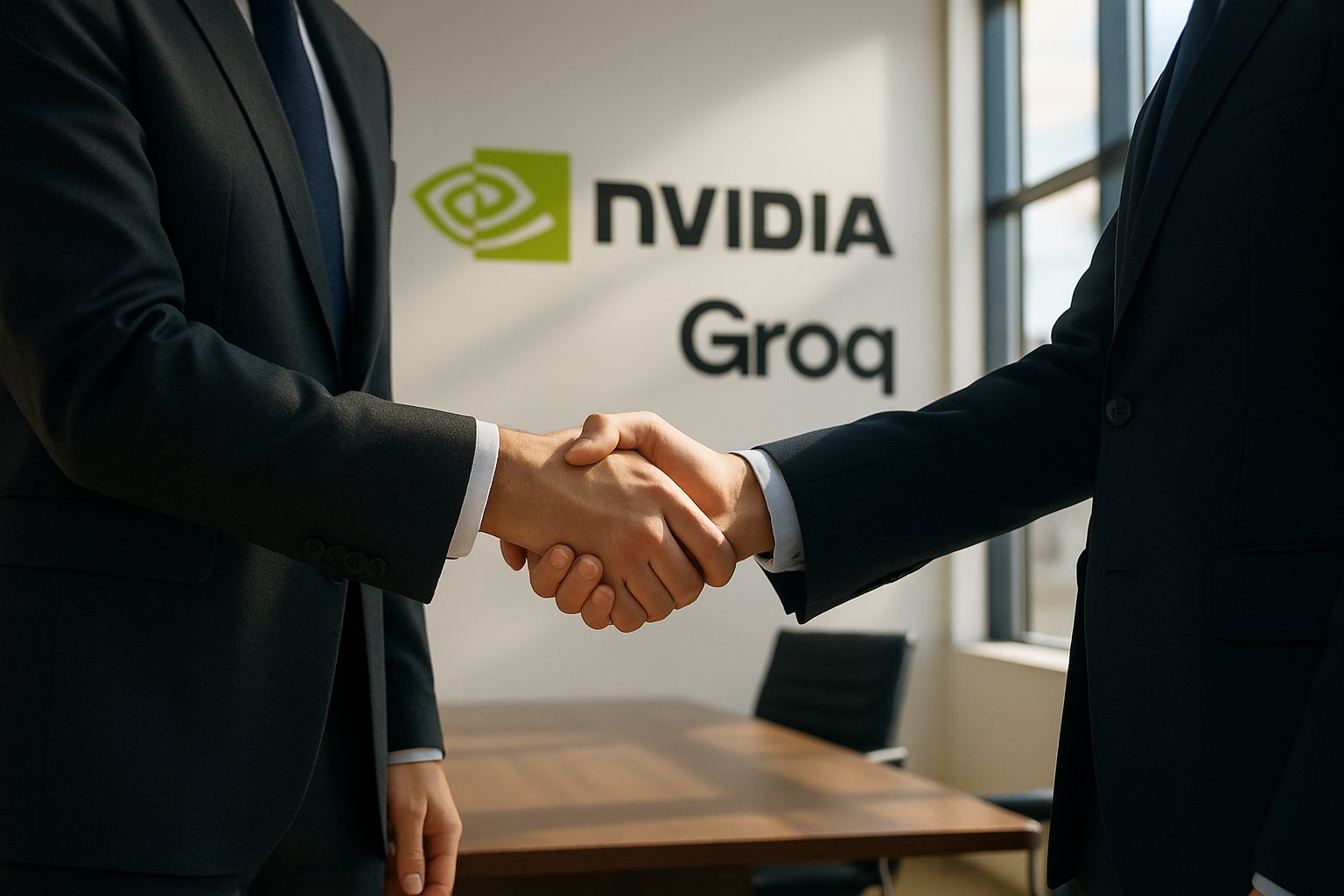
Market chatter also focuses on strategy. LPUs have shown impressive performance in conversational workloads, especially where predictable response times matter. Consequently, integrating Groq silicon could broaden Nvidia’s inference portfolio beyond GPUs. These dynamics explain the urgency behind the Nvidia Groq licensing decision.
The license immediately shifts competitive narratives. However, it also preserves a nominal competitor, which might appease regulators. These points summarize the deal’s initial shockwaves. Consequently, attention now turns to Groq’s technology itself.
Technology Behind LPUs
Groq’s LPUs depart from traditional GPU design. Instead of off-chip HBM, the devices store model weights in on-chip SRAM. Therefore, memory bandwidth reaches roughly 80 TB/s, far above typical GPU figures near 8 TB/s. Moreover, deterministic execution eliminates memory stalls, delivering consistent token times. Such low-latency behavior appeals to real-time conversational AI, recommendation ranking, and edge robotics.
Furthermore, the compiler maps entire graphs before execution, ensuring predictable scheduling. This approach contrasts with the dynamic kernels used on general-purpose chips. Consequently, software teams must adopt new toolchains to exploit these benefits. Nevertheless, Groq claims minimal code changes for popular transformer models.
Engineers praise the direct chip-to-chip links that let multiple LPUs act as one logical processor. Additionally, energy efficiency improves because on-chip SRAM reduces external memory accesses. These features explain why the Nvidia Groq licensing plan excites system architects.
In summary, Groq offers a specialized, compiler-centric path to speed. However, market forces, not benchmarks, will determine ultimate adoption. The next section examines why timing favors this hardware.
Strategic Market Drivers
Inference demand now outpaces training spend for many cloud providers. Moreover, MarketsandMarkets expects the inference segment to reach $255 billion by 2030. Consequently, Nvidia seeks products optimized for serving millions of queries per second. Groq’s low-latency profile directly aligns with that objective.
- Global AI inference TAM: $255 billion by 2030
- Groq post-money valuation: $6.9 billion (Sep 2025)
- Reported license value: ≈$20 billion (CNBC)
- On-chip bandwidth: 80 TB/s vs 8 TB/s for HBM GPUs
Additionally, supply constraints for high-bandwidth memory make alternative memory architectures attractive. Meanwhile, enterprises demand predictable service-level agreements, pushing vendors toward deterministic accelerator designs. Therefore, the Nvidia Groq licensing deal positions Nvidia to answer both supply and performance pressures.
These drivers underscore commercial urgency. Nevertheless, regulatory scrutiny could slow momentum, as the following section details.
Regulatory And Valuation Debate
Bernstein analyst Stacy Rasgon warns that removing a nimble rival through licensing may trigger antitrust concerns. Moreover, talent migration effectively weakens Groq’s competitive stance despite claims of independence. Consequently, agencies could investigate whether the move hampers innovation within inference hardware. Nevertheless, structuring the transaction as non-exclusive gives Nvidia plausible deniability.
Valuation questions persist as well. In contrast to the rumored $20 billion, Groq’s recent funding suggests a far lower worth. Furthermore, payments may be phased, tied to adoption milestones, or even partly equity-based. Therefore, stakeholders expect further disclosures through regulatory filings.
In summary, legal and financial opacity clouds the agreement. However, integration challenges may prove just as formidable.
Integration Challenges Ahead
Technically, merging compiler-driven LPUs with CUDA-centric GPUs is non-trivial. Moreover, Nvidia must harmonize two distinct programming models without confusing developers. Consequently, new runtime abstractions or middleware may appear.
Production system design also changes. LPUs thrive on deterministic scheduling, while GPUs excel in parallel throughput. Therefore, orchestration layers must allocate workloads intelligently across diverse chips. Additionally, cooling and board layouts differ because LPU packages emphasize on-chip SRAM rather than external HBM stacks.
Integration risks include software fragmentation and delayed product launches. Nevertheless, Nvidia’s vast ecosystem offers resources to overcome these hurdles. Two brief points summarize the challenge landscape. Firstly, aligning toolchains demands significant engineering. Secondly, product marketers must guide customers through architectural choices. Consequently, professional education becomes crucial.
Opportunities For Professionals
Engineers and architects can capitalize on the changing landscape. Furthermore, deterministic inference skills will command premiums as enterprises demand lower latency. Professionals can enhance their expertise with the AI Developer™ certification.
Additionally, product managers need fluency in mixed-accelerator roadmaps. Therefore, understanding LPUs, memory hierarchies, and energy profiles will boost career prospects. Meanwhile, regulatory specialists may find new consulting revenue as antitrust reviews unfold.
Overall, the Nvidia Groq licensing deal expands opportunity spaces across design, optimization, and compliance. However, foresight remains essential, as the market will evolve rapidly.
Future Outlook Summary
Industry observers expect early silicon integrations by late 2026. Moreover, Nvidia may unveil combined systems during its GTC keynote. Consequently, rival vendors like AMD and Cerebras must showcase competing low-latency offerings.
Groq, still independent, plans to grow GroqCloud and license LPUs elsewhere. Nevertheless, talent loss could slow roadmap execution. Therefore, analysts will monitor customer adoption to judge Groq’s ongoing viability.
To conclude, Nvidia Groq licensing redefines inference competition. Low-latency architectures, diverse chips, and specialized hardware now dominate strategic roadmaps. Consequently, professionals who master these trends will shape the next wave of AI infrastructure.
The agreement marks both an ending and a beginning. Nevertheless, informed stakeholders can navigate uncertainty by deepening technical skills and tracking regulatory signals.
Looking ahead, seize emerging roles, study evolving toolchains, and stay alert for product announcements. Together, these steps position you to thrive in the post-licensing era of accelerated inference.


