

AI CERTS
4 months ago
AI Automotive Spotlight: Xiaomi SU7’s Europe Track To 2027
This article explores the company’s launch timeline, technical milestones, production realities, and strategic hurdles before full commercial rollout. Moreover, it analyses what the case means for broader AI Automotive adoption across Europe’s premium performance segment. Later sections will highlight the Nürburgring record, expanding factories, and the January recall that still shadows customer trust. Additionally, we will outline talent recruitment in Munich and export partnerships that point toward a 2027 sales start. By reading on, executives can gauge risks, opportunities, and certification pathways relevant to the next wave of smart mobility.
Global Launch Momentum Snapshot
Xiaomi entered the crowded EV arena in March 2024 with the SU7 sedan. Furthermore, pricing started around 215,900 yuan, undercutting rivals such as Tesla Model 3 and Nio ET5. Orders surged, producing 139,000 domestic registrations during 2024, according to China EV DataTracker. Therefore, analysts call the model a watershed for AI Automotive affordability.
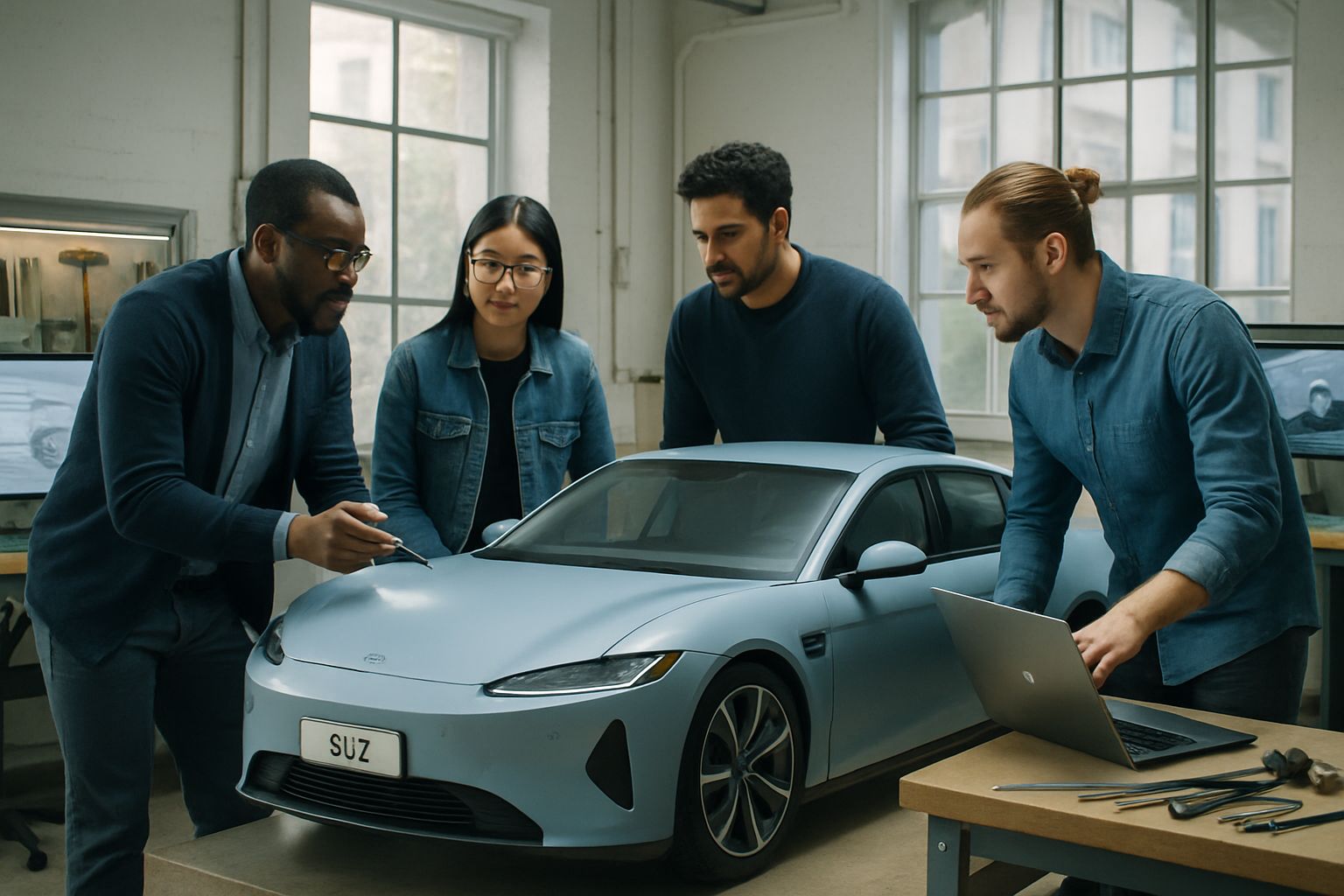
February 2025 brought the tri-motor SU7 Ultra. Moreover, Xiaomi recorded 10,000 orders within two hours and exceeded 15,000 by day’s end. Deliveries started in early March, reinforcing demand signals despite looming capacity constraints.
Consequently, Lei Jun labeled the vehicle a halo product that makes luxury speed accessible. Meanwhile, analysts noted that aggressive pricing rests on scale economies the company has yet to achieve. These early victories show momentum. However, real success depends on sustained production and global validation. The next section traces European milestones.
Key European Entry Milestones
Europe remains central to Xiaomi’s international growth narrative. In March 2025, the company shipped an SU7 Ultra to Barcelona’s MWC for its first overseas showcase. Subsequently, executives conducted road tests around Munich under experimental German registration plates.
Furthermore, Reuters reported Xiaomi hiring former BMW engineers for a Munich research hub. The team will localize chassis tuning, telematics, and driver-assistance software for strict European regulations. Consequently, observers see groundwork for 2027 commercial sales rather than an imminent launch.
Nevertheless, important hurdles persist. The company has not yet filed complete EU type-approval documentation, and service network plans remain vague. Analysts warn that recalls or data-security concerns could delay homologation. Europe milestones thus show promise yet underline unfinished preparation. Performance metrics offer additional insight.
Performance And Technology Highlights
The SU7 Ultra’s Nürburgring lap time of 7:04.957 shocked many performance purists. Moreover, the run beat Rimac Nevera’s production EV benchmark by over three-tenths of a second. Independent video evidence exists, yet timing verification from track officials remains pending.
Technically, the car rides on its Modena platform with a CATL Qilin 2.0 battery pack. Additionally, tri-motor architecture provides roughly 1,100 kilowatts and enables torque vectoring during fast corner exits. Such specifications position the sedan near hypercar territory while preserving four-seat practicality.
- 7:04.957 Nürburgring lap sets fastest production sedan EV time, June 2025.
- 10,000 SU7 Ultra orders logged within two hours of February 2025 launch.
- 31,000 SU7 units recalled January 2025 for parking software fix.
- 300,000 vehicle delivery target announced for full 2025 production year.
Further integration with the maker’s smartphone ecosystem differentiates the user experience. Therefore, cabin interfaces mirror MIUI aesthetics, and over-the-air updates push new driver-assistance functions regularly. These technology highlights reinforce AI Automotive leadership ambitions. Europe will judge results beyond lap times. However, impressive performance alone will not guarantee market share in Europe. Production capacity challenges come next.
Production Capacity And Risks
Xiaomi plans to deliver 300,000 units in 2025, yet factory phase-two expansion is ongoing. Moreover, early buyers already face waiting periods exceeding seven months, according to dealership forums. Consequently, analysts fear order backlogs could erode excitement if not addressed quickly.
The January 2025 recall of 31,000 SU7 units amplified those concerns. In contrast, the automaker responded swiftly with an over-the-air software patch that restored parking-assist reliability. Nevertheless, European regulators will scrutinize recall procedures when assessing long-term safety culture.
Production limits and quality glitches form tangible risks. However, strategic hiring may mitigate them. The following subsection details that recruitment.
Strategic European Talent Recruitment
Reuters confirmed that the firm lured engineers from BMW’s i4 and iX programs to its Munich lab. Additionally, the firm hired compliance specialists versed in European type-approval documents. These professionals will adapt suspension geometry, battery thermal maps, and cybersecurity protocols to EU norms.
Consequently, experts predict faster homologation once manufacturing volumes stabilize. Moreover, localized R&D can calm political worries about data sovereignty. Such recruitment supports the maker’s European ambitions. Yet AI Automotive implications stretch further.
Implications For AI Automotive
Every test lap and recall shapes public trust in AI Automotive systems. Furthermore, Xiaomi’s sensor-fusion software competes directly with Tesla’s Full Self-Driving and Mobileye’s REM. Consequently, successful European launches could validate deep-learning perception stacks for other Chinese manufacturers.
On the workforce side, demand for cross-domain project managers is climbing. Professionals can enhance credibility through the AI Project Manager™ certification. Such credentials bridge engineering, data, and regulatory skill gaps.
AI Automotive progress depends on trustworthy software and skilled leadership. The conclusion summarizes key insights and next moves.
Conclusion And Forward Outlook
Xiaomi’s SU7 family demonstrates how speed, connectivity, and pricing can disrupt premium EV incumbents. Moreover, European showings and record laps generate critical brand awareness ahead of 2027 retail targets. However, factory expansion, recall prevention, and homologation remain non-negotiable obstacles. Consequently, stakeholders should watch capacity build-outs and regulatory filings during 2025-2026. Meanwhile, professionals can future-proof careers by mastering AI Automotive project management fundamentals. Take the initiative and explore specialised certifications to drive the next generation of intelligent mobility projects.
Disclaimer: Some content may be AI-generated or assisted and is provided ‘as is’ for informational purposes only, without warranties of accuracy or completeness, and does not imply endorsement or affiliation.


