

AI CERTS
3 months ago
Space AI Insights: LandSpace’s Reusable Rocket IPO Push
Nevertheless, regulators applauded the progress and cleared the company’s IPO tutoring milestone. Momentum keeps building, and professionals want clear context. This article delivers that perspective.
Chinese Launch Scene Overview
China’s commercial spacefield has expanded quickly. Moreover, multiple startups pursue methane engines, stainless steel tanks, and reusable first stages. Analysts estimate launch services hit double-digit billion dollars worldwide. Meanwhile, Beijing views frontier launch capacity as strategic. Therefore, rules now encourage rapid domestic financing. Space AI tools map optimal trajectories, refurbish cycles, and supply chains for these ventures.
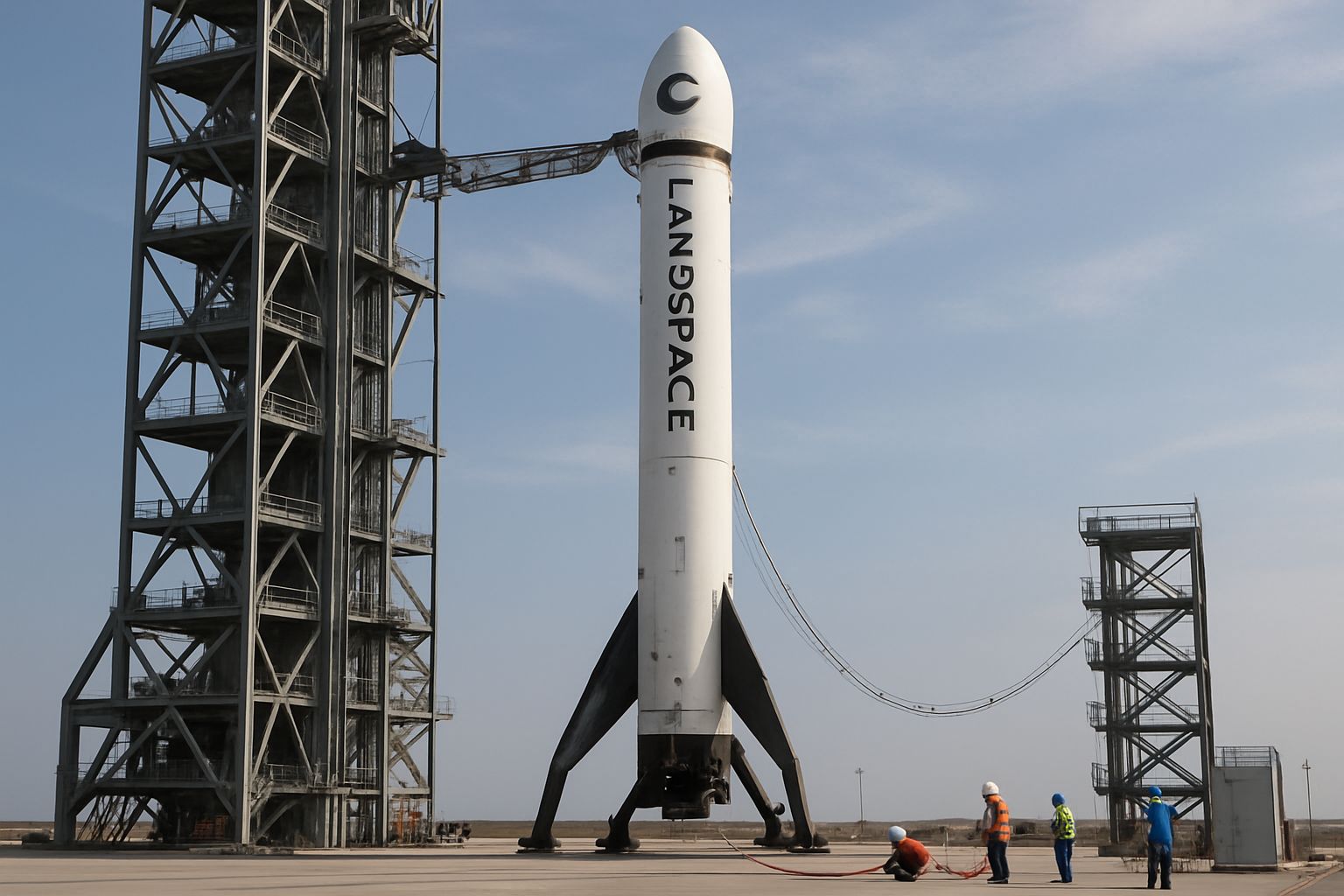
LandSpace stands among the most advanced private contenders. Competitors include iSpace, Space Pioneer, and Galactic Energy. In contrast, state giant CASC remains dominant for government payloads. However, private firms chase commercial constellations, imaging fleets, and rideshare contracts. These dynamics set the stage for LandSpace’s headline flight.
The domestic ecosystem presents clear benefits: integrated suppliers, policy support, and abundant engineering talent. Yet technical risk and capital intensity remain significant hurdles. These factors influence investor sentiment and regulatory responses.
China’s cluster growth signals robust competition. However, only reusable mastery can unlock sustained cost cuts. That reality shapes every boardroom discussion.
These market foundations explain LandSpace’s importance. Subsequently, the next section examines its IPO journey.
LandSpace IPO Progress Update
LandSpace completed mandatory IPO tutoring in late December. Consequently, the firm entered the “辅导验收” stage with Shanghai regulators. Media reports cite China International Capital Corp as lead adviser. Filing on the STAR Market is targeted for 2026. Moreover, recent rule changes create a “fast lane” for reusable launch firms. The board now waives some profitability thresholds if technical milestones are met.
Executives argue that Zhuque-3 development demands fresh capital quickly. Therefore, an IPO enables engine production lines, booster refurbishment centers, and pad upgrades. Reuters places private valuation near RMB 20 billion. Nevertheless, audited figures will only appear within the prospectus.
Investors focus on transparency, burn rate, and cadence projections. Furthermore, many will benchmark Falcon 9 economics when modeling LandSpace cash flows. Here, Space AI forecasting models provide vital clarity by integrating mission data, refurbishment timelines, and market demand scenarios.
Progress toward listing signals regulatory confidence. However, investors will scrutinize the planned proceeds. Two more booster recovery attempts are expected before pricing the deal.
This capital narrative links closely with technical milestones. The following section reviews the recent flight.
Zhuque-3 Flight Test Lessons
The Zhuque-3 maiden flight lifted off 3 December 2025. Upper stage insertion succeeded, placing a dummy payload in low Earth orbit. However, the first stage suffered anomalous combustion during the landing burn. Investigators target engine reignition parameters and propellant conditioning.
Despite the loss, the mission validated key systems: stainless structural integrity, thermal shielding, grid-fins, and guidance algorithms. LandSpace engineers highlight attitude control stability during entry. Moreover, telemetry confirmed propellant residuals sufficient for landing, supporting the engine fault diagnosis.
Technical specifications intrigue observers. Zhuque-3 stands roughly 70 meters tall and uses nine methalox engines on its reusable booster. Payload capacity reaches 21 tonnes in expendable mode. Meanwhile, downrange recovery subtracts nearly 3 tonnes. These numbers echo Falcon 9 Block 5 benchmarks, although costs remain undisclosed.
Lessons from SpaceX shape LandSpace’s roadmap. Chief designer Dai Zheng cites a “rapid iteration” philosophy. Consequently, multiple hardware blocks will fly before mass production stabilizes. Space AI algorithms accelerate design loops by predicting failure modes and optimizing material selections.
The flight’s partial success boosts regulatory and investor confidence. Nevertheless, reliable booster recovery remains critical. The next section explores policy levers supporting that goal.
Policy Fast Lane Effects
Shanghai’s STAR Market introduced tailored listing rules in December. Additionally, the exchange relaxed revenue and profit thresholds for launch firms that prove reusable capabilities. Consequently, LandSpace qualifies after its orbital test.
Regulators perceive strategic value in domestic launch autonomy. Moreover, they aim to match the private capital flow fueling SpaceX. Faster IPO access gives startups funds for engine testing, composite research, and refurbishment infrastructure. Meanwhile, oversight tightens on governance and disclosure.
Industry analysts applaud the balance. In contrast, skeptics warn of technology risk being transferred to retail investors. However, strict milestone gating attempts to mitigate that exposure.
Beyond equity markets, policy backing includes tax rebates and streamlined export licensing. These incentives reduce production costs and encourage supply chain localization. Space AI platforms help agencies monitor compliance and performance metrics in real time.
The policy toolkit lowers financial barriers. Subsequently, commercial outlooks warrant deeper evaluation.
Commercial Outlook And Risks
Demand drivers look promising. Satellite broadband, earth observation, and data-relay networks require frequent launches. Moreover, Chinese constellation projects need domestic providers due to geopolitical constraints. LandSpace could capture a sizable share if costs approach global best practice.
However, several risks persist:
- Technical: Booster recovery timeline extends beyond projections.
- Capital: High cash burn before full reuse maturity.
- Market: Oversupply if multiple startups scale simultaneously.
- Regulatory: Export controls limiting foreign payload growth.
- Competition: CASC price cuts and new private entrants.
Furthermore, insurance premiums for unproven reusable stages remain elevated. Consequently, early commercial customers may demand discounts. Space AI enabled pricing models can factor risk levels and market elasticity to safeguard margins.
Professionals can enhance strategic insight through the AI Policy Maker™ certification. Coursework covers frontier technology governance, capital markets, and ethical deployment.
Balanced consideration of upside and downside clarifies investment theses. Accordingly, the next section synthesizes key points and guides further action.
Key Takeaways And CTA
LandSpace’s trajectory illustrates China’s ambition to close the reusability gap. Technical progress, supportive regulation, and looming IPO converge to create opportunity. Moreover, Space AI expertise underpins design optimization, market forecasting, and operational scaling. Nevertheless, execution risk remains substantial until booster recovery succeeds repeatedly.
Sector professionals should monitor forthcoming flight tests, the draft prospectus, and competitive launch pricing. Additionally, policy watchers must assess how the STAR fast lane influences capital allocation across deep-tech sectors.
Advancing personal knowledge is equally crucial. Therefore, consider the AI Policy Maker™ program to master governance frameworks shaping space innovation. Equip yourself to lead in this evolving market.


