

AI CERTS
3 months ago
Evolving LLM Market: Anthropic Leads 2025 Enterprise Share
Moreover, projected enterprise LLM API spend hit $8.4 billion, more than doubling within six months. These figures sparked headlines, investor discussions, and strategic debates across the market. Nevertheless, Menlo invests in Anthropic, raising questions about bias and sample breadth. This article dissects the numbers, examines methodology, and outlines practical steps for technology leaders navigating the shifting landscape.
Enterprise Usage Snapshot Data
Menlo’s survey offers the clearest quantitative window into mid-2025 enterprise adoption patterns. According to its charts, Claude models powered 32% of production workloads among respondents. Meanwhile, OpenAI secured 25%, and Google’s Gemini family reached 20%. In contrast, Meta’s Llama captured 9%, while DeepSeek barely registered at 1%. Therefore, closed-source models controlled 87% of observed enterprise usage, eclipsing open-source deployments.
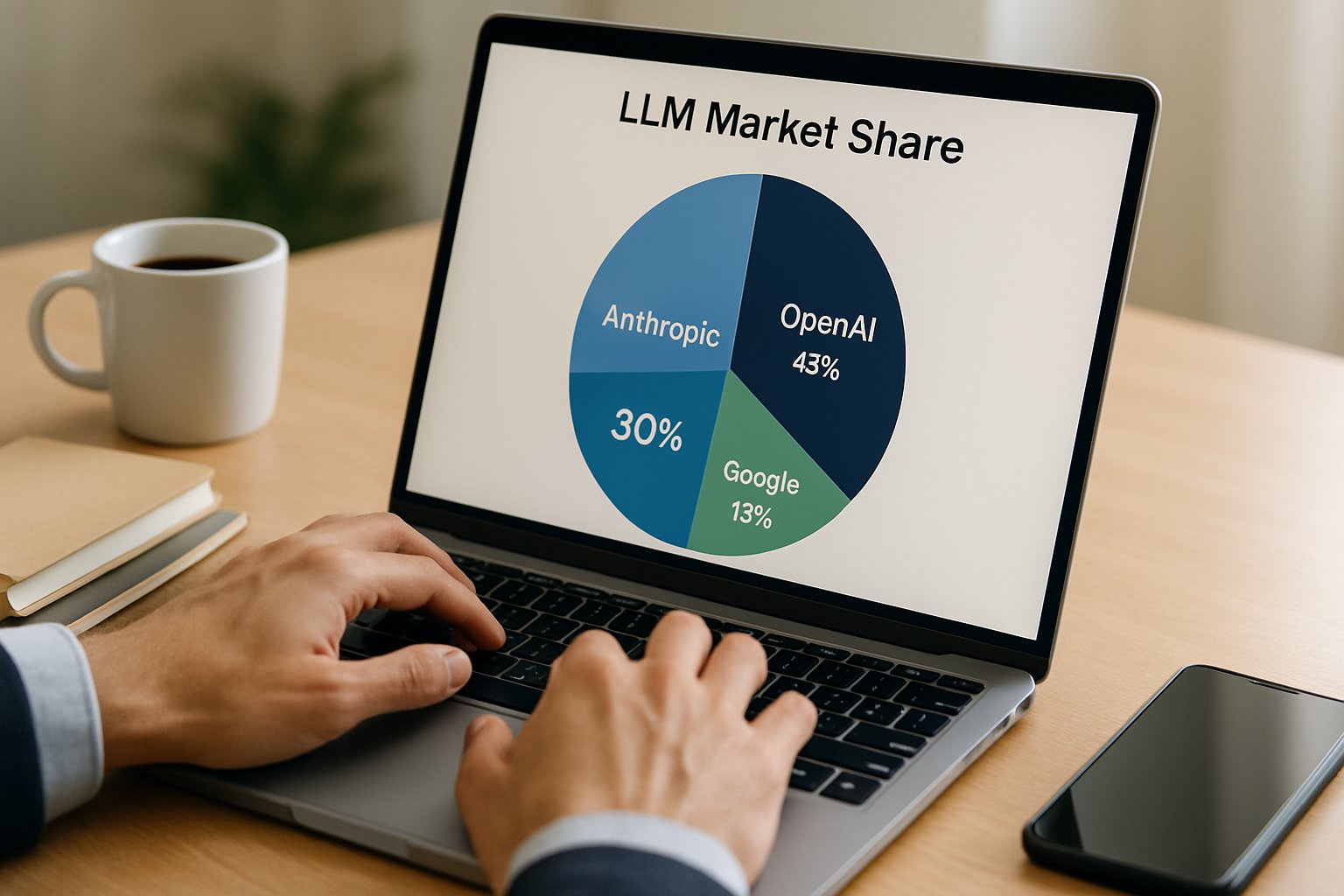
- Claude: 32% share
- OpenAI GPT: 25% share
- Google Gemini: 20%
- Meta Llama: 9%
- DeepSeek: 1%
These statistics reveal a notable shift in provider preference. Consequently, the LLM Market hierarchy is no longer fixed. Next, we unpack the broader signals driving this momentum.
Menlo Report Key Highlights
Beyond raw percentages, Menlo spotlighted rapid budget acceleration toward inference workloads. Furthermore, enterprise LLM API spend jumped from $3.5 billion to $8.4 billion within two quarters. Menlo attributes the curve to recent Claude releases Sonnet 3.5 and 3.7, which improved code generation accuracy. Consequently, developer teams reported 42% adoption of Claude for coding, double OpenAI’s footprint. The report also notes only 11% of groups switched vendors, suggesting sticky platform dynamics.
Moreover, closed models appear to win procurement battles because compliance teams favor vendor-managed security. Analysts agree the broader market remains highly dynamic. Menlo partner Tim Tully stated that production performance now outranks brand recognition. Therefore, the LLM Market could reward iterative quality gains over first-mover hype.
Menlo links spending surge to tangible model improvements. Nevertheless, its investor status warrants deeper scrutiny. We examine those methodological questions in the following section.
Methodology And Caveats Explained
Sample size and respondent profile shape any survey’s authority. Menlo questioned 150 technical leaders between June 30 and July 10, 2025. Additionally, responses were weighted by application scale, a process not fully disclosed. In contrast, Gartner reports often involve thousands of enterprises across geographies. Menlo also discloses financial ties to Anthropic, underscoring potential confirmation bias. Consequently, some analysts caution against treating the percentages as definitive LLM Market gospel. Independent telemetry from cloud providers or API billing records could validate or challenge the findings. Therefore, leaders should triangulate multiple data sources before shifting architecture decisions.
Methodological gaps leave reasonable uncertainty around exact provider positions. However, the directional insight still offers planning value. Competitive dynamics further clarify the stakes involved.
Competitive Landscape In Flux
Enterprise buyers evaluate performance, cost, and integration depth. Google tightly binds Gemini to Vertex AI and managed security services. Meanwhile, Anthropic collaborates with AWS, offering Claude through Bedrock for low-latency inference. OpenAI leans on Microsoft Azure exclusivity, which simplifies global compliance for regulated sectors. Meta promotes Llama as open weights, yet production support remains nascent. Consequently, the competitive map shifts with every model update cycle. Private valuations also mirror competitive market expectations. Yet Menlo’s figures suggest the LLM Market currently favors specialized performance gains over general availability.
Provider strategy alignment with enterprise needs drives adoption curves. Subsequently, spend patterns follow perceived capability leadership. The spending trajectory deserves its own inspection.
Enterprise Spend Growth Drivers
Inference cost now dominates budget discussions, surpassing earlier training outlays. Moreover, Menlo estimates inference spend will reach $15 billion by 2026 if current velocity holds. Developers increasingly embed API calls directly into production workflows, raising per-request volumes. Subsequently, pricing negotiations focus on token efficiency and reserved capacity tiers. Tiered Claude offerings encourage predictable consumption, reducing surprise invoices. In contrast, some open-source deployments appear cheaper initially but require heavy DevOps investment. Therefore, total cost of ownership increasingly shapes vendor selection within the model landscape.
Spending curves illustrate the financial stakes attached to model selection. Nevertheless, cost is only one leadership consideration. Decision makers must also weigh organizational impact.
Implications For Tech Leaders
CTOs face pressure to deliver immediate productivity gains while preserving architectural flexibility. Consequently, multi-model strategies are gaining popularity to avoid vendor lock-in. Teams pilot Anthropic for code, OpenAI for retrieval, and Gemini for multimodal prototypes. Additionally, robust governance frameworks help balance innovation with risk controls. Professionals can sharpen skills through the AI Cloud Architect™ certification. Moreover, aligning certification learning paths with strategy accelerates decision cycles. Therefore, wise leaders track LLM Market movements while investing in people and platforms.
Balanced talent, tooling, and oversight underpin sustainable AI rollouts. Subsequently, horizon scanning remains mandatory. The final section explores what lies ahead.
LLM Market Outlook 2026
Menlo predicts long-horizon agents will dominate enterprise roadmaps within eighteen months. Furthermore, additional report updates are scheduled for early 2026, offering clearer telemetry. Analyst houses such as Gartner plan parallel studies, which could affirm or revise current LLM Market rankings. Cloud alliances may also influence pricing, latency, and regional compliance regimes. In contrast, open-source communities will keep iterating, pushing proprietary vendors to innovate faster. Consequently, executives should expect quarterly shifts rather than annual resets. Nevertheless, the LLM Market thesis remains: performance and reliability convert trials into production usage. Therefore, ongoing benchmarking, contract flexibility, and skill development will stay critical.
Outlook scenarios underscore continuous uncertainty and opportunity. Meanwhile, proactive governance will separate leaders from laggards.
Enterprises stand at a pivotal decision point in their AI journeys. Menlo’s survey positions Claude ahead, yet sampling limitations temper absolute confidence. Furthermore, closed models continue to secure budgets as agentic use cases mature. Nevertheless, the LLM Market will keep evolving as more telemetry emerges. Therefore, technology leaders should diversify providers, benchmark relentlessly, and invest in certified talent. Explore advanced credentials today to strengthen readiness for the coming wave of enterprise AI adoption.


