

AI CERTS
3 months ago
What the ServiceNow federal discount means for agencies
It positions ServiceNow to handle more mission-critical workflows across civilian and defense domains. Consequently, procurement officers now study the offer’s fine print, benefits, and long-term trade-offs about lock-in and budgeting.
Inside OneGov Agreement
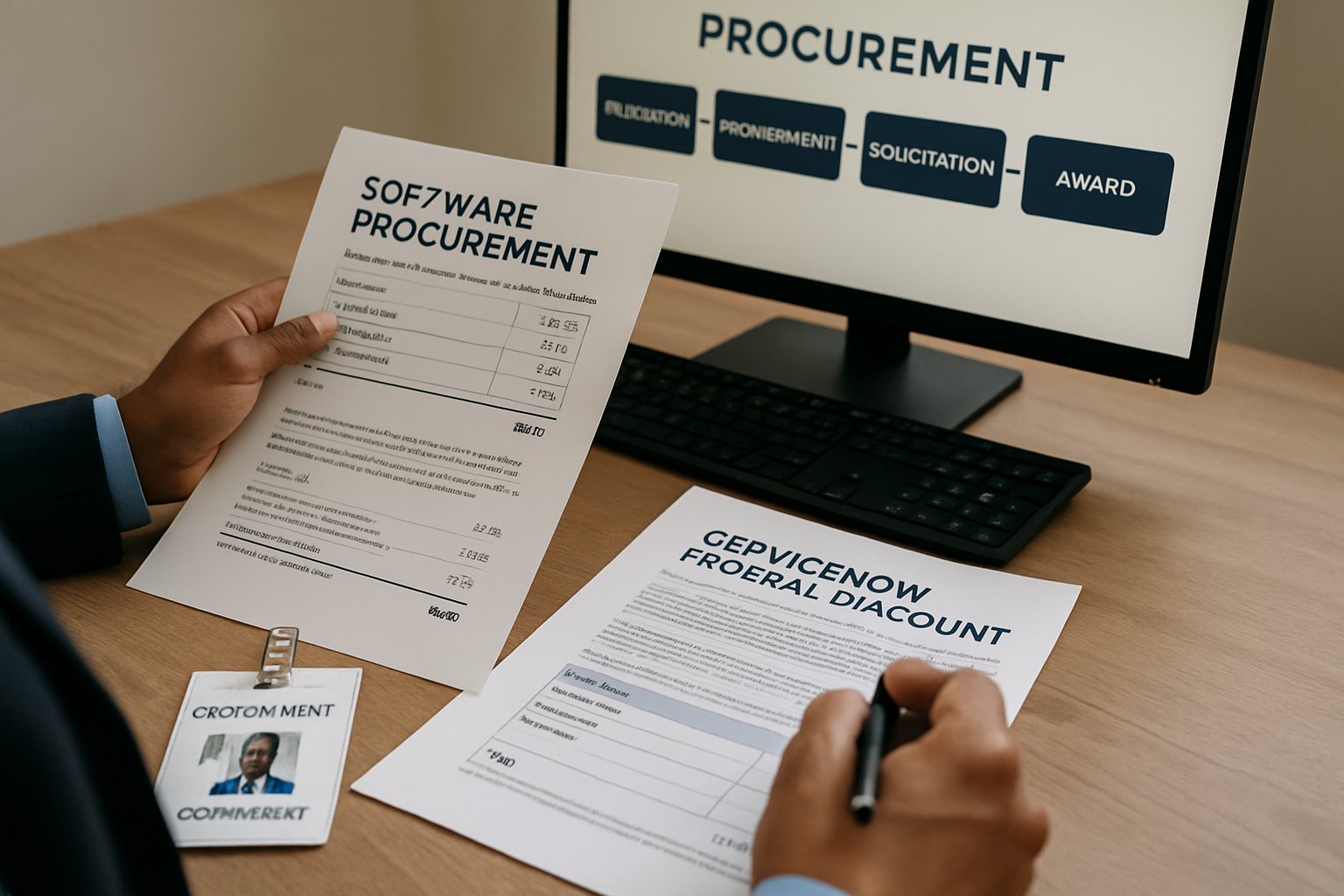
The OneGov contract aims to streamline acquisitions across more than 400 agencies. Moreover, it bundles ServiceNow ITSM Pro and Pro Plus into a single unrestricted-user license. This structure removes many administrative hurdles that previously slowed platform upgrades. GSA officials describe the vehicle as a government-wide "standard offer" that eliminates fragmented negotiations. Therefore, many procurement leaders label the ServiceNow federal discount of the decade.
Analyzing Deal Discount Structure
The headline figure is eye-catching. However, the up-to-70 percent cut applies only to the combined bundle. A separate 40 percent concession covers a standalone ITSM Pro upgrade until September 2026. Therefore, agencies must compare timelines carefully before selecting a path.
GSA published discount percentages yet withheld exact unit costs. Consequently, procurement teams still need the price matrix attached to the blanket purchase agreement. This gap complicates benchmarking against existing pricing baselines. In contrast, Google’s earlier Workspace deal included clear per-user numbers, easing comparative analysis. The ServiceNow federal discount also includes support services priced under the same ceiling.
- Up to 70% off ITSM Pro + Pro Plus bundle through September 2028
- 40% off standalone ITSM Pro until September 2026
- FedRAMP High and IL5 deployment options available
- Estimated 30% workflow efficiency gains, according to GSA
- ServiceNow federal discount valid through 2028 for bundle buyers
These figures spotlight significant short-term savings. Nevertheless, undisclosed baseline costs demand further scrutiny before final commitments.
The next section details procurement mechanics and eligibility considerations.
Procurement Steps Federal Agencies
Before purchasing, contracting officers must verify their agency qualifies as an “eligible federal customer.” Additionally, they should confirm whether FedRAMP High or IL5 hosting is required. Those determinations influence which ServiceNow environment appears in the OneGov catalog. Subsequently, agencies can issue task orders directly or work through authorized resellers such as Carahsoft.
GSA recommends a three-step process for smoother execution:
- Review the OneGov ordering guide and match functional requirements
- Obtain the detailed pricing matrix from GSA or Carahsoft
- Submit a simplified task order referencing the OneGov blanket agreement
Following this checklist minimises administrative effort and aligns orders with the standard contractual terms. Consequently, agencies avoid duplicative negotiations and accelerate delivery schedules. Each order must explicitly reference the ServiceNow federal discount to activate reduced rates.
These procedural guardrails simplify acquisition while preserving compliance. However, benefits come with technology and budget risks explored next.
Benefits And Emerging Risks
Advocates cite multiple advantages. Moreover, steep discounts could unlock rapid deployment of agentic AI capabilities that drive measurable automation gains. GSA forecasts up to 30 percent workflow efficiency, translating into faster incident resolution and lower administrative overhead. Therefore, taxpayers may see improved service delivery and cost control. Supporters argue the ServiceNow federal discount frees resources for mission innovation.
Vendor Lock-In Concerns
Critics warn that temporary concessions can create future dependency. In contrast, alternative platforms might become cost-competitive after the promotion expires. Subsequently, renewal negotiations could reset pricing closer to list, straining budgets. Agencies must therefore establish exit terms and data portability standards before signing.
Security posture forms another debate. Nevertheless, the availability of FedRAMP High and IL5 instances meets current federal security standard mandates. That assurance reduces approval cycles for defense and intelligence components. Yet agencies must still conduct Authority to Operate assessments for their specific integrations.
Discounts, efficiency claims, and security coverage deliver powerful incentives. Conversely, renewal uncertainty and lock-in risk demand vigilant contract governance. Industry trends provide additional context for the ServiceNow federal discount.
Market Context And Competition
ServiceNow is not alone. Previously, Google offered a 71 percent cut on Workspace while Oracle advertised roughly 75 percent off cloud databases. Consequently, analysts view the ServiceNow federal discount as part of an aggressive industry race to secure government workloads. Moreover, vendors seek to lock seats before tighter budget cycles arrive.
Competitive pressure benefits buyers when contracts include transparent pricing metrics. However, current OneGov materials lack detailed cost breakdowns, unlike some competitor disclosures. Furthermore, agencies may leverage these gaps during negotiations to demand additional concessions. Therefore, gathering external benchmarks remains a prudent step.
Key questions for market comparison include:
- What exit clauses accompany each vendor’s software agreement?
- How will standard support costs evolve after introductory periods?
- Does each platform align with the agency’s long-term automation roadmap?
Monitoring peer deals sharpens negotiating leverage. Subsequently, agencies can balance innovation, pricing, and risk across multiple platforms.
Key Takeaways And Actions
The ServiceNow federal discount offers immediate savings and modern capabilities. Additionally, OneGov reduces administrative strain through standardized paperwork. Agencies should still request the confidential pricing matrix, evaluate renewal projections, and confirm data exit procedures. Moreover, integration pilots will clarify actual automation benefits before large-scale rollouts.
Professionals can enhance evaluation skills with the AI Human Resources™ certification. That program covers vendor selection frameworks and governance models for AI-driven software implementations. Consequently, graduates bring structured approaches to complex administrative procurements. Leveraging the ServiceNow federal discount requires skilled negotiators who understand AI contract subtleties.
Actionable due diligence today prevents painful surprises tomorrow. Therefore, start data gathering, pilot critical workflows, and negotiate renewal safeguards.
Final Thoughts
Federal buyers face a rare opportunity. Moreover, the ServiceNow federal discount combines aggressive pricing, strong security options, and mature automation features. Agencies that navigate eligibility rules and capture the discount window could realise quick wins and long-term digital dividends. Nevertheless, careful review of renewal clauses, baseline support fees, and migration safeguards stays essential. In contrast, skipping due diligence invites costly lock-in. Ultimately, strategic teams should collect the price matrix, pilot priority workflows, and benchmark competing software offers. Afterwards, consider advancing expertise through accredited programs like the linked certification. Take decisive steps now and transform government service delivery.


