

AI CERTS
3 months ago
Nvidia Groq License: $20B Bet on Low-Latency AI Chips
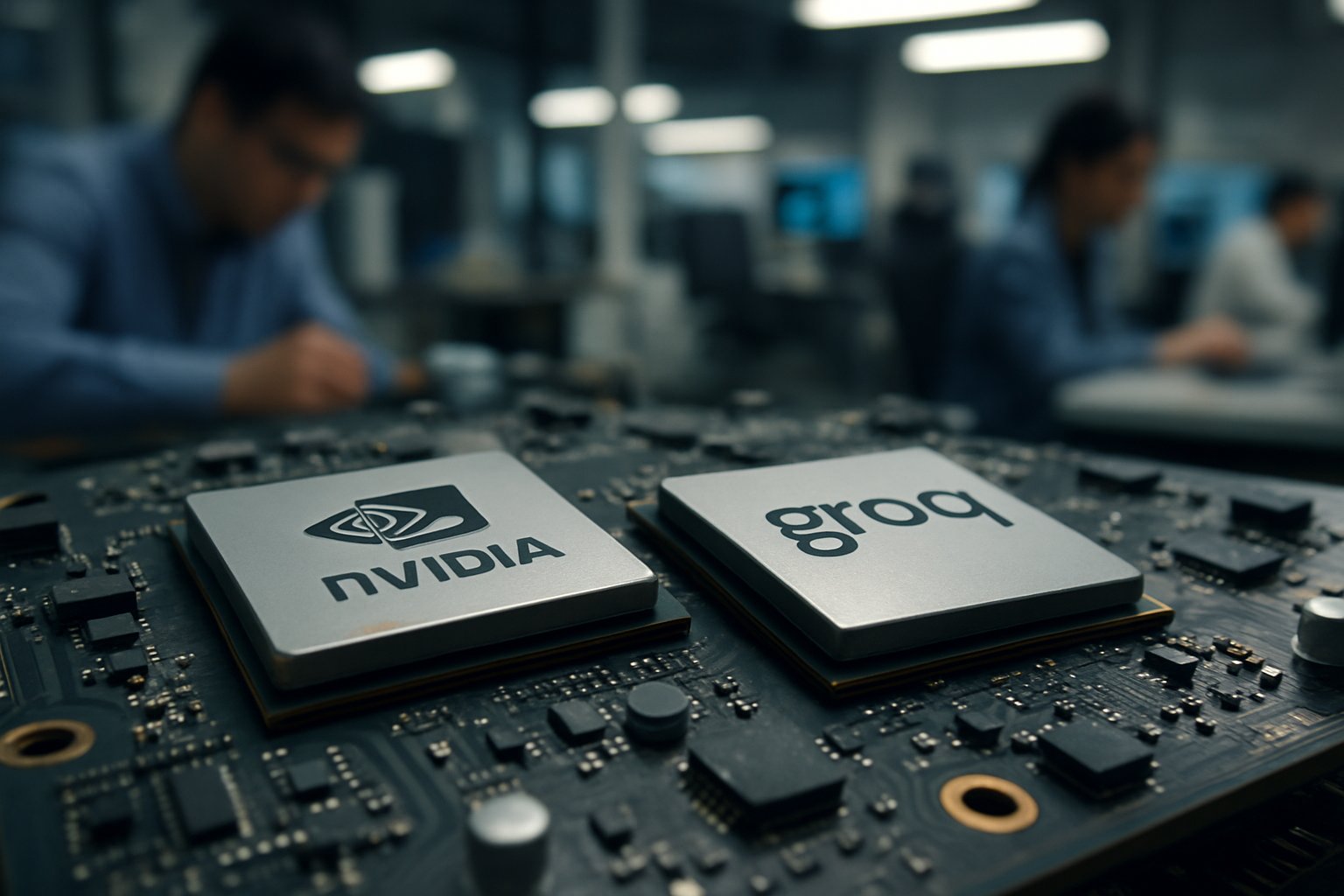
Consequently, analysts rushed to decode the structure, size, and potential ripple effects of the unusual arrangement.
Unlike classic acquisitions, the pact transfers intellectual property while keeping Groq corporately independent.
Furthermore, founding executives Jonathan Ross and Sunny Madra will join Nvidia alongside selected engineers.
Meanwhile, GroqCloud will continue serving customers under incoming chief executive Simone Edwards.
Reuters noted that financial terms remain undisclosed, although CNBC cited an eye-catching $20 billion estimate.
Therefore, market participants are debating both valuation realism and competitive consequences.
This article unpacks technical, regulatory, and market angles surrounding the unprecedented Christmas-eve announcement.
Licensing Move Sends Shockwaves
Groq described the pact as a simple licensing agreement rather than an outright sale.
However, multiple outlets framed the structure as a de facto acquisition because key talent will depart.
Nvidia confirmed it will license low-latency processors while hiring Ross, Madra, and several engineering teams.
Consequently, competitors like AMD and Cerebras awoke to headlines declaring Nvidia’s largest reported deal to date.
In contrast, Groq maintained that the organization remains independent and free to strike future partnerships.
The Nvidia Groq license therefore straddles corporate and contractual boundaries, complicating antitrust analysis.
Market observers note that such agreements let giants absorb breakthrough technology without lengthy regulatory delays.
These implications set the stage for deeper technical scrutiny in the next section.
Groq LPU Hardware Edge
Groq’s Language Processing Unit uses on-chip SRAM instead of external HBM to cut latency dramatically.
Moreover, this hardware choice reduces memory bottlenecks and energy use per generated token.
Such technology reduces energy draw significantly.
Nvidia executives believe marrying LPU principles with CUDA software could halve response times for complex inference workloads.
Nevertheless, the architecture limits maximum model size per device because SRAM capacity remains constrained.
The Nvidia Groq license grants access to these design files, compiler techniques, and performance benchmarks.
Consequently, analysts expect hybrids combining GPUs and Groq chips inside future AI Factory racks.
Key technical advantages include:
- Sub-microsecond token latency under moderate sequence lengths
- Lower watts per token versus comparable GPU nodes
- Deterministic execution that simplifies real-time scheduling
- Compiler stack optimized for sequential language generation
Together, these factors highlight why low-latency hardware has become strategic for large language model deployment.
However, talent integration remains equally critical, as the next section explains.
Talent Transfer And Impact
Jonathan Ross pioneered the LPU after earlier TPU work at Google.
Additionally, Sunny Madra built GroqCloud into a developer community exceeding two million users.
Consequently, their move to Nvidia brings deep compiler and runtime expertise under one corporate roof.
The Nvidia Groq license accompanies offers to many senior engineers, though headcount numbers remain undisclosed.
Such acquihires often accelerate roadmaps while weakening the originating start-up’s competitive prospects.
In contrast, Groq appoints Simone Edwards as CEO and vows to continue customer operations unchanged.
Nevertheless, skeptics question whether remaining staff can iterate hardware and software at prior velocity.
Talent migration could turbocharge Nvidia’s roadmap.
However, it simultaneously diminishes Groq’s independent allure, linking fortunes to the license.
Regulatory scrutiny may intensify given these competitive shifts.
Regulatory Hurdles And Risks
Antitrust experts quickly flagged the deal’s unusual license-plus-talent structure.
Bernstein analyst Stacy Rasgon warned that regulators could view it as competition elimination.
Furthermore, the reported $20 billion magnitude rivals several recent tech mega-mergers that required filings.
Nevertheless, the non-exclusive language gives Nvidia plausible deniability, arguing Groq can license others.
The agreement remains non-exclusive, allowing Groq to license peers theoretically.
Consequently, authorities in Washington and Brussels may probe whether substantial assets effectively changed control.
Professionals can deepen insight via the AI Legal Navigator™ certification covering fresh compliance duties.
Regulators have months to react.
Meanwhile, engineering integration marches ahead regardless of legal uncertainty.
Market context offers additional perspective.
Market Context For Inference
Global Market Insights pegs AI chips sector at tens of billions this year.
Moreover, projections suggest multi-hundred-billion revenues by 2030 as inference demand explodes.
Several statistics illustrate the surging opportunity:
- Groq reports two million developers on GroqCloud.
- Latest Groq round valued the company near $6.9 billion.
- Nvidia commands over 80% of training GPUs by revenue.
- Streaming LLM usage grows more than 10x annually.
Consequently, the Nvidia Groq license positions Nvidia to defend share while attacking specialized niches.
In contrast, rivals like AMD and Cerebras must differentiate on open ecosystems or pricing.
The numbers confirm inference has become central to monetizing generative applications.
Integration mechanics therefore deserve closer inspection next.
Integration Challenges Loom Ahead
Melding GPU and LPU instruction sets will test compiler engineers.
Additionally, Nvidia must align memory hierarchies because LPUs rely on SRAM, not HBM.
Software abstraction layers could mask differences, yet performance tuning will still demand silicon-aware code.
Consequently, developer toolchains may require overhaul before the first combined chips ship.
The Nvidia Groq license also obligates knowledge transfer schedules that could delay roadmap milestones.
Nevertheless, Nvidia’s vast manufacturing partnerships can accelerate volume once designs freeze.
Technical friction could slow deployments temporarily.
However, success would recalibrate latency expectations across cloud services.
Strategic implications crystallize next.
Strategic Takeaways And Outlook
Analysts see three primary motives behind the deal.
First, Nvidia gains low-latency intellectual property without buying the whole company.
Second, departing Groq leaders secure resources to scale ambitions inside a dominant platform.
Third, the arrangement weakens a challenger while sidestepping immediate antitrust filings.
Moreover, Nvidia can experiment with heterogeneous chips before the next generational GPU leap.
Customers could benefit through faster token delivery and potentially lower operational costs.
The Nvidia Groq license, however, remains unconfirmed at the rumored $20 billion price.
Therefore, investor reaction may shift once concrete economics emerge.
Overall, the saga underscores how licensing can reshape competitive dynamics in advanced hardware markets.
Stakeholders should monitor regulatory filings and product roadmaps closely.
Consequently, next quarters will reveal whether Nvidia successfully fuses GPU versatility with LPU technology speed.
Nevertheless, Groq retains rights to license its technology elsewhere, potentially sustaining competitive tension.
Professionals tracking the Nvidia Groq license should follow benchmark disclosures and regulatory updates.
Meanwhile, deepen your strategic skill set by exploring certifications such as the AI Legal Navigator™ program.
Prepared leaders will exploit coming hardware inflection points and turn inference performance into market advantage.
The Nvidia Groq license may even set precedent for future semiconductor collaborations.
Stay informed as the Nvidia Groq license story evolves across engineering, legal, and commercial fronts.


