

AI CERTS
5 hours ago
Cancer Network Tool Offers Transparent Survival Predictions
This article explains how the Cancer Network Tool operates, evaluates evidence, and outlines practical adoption steps. Moreover, the open-source release eases installation through PyPI and Docker containers. Nevertheless, users must understand performance variability and data caveats before clinical translation. Therefore, we review strengths, limitations, and future directions for this promising platform.
Why Networks Beat Genes
Historically, many prognostic models focused on single genes. In contrast, disease mechanisms rarely hinge on isolated molecules. Instead, post-transcriptional webs of miRNA and mRNA interactions sculpt tumour behaviour. Consequently, network-based approaches capture emergent effects unreachable by univariate methods. Furthermore, they align with systems biology theories that stress modular regulation. The Cancer Network Tool embraces this paradigm by outputting interaction graphs alongside predictions. These insights illustrate why networks enhance biological relevance. However, practical implementation requires robust pipelines, leading to our next section.
Inside The RNACOREX Pipeline
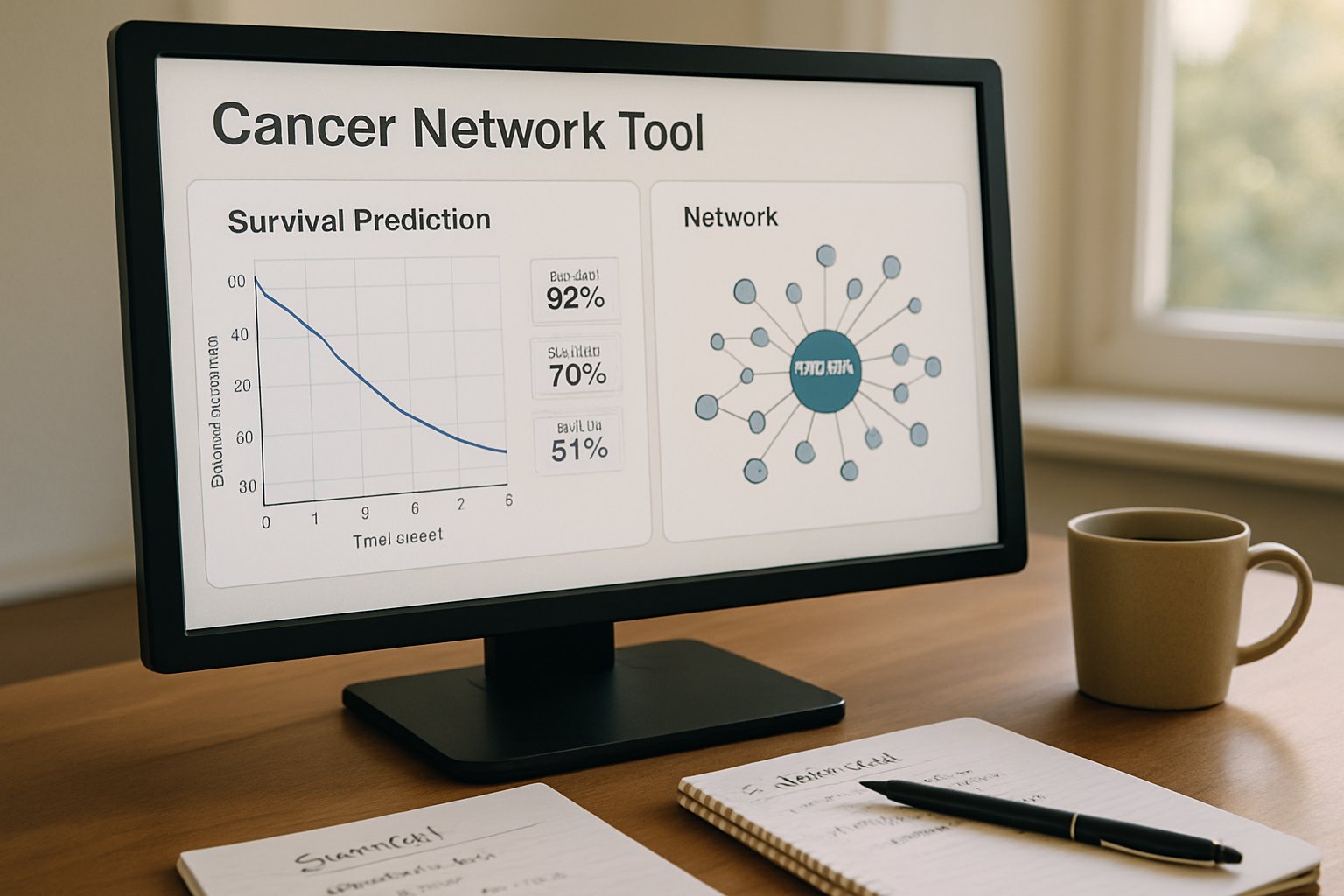
RNACOREX integrates curated interaction repositories with The Cancer Genome Atlas expression matrices. Subsequently, the software ranks candidate miRNA–mRNA pairs using conditional mutual information. Additionally, structural and functional scores refine the selection to high-confidence links. The algorithm then trains Conditional Linear Gaussian classifiers on the chosen set. Therefore, every prediction ties back to a concrete subgraph. Developers designed the Cancer Network Tool to export those subgraphs as easy-to-read diagrams. This pipeline blends statistical rigor with explainable AI mechanics. Consequently, users receive both metrics and mechanisms. Genetic context awareness guides interaction ranking within the model.
Performance Across Tumor Types
The authors validated results on 13 tumour cohorts from TCGA. For example, acute myeloid leukemia achieved a best AUC of 0.796. Meanwhile, breast carcinoma peaked around 0.693 AUC. Nevertheless, accuracies varied, with colon samples averaging only 0.666. Therefore, users should benchmark the Cancer Network Tool on their own datasets. RNACOREX reported standard deviations near 0.025, indicating some stability across random splits. These metrics demonstrate respectable but not flawless performance. In contrast, black-box deep models often score higher yet remain opaque.
Interpretable Results For Researchers
Transparency distinguishes this approach from many competing AI platforms. Moreover, each prediction lists the miRNA and mRNA interactions driving survival classification. Authors highlighted recurrent molecules such as BACH2 and SLC2A1 across five tumour types. Consequently, laboratory teams can prioritize those targets for perturbation assays. Rubén Armañanzas noted that the software supplies a reliable molecular map. The Cancer Network Tool therefore accelerates hypothesis generation while preserving interpretability. These features align with funding bodies demanding reproducible insights. Furthermore, they motivate skills development through specialized credentials. Professionals can enhance their expertise with the AI+ Researcher™ certification.
Limits And Future Work
Every computational method carries caveats. In contrast, RNACOREX relies on bulk expression that merges tumour and stromal signals. Therefore, the Cancer Network Tool currently functions as a hypothesis generator, not a diagnostic device. Consequently, cell-type-specific interactions remain obscured. Moreover, predictive performance dipped for certain cancers, underscoring cohort dependence. Experimental validation is required to confirm suggested links. The Cancer Network Tool authors are already extending the framework to pathway and multi-omics layers. These limitations caution against immediate clinical use. Nevertheless, active development promises broader applicability.
Practical Adoption Steps Now
Installation is straightforward via pip install RNACOREX or Docker run. Subsequently, users load expression matrices and optional interaction databases. Additionally, command-line flags adjust ranking thresholds, folds, and output formats.
- Download TCGA or local cohort expression files.
- Run RNACOREX fit to train classifiers.
- Inspect graph outputs for recurrent interactions.
- Compare performance against existing benchmarks.
Therefore, teams can pilot the Cancer Network Tool within one afternoon. Moreover, the Apache-licensed code encourages forked improvements. These steps reduce technical barriers for translational groups. Consequently, adoption could scale quickly across bioinformatics cores.
Key Takeaways And Action
Interpretable network modeling fills a vital gap between accuracy and mechanistic insight. RNACOREX offers that blend through the Cancer Network Tool platform. Moreover, open-source packaging fosters reproducibility and community vetting. Genetic researchers gain prioritized interactions that guide bench experiments. Additionally, clinicians receive survival predictions they can scrutinize visually. Nevertheless, further validation using single-cell and longitudinal cohorts remains essential. Consequently, stakeholders should test, critique, and iterate on the framework. Readers eager to contribute can start by installing the tool and exploring supplied notebooks. Finally, consider strengthening analytical credentials through the earlier linked certification.
In summary, the Cancer Network Tool balances interpretability with respectable predictive power. Moreover, it democratizes network analytics through an accessible PyPI package and Docker image. Genetic discoveries can accelerate because hypotheses emerge directly from the model's ranked interactions. Nevertheless, experimental confirmation and multi-omics integration remain top priorities. Therefore, we encourage readers to download the software, examine their data, and share feedback. You can deepen your expertise with the AI+ Researcher™ credential. Consequently, you will join a growing community advancing explainable models in oncology.


