

AI CERTS
5 hours ago
Altman Job Outlook: Navigating AI-Driven Workforce Shifts
Consequently, boardrooms seek clarity on which tasks disappear, which emerge, and how quickly workers must adapt. This article dissects the forecast, balances optimism and risk, and offers clear guidance for technical leaders. Meanwhile, we anchor every claim in data from the World Economic Forum, McKinsey, and Goldman Sachs. Readers will leave with actionable insights on reskilling, policy leverage, and strategic workforce planning. The Altman Job Outlook unsettles some, yet informed preparation can convert disruption into competitive advantage. Future leaders must internalize that timeline now.
Rapid AI Shock Timeline
Altman framed the coming decade as a compressed replay of earlier industrial upheavals. Historically, major revolutions stretched across generations. However, the Altman Job Outlook suggests similar turnover could unfold within five years for some functions. Moreover, rival CEO Dario Amodei echoed the warning, estimating half of entry-level white-collar positions are exposed. Consequently, contact-center operators already pilot generative AI agents to trim call volumes. In contrast, programming remains uncertain because agentic systems still falter on complex architectures. Nevertheless, McKinsey models show 15-30% of total hours could shift to machines by 2030. These signals underline the accelerated timetable; leaders must act before the window narrows further.
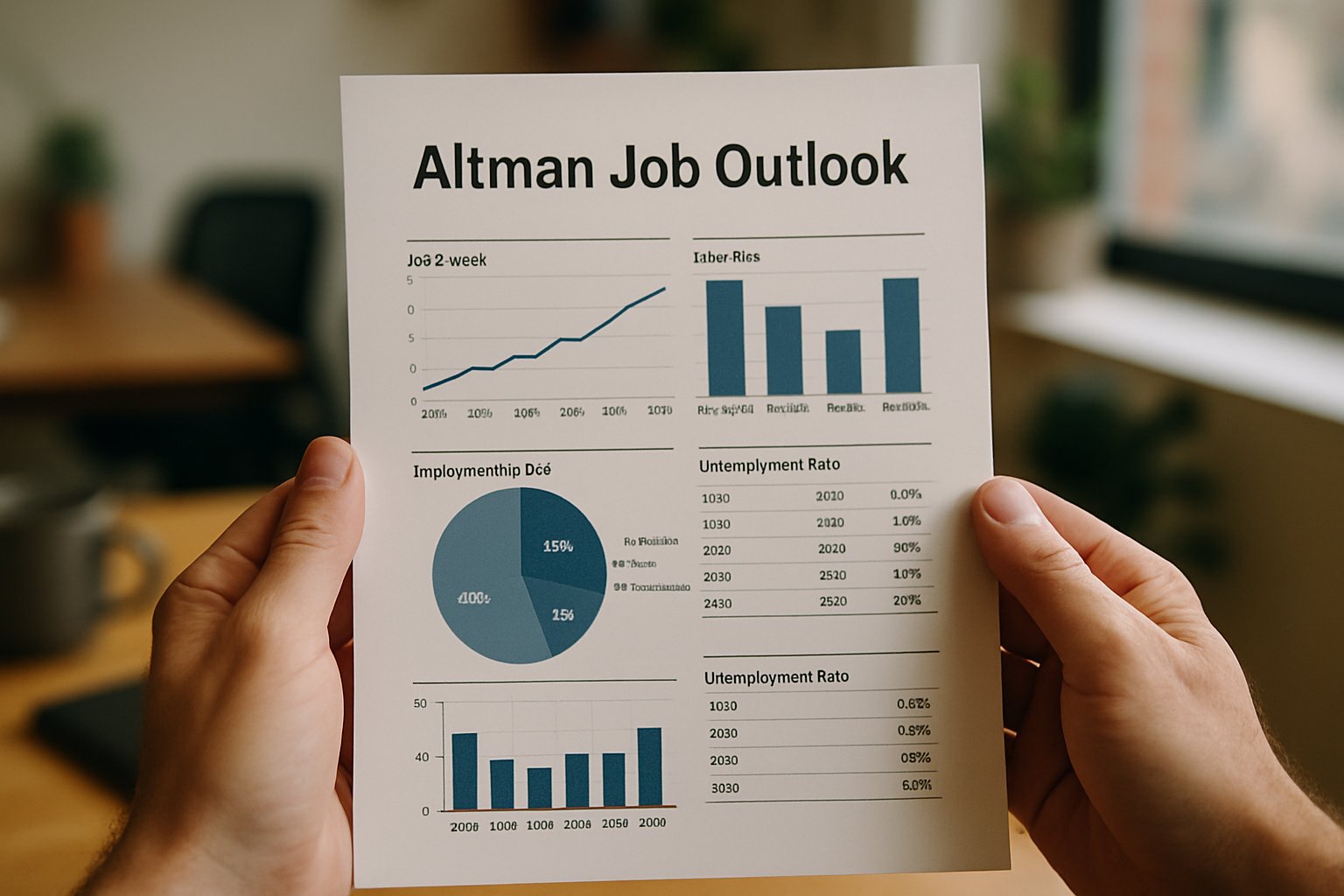
Altman and peers foresee unprecedented speed for Careers. Therefore, understanding role exposure becomes the next critical step.
Displacement Hits Service Roles
Customer support sits squarely in the crosshairs. The Altman Job Outlook names the function first among vulnerable groups. Meanwhile, World Economic Forum surveys show companies already automate 22% of routine tasks. Furthermore, contact-center employment in the United States tops 2.8 million, magnifying social impact potential. Generative AI chatbots answer repetitive queries, escalate only nuanced cases, and reduce handle time. Consequently, agents requiring empathy and complex troubleshooting may survive longer, yet call volumes will shrink. Jobs focused on pure data lookup will likely vanish first, mirroring past clerical automation patterns. Nevertheless, service staff can pivot toward proactive outreach, guided by AI insights.
Service displacement appears imminent and uneven. In contrast, broader numerical evidence offers context for the projected scale.
Numbers Behind The Shift
Quantifying disruption turns abstract fears into manageable metrics. Moreover, the Altman Job Outlook gains credibility when mapped against independent studies. Analysts group exposed jobs into low, medium, and high-risk buckets.
- WEF projects 170 million jobs created and 92 million lost, net 78 million gains by 2030.
- McKinsey estimates 15-30% of hours automated, emphasizing tasks rather than entire occupations.
- Goldman Sachs predicts 6-7% of U.S. jobs displaced, producing only a modest unemployment peak.
Additionally, OECD exposure indices highlight gender and regional disparities within similar role categories. These converging figures support scenario planning accuracy.
Data clarifies magnitude, yet direction matters equally. Consequently, examining emerging opportunities balances the narrative.
Opportunities Outpace Role Losses
Altman stresses opportunity whenever he outlines risks. The Altman Job Outlook therefore includes an optimistic subplot focused on new, high-paying positions. Generative design engineers, prompt architects, and AI compliance auditors already appear on recruiting platforms. Moreover, World Economic Forum respondents expect digital commerce, sustainability tech, and healthcare analytics to surge. Startups leverage agentic systems to ship products with skeletal teams, thereby creating founder-centric career pathways. Consequently, displaced workers can re-enter growth sectors faster if they upskill proactively. Professionals can enhance their expertise with the AI for Everyone™ certification. Careers built around orchestration, oversight, and ethical governance will complement automated execution layers.
Opportunity pipelines appear robust when skill alignment exists. Therefore, attention turns to the reskilling engine powering that alignment.
Reskilling Imperative Gains Urgency
Workforce agility decides whether displacement becomes prolonged unemployment. McKinsey warns that smooth Transition hinges on rapid training availability for millions. Meanwhile, governments test voucher programs, and enterprises scale internal academies. Furthermore, the Altman Job Outlook emphasizes early action before organizational fatigue sets in. Effective curricula blend technical depth, business context, and soft skills like communication. In contrast, generic video tutorials often fail because learners lack project scaffolding. Subsequently, peer communities and mentorship accelerate knowledge retention. Transition success stories foster cultural momentum, encouraging wider participation.
Reskilling must scale quickly to absorb shocks. Nevertheless, policy frameworks determine whether that scale materializes.
Policy Choices Shape Transition
Legislation and incentives steer automation outcomes. The Altman Job Outlook therefore resonates inside ministries designing tax credits and safety nets. Moreover, European regulators debate mandatory notice periods for algorithmic layoffs. United States agencies focus on portable benefits and wage insurance experiments. Consequently, multinational firms juggle divergent compliance timelines. Economists argue that active labor market policies cut unemployment duration by supporting job search intensity. Additionally, targeted R&D subsidies can boost productivity, offsetting early revenue dips from workforce investment.
Regulation shapes incentives and worker security. Therefore, individuals still need personal strategies for their Careers.
Key Takeaways And Actions
Technical leaders must integrate foresight into planning immediately. First, audit task exposure across support, finance, and engineering. Second, map displaced employees to emerging roles before attrition erodes knowledge. Third, fund continuous learning paths aligned with certifications and internal gig marketplaces. Finally, maintain dialogue with policymakers, ensuring aligned incentives. Moreover, referencing the Altman Job Outlook during board reviews grounds strategy in recognizable narratives. Future resilience emerges when organisations combine data, empathy, and decisive execution. Consequently, workers perceive stability and invest in growth.
These steps operationalize foresight. Nevertheless, success finally depends on sustained attention.
The Altman Job Outlook paints a dual picture of accelerated threat and amplified possibility. Evidence from WEF, McKinsey, and Goldman Sachs confirms large yet manageable structural shifts. However, outcomes hinge on choices made today by executives, educators, and legislators. Tasks will automate, but creative problem solving, systems thinking, and empathy remain scarce. Therefore, invest in adaptive skills, build cross-functional teams, and benchmark progress quarterly. Meanwhile, empower employees to pursue certified learning like the AI for Everyone™ credential. Consequently, businesses can negotiate disruption during the Transition while capturing new value streams. Secure jobs demand continuous reinvention. Act now; the Future rewards preparedness.


