

AI CERTS
3 months ago
Liquid Foundation Models reshape edge AI
Liquid AI blends efficiency and accuracy, targeting engineers who must squeeze large language functionality into strict hardware envelopes. Moreover, the firm published open weights and detailed documentation, fostering transparent evaluation. Analysts therefore consider the drop a pivotal milestone for edge intelligence.
Market Context Shift
Enterprise teams crave private inference at low latency. Consequently, vendors race to condense models without crushing quality. Liquid AI positions its second generation as the fastest open small model family. VentureBeat framed the release as a practical roadmap for regulated industries. Meanwhile, stricter data policies push workloads away from remote clouds. Smartphones and industrial gateways become first-class hosts. In contrast, earlier solutions demanded discrete GPUs or costly accelerators. Liquid’s approach thus redefines viable deployment scenarios.
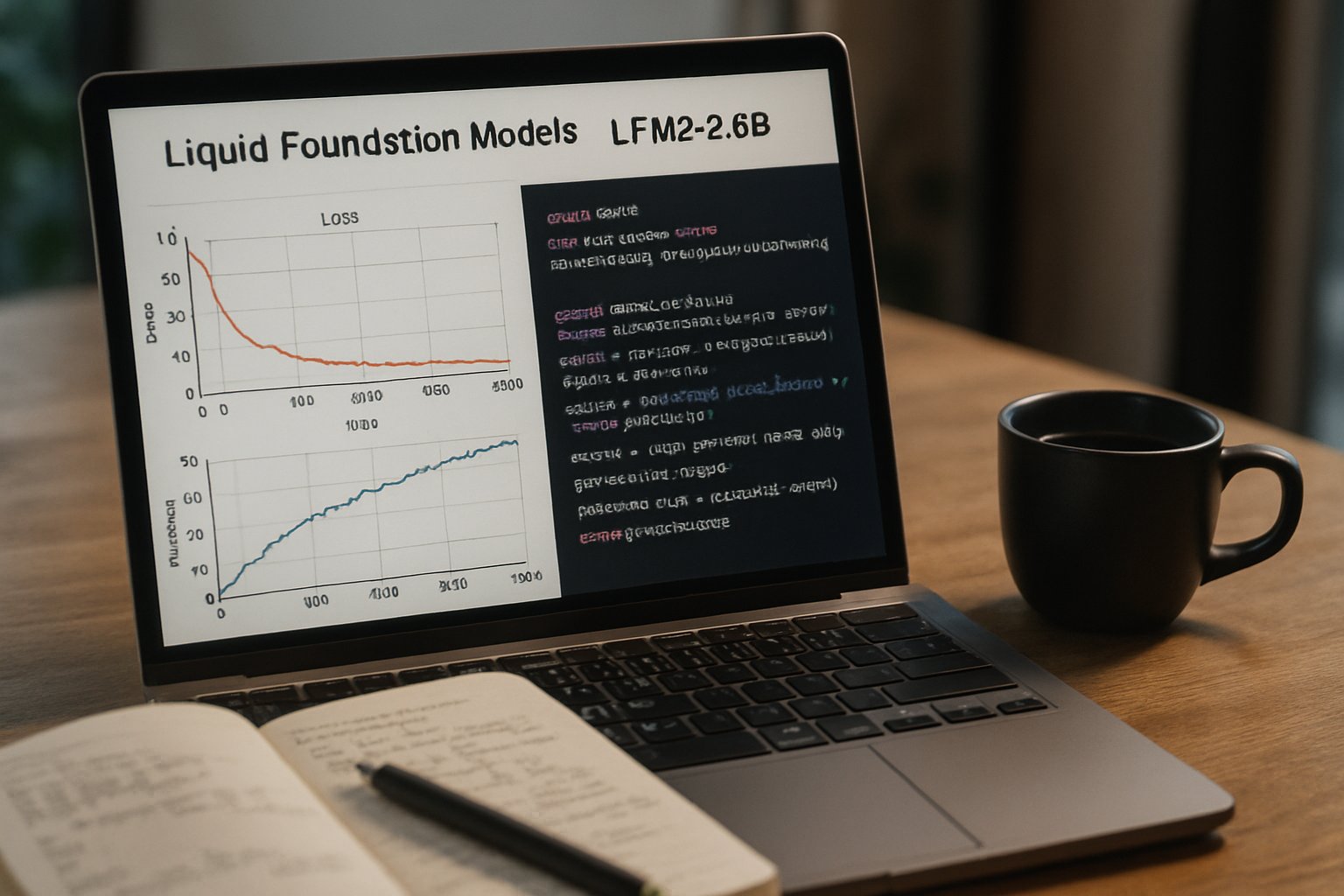
The shift clarifies a fundamental trend. Edge capacity keeps rising while budgets tighten. Nevertheless, leaders still demand state-of-the-art conversational systems. These pressures gave birth to Liquid Foundation Models and their distinctive architecture. The context now sets the stage for deeper technical exploration.
These dynamics highlight evolving buyer priorities. Furthermore, they underline why efficiency research matters. The next section examines the hybrid design underpinning these gains.
Technical Architecture Overview
Liquid engineers mixed short gated convolutions with periodic grouped-query attention. Therefore, the model prunes compute where global tokens are unnecessary. Each of the 30 backbone layers handles local features quickly, then hands off selective information to attention blocks. Consequently, key-value caches remain small, slashing memory pressure on a CPU. Additionally, the 32,768-token window enables long documents without fragmenting context.
Four vital concepts drive the stack:
- Hybrid backbone interleaving convolution and attention for balanced speed.
- Grouped-query attention reducing cache footprints.
- Reinforcement learning refinement producing an Experimental checkpoint for tighter instruction adherence.
- Optional mixture-of-experts variant scaling capacity with sparse activation.
Moreover, the base 2.6B model consumed roughly ten trillion pretraining tokens. Engineers later applied supervised fine-tuning, direct preference optimization, and decoupled top-K distillation. Consequently, the resulting Liquid Foundation Models rival larger systems on many reasoning tests.
These design choices deliver clear advantages. However, performance metrics tell the real story. The next section dives into benchmark numbers.
Benchmark Performance Highlights
Liquid published transparent tables on Hugging Face. GSM8K math accuracy reached 82.41 percent. Furthermore, IFEval instruction compliance scored 79.56 percent. Independent reviewers noted competitive IFBench and MMLU marks against heavier rivals. Meanwhile, the Experimental reinforcement checkpoint shows gains on instruction-heavy suites.
Liquid also emphasized throughput:
- Up to two-fold faster prefill on a single CPU core.
- Roughly 200 percent higher total tokens per second versus comparable 3-billion-parameter peers.
- Stable decoding on a mid-range smartphone at usable chat speeds.
These figures require third-party replication. Nevertheless, early community tests align with headline claims on mainstream laptops. Consequently, the 2.6B release narrows the gap between edge and server class inference.
The numbers illustrate impressive efficiency. Yet deployment realities still matter. The following section explores practical edge scenarios.
Edge Deployment Impact
Developers frequently target devices lacking discrete GPUs. Therefore, Liquid ensured first-class support for llama.cpp, vLLM, and ExecuTorch. Engineers can quantize the model and run it entirely on a smartphone. Additionally, the small cache enables multi-threaded streaming without thermal throttling. Moreover, the company’s license welcomes commercial redistribution under clear safety terms.
Consequently, privacy-sensitive industries, such as healthcare, gain local language capability. Field technicians running rugged tablets enjoy offline reasoning assistance. Meanwhile, call-center kiosks deliver real-time suggestions with negligible rack power. Smartphone manufacturers already prototype native chatbots using the checkpoint. Benchmark logs show four-token-per-second generation on a flagship CPU core at 6-bit quantization.
These deployment wins validate Liquid Foundation Models for production pilots. However, community reactions remain diverse, as the next section reveals.
Community Reactions Mixed
Open-source contributors welcomed the transparent report. Furthermore, many praised the reproducible recipes. Independent analysts, however, flagged the absence of external benchmark audits. In contrast, security researchers urged caution, noting that open weights lower misuse barriers. Nevertheless, enterprise architects appreciate the license clarity compared with restrictive competitors.
VentureBeat called LFM2 a blueprint for edge AI. Meanwhile, several academics highlighted innovative distillation steps. Yet some skeptics questioned whether small models can handle complex legal drafting. Therefore, adoption decisions still hinge on task complexity and acceptable latency.
Feedback underscores both promise and caution. Subsequently, professionals must evaluate fit through structured testing. The next section outlines a practical checklist.
Adoption Guidance Steps
Evaluation Setup Checklist
Firstly, define critical reasoning workloads. Secondly, replicate GSM8K and IFEval runs on target hardware. Additionally, measure latency with representative prompt sizes. Moreover, capture energy consumption for each quantization level. Finally, compare results against internal baselines.
Skill Development Pathways
Teams need aligned expertise. Consequently, professionals can enhance their competence with the AI Researcher™ certification. The program covers model fine-tuning, safety audits, and performance optimization.
Following these steps mitigates deployment risk. Nevertheless, technology evolves rapidly. The final section reviews upcoming milestones.
Future Outlook Summary
Liquid plans multimodal and sparse successors across 2026. Moreover, additional reinforcement rounds may refine instruction behavior. Community members anticipate broader third-party audits and perhaps a 4-billion-parameter edge variant. Consequently, competition almost certainly will intensify.
Meanwhile, hardware vendors integrate NPUs into mainstream smartphones. Therefore, weight reductions and clever scheduling remain essential. Liquid Foundation Models seem poised to benefit from these advancements. However, governance debates over open weights will continue. Independent benchmarking bodies may emerge, offering standardized CPU performance grades.
These projections illustrate both opportunity and responsibility. Consequently, stakeholders should monitor releases while enforcing robust evaluation pipelines.
Conclusion
Liquid Foundation Models demonstrate that strategic architectural choices can compress advanced reasoning into compact footprints. Furthermore, benchmark results suggest real-world viability on CPUs and smartphones. Nevertheless, independent testing remains necessary. Edge deployment scenarios already show promising latency and privacy gains. Meanwhile, community feedback balances excitement with caution. Therefore, teams should pilot the 2.6B checkpoint, validate metrics, and plan continuous monitoring. Professionals seeking deeper mastery can pursue the linked AI Researcher™ certification to stay ahead. Act now, evaluate the model, and accelerate your edge AI roadmap.


