

AI CERTS
5 months ago
Fujitsu Debuts Physical AI Integration Platform With NVIDIA NIM
Consequently, procurement pilots inside Fujitsu showed a 50% reduction in order-confirmation workload. Furthermore, engineers project a 50% inference speed gain once NIM moves into production. This article dissects the announcement, technical design, business impact, and risks for teams evaluating Physical AI Integration. Moreover, we outline certification paths to deepen robotics and agentic skills. Analysts note enterprise AI adoption hit record levels in 2025, yet governance gaps persist. Therefore, solutions that combine performance, privacy, and control now dominate boardroom discussions.
Market Forces Rapid Shift
Global surveys suggest 78% of enterprises ran agent pilots during 2025. However, only 26% moved projects into scaled production, citing security and latency concerns. Analysts argue those blockers open space for integrated stacks like the platform. Fujitsu meets that demand through its October 2025 alliance with NVIDIA. Consequently, Physical AI Integration offers a combined software and hardware roadmap rather than disparate tools. Market watchers expect agentic spending to reach US$45 billion by 2026, led by manufacturing and finance sectors. Therefore, timing seems advantageous for Kozuchi Physical AI 1.0 trials.
These figures reveal surging interest yet persistent execution gaps. Subsequently, architecture insights clarify how Fujitsu addresses them.
Kozuchi Architecture Details Explained
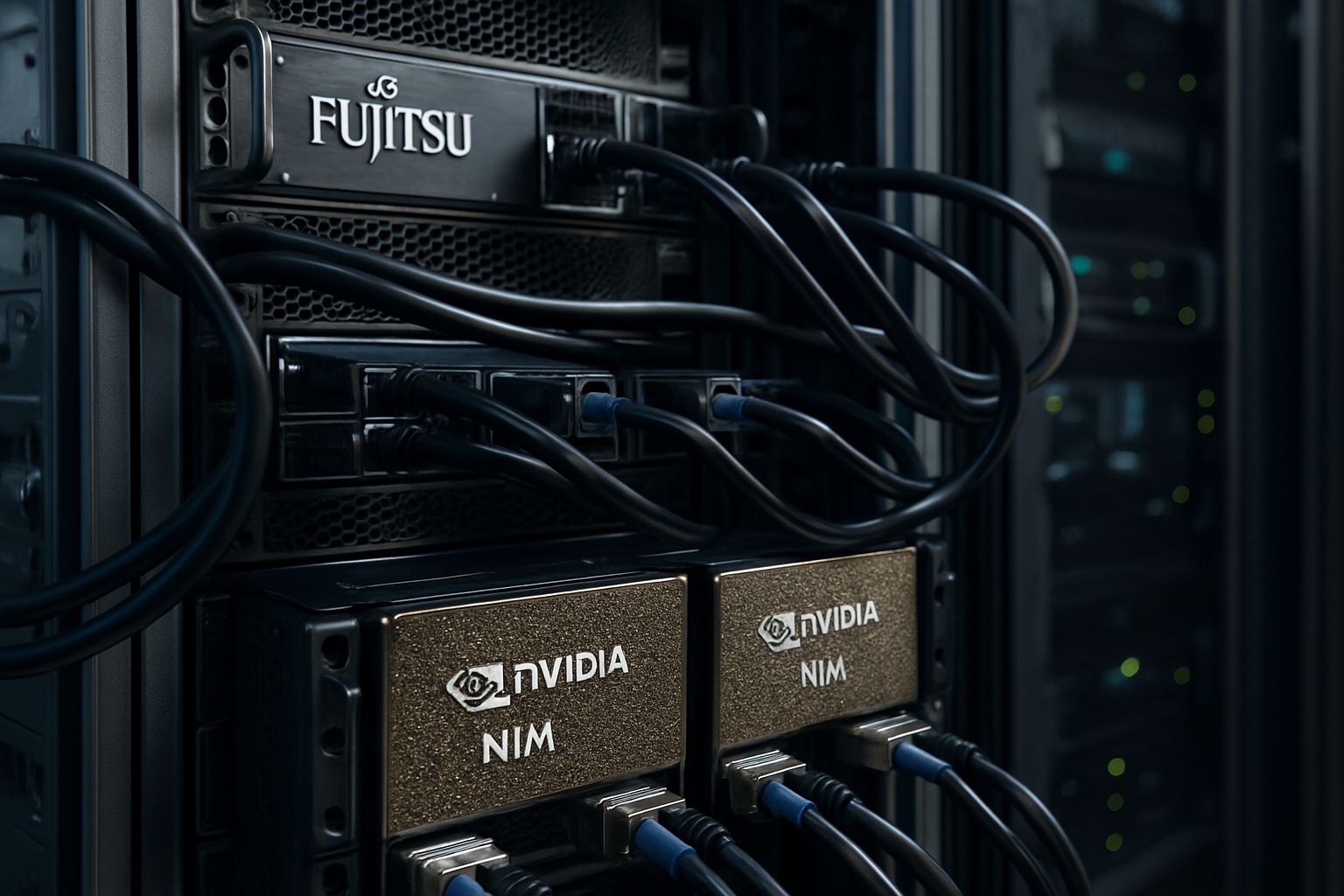
Kozuchi bundles the Takane LLM, knowledge-graph enhanced RAG, and Composite AI reasoning modules. Additionally, a visual builder lets developers drag agents into sequenced workflows without custom code. The platform’s heart is a secure inter-agent gateway that prevents data leakage across tasks. Consequently, regulated industries can keep trade secrets within sovereign environments. Physical AI Integration appears at two layers in this stack. At orchestration level, Kozuchi coordinates Takane agents that read documents, check regulations, and flag anomalies. At the infrastructure level, NIM containers expose optimized APIs for every model, supporting on-prem or cloud deployment. This dual-layer Physical AI Integration enables end-to-end control, from prompt engineering down to GPU utilization.
The architectural choice maximizes modularity while safeguarding data. Nevertheless, deeper performance metrics depend on hardware acceleration, examined next.
Secure Workflow Automation Gains
Fujitsu’s internal purchasing group ran a six-week proof-of-concept with three specialized Takane agents. Moreover, the pilot trimmed human order-confirmation effort by roughly 50%. Agents parsed documents, verified compliance rules, and generated confirmation drafts in seconds. Physical AI Integration here replaced manual email chains with governed agent dialogues.
- Order-confirmation workload: −50% versus baseline
- Average response time: 18 seconds per request
- Daily compliance checks handled: “hundreds,” per Fujitsu
- Projected inference speed gain with NIM: +50%
Consequently, managers reported smoother audit trails and faster supplier responses. These automation results validate gateway security and agent synergy. In contrast, raw speed still relies on NIM efficiency.
NIM Performance Acceleration Benefits
NVIDIA markets NIM microservices as turnkey containers tuned for its latest GPUs. Fujitsu integrated each Takane variant into NIM, gaining consistent APIs and driver updates. Furthermore, early profiling suggests 50% lower latency compared with generic PyTorch deployments. Physical AI Integration therefore gains throughput headroom, especially for bursty compliance workloads.
- Optimized tensor cores shorten decoding time.
- Automatic quantization reduces memory pressure.
- Unified logging eases incident analysis.
Nevertheless, enterprises must still size clusters considering peak traffic and regulatory redundancy. The NIM layer supplies raw speed but not governance. Subsequently, Robotics aspirations illustrate future compute requirements.
Toward Physical Robotics Integration
NVIDIA frames Physical AI as the merger of perception, planning, and actuation. Fujitsu echoes that vision, positioning Kozuchi as the cognitive layer above shop-floor robots. Current release targets documents, yet roadmaps point toward robots running NVIDIA Isaac or GR00T stacks. Physical AI Integration will then synchronize digital twins, sensors, and scheduling agents in real time. Robotics partners anticipate safer cooperation because the secure gateway mediates commands and telemetry. Additionally, Kozuchi supports knowledge-graph RAG, grounding commands in updated shop rules. Agentic control loops will bridge virtual twins and physical movement. Successful Physical AI Integration within factories could reduce changeover delays and incident response minutes.
These scenarios extend value from desks to machines. Therefore, risk assessment becomes even more crucial.
Adoption Risks And Mitigations
Multi-agent systems introduce orchestration complexity, testing overhead, and new attack surfaces. In contrast, Kozuchi offers audit logging and role-based agent permissions. Agentic architectures require strict observability to ensure explainability. Still, reliability remains a concern because LLMs can hallucinate or misroute tasks. Physical AI Integration demands rigorous validation, human-in-the-loop checks, and continuous monitoring. Cost also matters; GPU energy budgets can spike during inference bursts. Consequently, architects should benchmark NIM efficiency against enterprise service-level targets. Professionals can enhance their expertise with the AI+ Robotics™ certification.
Mitigation strategies reduce, yet never eliminate, these challenges. Meanwhile, roadmap clarity assists investment planning.
Roadmap And Next Steps
Fujitsu offers trial access to Kozuchi Physical AI 1.0 today. Customer feedback will shape commercial release planned before March 2026. Moreover, NVIDIA and Fujitsu will co-publish performance whitepapers during 2025 to validate NIM claims. Physical AI Integration pilots outside Fujitsu are expected in finance and manufacturing during Q2 2026. Analysts advise forming cross-functional teams now to evaluate agent governance, cost, and talent requirements. Subsequently, early adopters can influence roadmap features and support models.
The path forward mixes experimentation with due diligence. Consequently, conclusions underline strategic actions.
Fujitsu’s latest release merges multi-agent orchestration, secure data handling, and accelerated inference. Consequently, early results indicate tangible efficiency gains for confidential workflows. However, reliability, governance, and cost considerations remain critical for scaled deployment. Independent validation of Takane accuracy and gateway security will boost executive confidence. Meanwhile, close collaboration with NVIDIA can optimize hardware footprints and energy budgets. Teams evaluating advanced automation should review trial documentation, benchmark NIM performance, and pursue specialized training. Additionally, earning the AI+ Robotics™ certification strengthens skill sets for upcoming agent-robot projects. Act now to transform exploratory pilots into resilient, value-driven solutions.
Disclaimer: Some content may be AI-generated or assisted and is provided ‘as is’ for informational purposes only, without warranties of accuracy or completeness, and does not imply endorsement or affiliation.


