

AI CERTS
3 months ago
NOAA’s AI Weather Models Redefine Global Forecasting
Moreover, their debut signals a strategic pivot that could reshape operational Prediction for decades. Industry experts already debate how the shift will influence Forecast workflows, energy budgets, and public trust. Meanwhile, early skill scores suggest tangible accuracy gains on large-scale Climate patterns and cyclone tracks.
Therefore, this article unpacks the technology, efficiency metrics, opportunities, and unresolved challenges surrounding the rollout. Readers will also discover how professional growth can accelerate through specialized certification pathways. Let us explore the numbers, context, and implications behind NOAA’s bold leap.
Deployment Marks New Milestone
Historically, NOAA invested billions in physics-based supercomputers. However, training breakthroughs in graph neural networks changed that calculus. Subsequently, Project EAGLE adapted Google DeepMind’s GraphCast architecture to generate fast, data-driven forecasts. On 9 December 2025, NCEP opened a brief evaluation window. Evaluation products flowed through NOMADS, letting scientists compare AI Weather Models with legacy baselines.
Therefore, at 1200 UTC on 17 December, the models became operational for every Forecast cycle. Such rapid transition underscores rising confidence in machine learning Prediction techniques. Nevertheless, NOAA emphasizes that physics models remain critical backups when extremes emerge. The milestone sets expectations for continued hybrid innovation moving forward. This rapid deployment illustrates unprecedented agility. Meanwhile, further analysis of model architecture clarifies why speed gains are possible.
Core Systems At Work
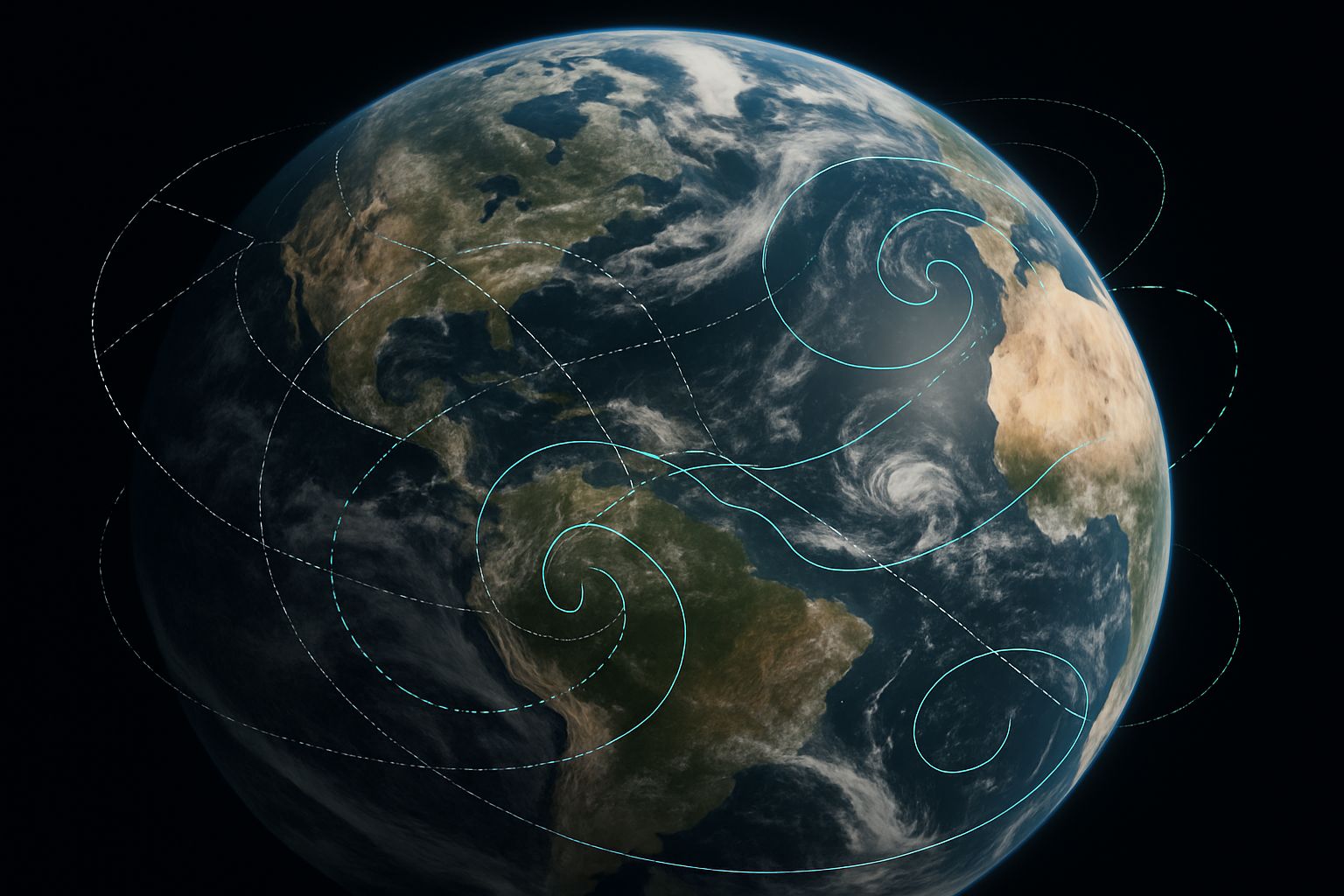
Three distinct engines power the new suite. AIGFS delivers a single best-estimate deterministic run each cycle. Collectively, these AI Weather Models form a unified backbone for routine global services. AIGEFS follows with 31 ensemble members that sample initial condition uncertainty. In contrast, HGEFS merges 31 AI with 31 physics traces, forming a 62-member grand ensemble. Moreover, every engine operates on a 0.25-degree grid, roughly 28 kilometers in spacing. Forecast length reaches 16 days for the AI components and 10 days for the hybrid product. Data output arrives every six hours in GRIB2 files mapped to standard pressure levels.
Consequently, forecasters can ingest consistent content without rewriting existing pipelines. Performance metrics reveal similar synoptic skill across the trio, yet tropical cyclone track error improves modestly. These design choices combine efficiency with familiarity for operational teams. Together, the engines supply comprehensive guidance at multiple uncertainty scales. Subsequently, attention turns to compute savings and energy impact. These AI Weather Models integrate seamlessly with existing ingest systems.
Performance And Efficiency Claims
Media outlets spotlight runtime breakthroughs first. CBS reported AIGFS consumes only 0.3 percent of the computing power required by GFS. Therefore, operational cost drops sharply without hardware upgrades. Moreover, shorter runtimes let meteorologists rerun AI Weather Models more frequently during rapidly evolving events. Expert Neil Jacobs called the shift “a significant leap forward” for national resilience. Nevertheless, training demands remain energy-intensive, as Daryl Kleist cautioned. NOAA analysts insisted that runtime numbers exclude training phases. Training Data ingestion and gradient computations still require massive accelerator clusters over weeks. Initial verification also shows roughly 18 to 24 extra hours of useful Prediction skill against GFS baselines.
- 0.3 % compute for AIGFS 16-day run
- 9 % compute for AIGEFS ensemble
- 62-member hybrid HGEFS ensemble
- 16-day Forecast horizon maintained
Efficiency promises look compelling for daily operations. AI Weather Models could run even more often as compute costs drop. However, balanced assessments weigh training energy before declaring net Climate benefits.
Hybrid Ensemble Advantage Explained
Uncertainty quantification drives decision-making in emergency management. Traditional ensembles sample perturbations within one modeling philosophy. In contrast, HGEFS blends physics and AI realizations, capturing structurally different error modes. Consequently, ensemble spread better reflects real atmospheric chaos, especially for tropical cyclone Prediction. Moreover, large-scale pattern Forecast accuracy improves when disparate members share complementary strengths.
Early case studies show narrower track error envelopes during Hurricane Sonia’s landfall simulation. Therefore, emergency planners received higher confidence probabilities while still accessing deterministic detail from AIGFS runs. Scientists view this hybrid blueprint as a template for Climate risk modeling beyond weather timescales. Nevertheless, verifying probabilistic reliability demands multi-season archives now under construction. Open Data repositories on NOMADS will support independent ensemble diagnostics. These findings support continued fusion of modeling paradigms. Subsequently, community benefits and democratization become clearer.
Benefits For Wider Community
Faster turnaround times influence more than national centers. Regional offices, private vendors, and startups can now test AI Weather Models without supercomputers. Therefore, barrier reduction accelerates innovation across agriculture, insurance, and renewable energy sectors. Additionally, open-source EPIC tooling streamlines Data access, model evaluation, and visualization. Students gain hands-on training opportunities, promoting next-generation workforce capacity.
Furthermore, compute efficiency aligns with corporate sustainability commitments, strengthening Climate governance narratives. Experts may upskill through the AI+ Data Robotics™ certification. Consequently, many local broadcasters can integrate superior guidance without capital expenditure. This democratization echoes earlier open radar initiatives that revolutionized severe storm coverage. Nevertheless, training curricula must evolve so users interpret probabilities responsibly. Community access widens the innovation funnel. Next, we examine remaining technical hurdles.
Challenges And Open Questions
Despite promise, several hurdles persist. First, AI Weather Models sometimes underestimate tropical cyclone intensity during rapid deepening. Researchers are exploring bias-correction schemes and mixed-precision retraining to mitigate the issue. Secondly, transparency around training datasets remains limited, complicating reproducibility studies. Therefore, independent audits urge NOAA to publish detailed metadata and hyperparameter logs. Moreover, energy assessments rarely account for full training lifecycle, leaving Climate impact claims uncertain.
Consequently, stakeholders debate total carbon savings across multi-year operating horizons. In contrast, physics models carry well-understood limitations but offer decades of peer review. Hybrid coexistence may thus endure longer than some advocates predict. Finally, workforce readiness lags technology, demanding new curricula for probabilistic Prediction literacy. Addressing these gaps will decide long-term success. Subsequently, strategic planning becomes essential.
Conclusion And Next Steps
NOAA’s operational launch cements machine learning as a core forecasting pillar. Moreover, AI Weather Models now deliver faster guidance at dramatically lower runtime cost. Performance improvements, hybrid ensembles, and community accessibility present compelling advantages. Nevertheless, unresolved issues around training energy, cyclone intensity, and open Data demand vigilance.
Therefore, decision-makers should balance enthusiasm with rigorous verification and sustainability audits. Professionals seeking leadership roles can strengthen credentials through targeted certifications. Consequently, now is the ideal moment to study, deploy, and refine next-generation forecasting tools. Explore the linked certification to stay ahead of the competence curve.


