

AI CERTS
3 months ago
Predictive Health AI Forecasts Future Knee X-rays And Risk
These twin outputs—synthetic X-ray and progression probability—arrived in an arXiv preprint and a MICCAI 2025 paper. Consequently, media outlets highlighted the potential to change osteoarthritis care. This introduction outlines why the advance matters and how Predictive Health AI may reshape imaging workflows.
Advancing Generative Model Tech
The Surrey model relies on latent diffusion. Therefore, it first compresses each Knee X-ray using a VQ-VAE. The latent space then guides noise removal steps that finally render the future image. In contrast, earlier GAN versions showed blur and artifact issues. Additionally, the Surrey team embedded 16 anatomical landmarks to signal where the algorithm observes change. Prof. Gustavo Carneiro noted that visual cues help clinicians trust the Forecast. Predictive Health AI thus merges image realism with interpretability.
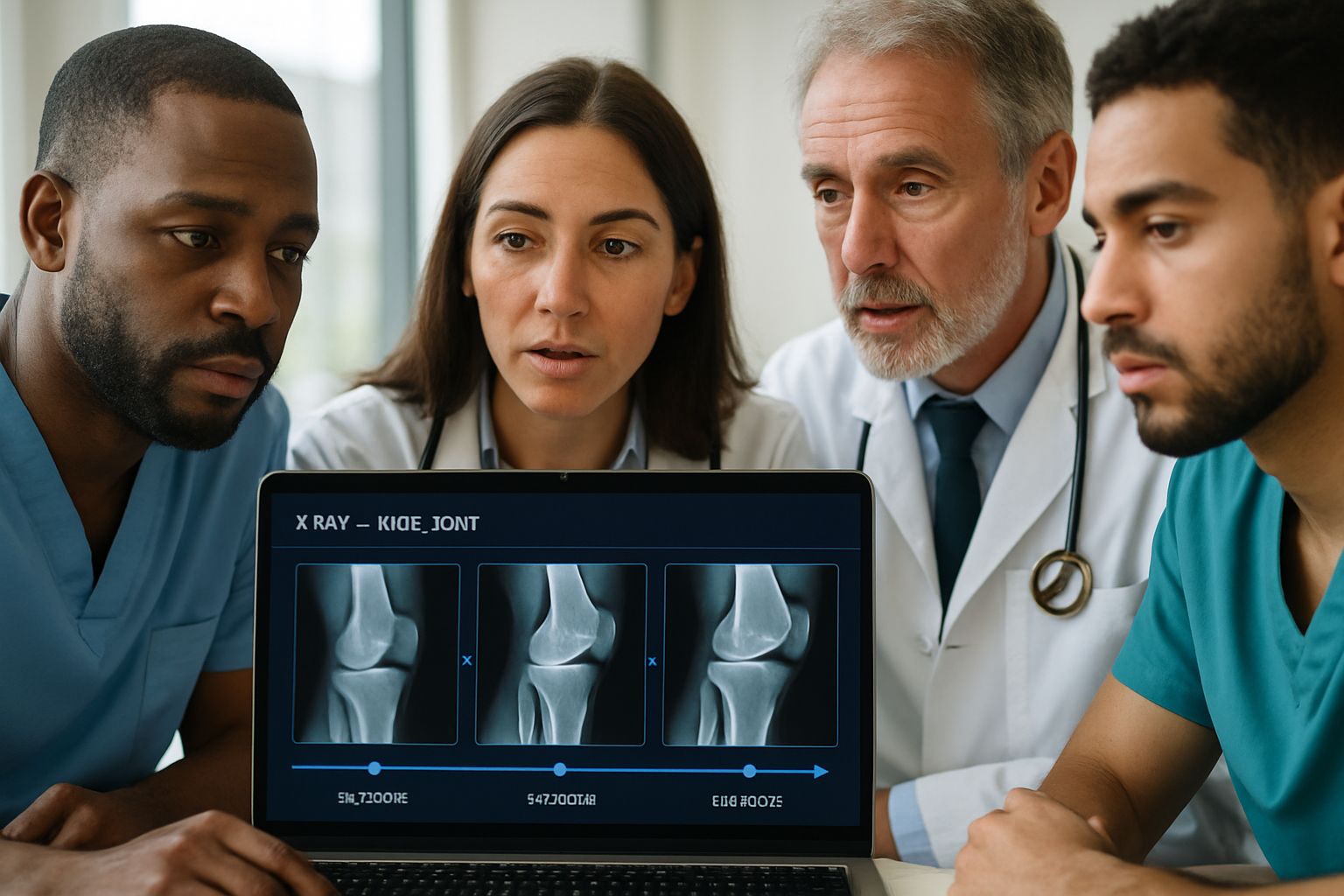
Key technical numbers underline the leap. AUC for 12-month KL progression hit 0.71, edging the previous 0.69 benchmark. Meanwhile, inference ran roughly nine times faster than the prior model. These figures arose from nearly 50,000 OAI radiographs. However, reviewers cautioned that single-dataset training threatens generalisability. These achievements illustrate current strengths. Nevertheless, wider validation remains essential.
These advances clarify the science behind image prediction. Consequently, the next section explores performance and workflow speed.
Performance And Speed Gains
Speed matters inside radiology reading rooms. Predictive Health AI produced each Forecast in under one second on a standard GPU. Furthermore, the system’s compact architecture eases hospital deployment. David Butler said, “Our approach produces realistic X-rays quickly.” Clinicians could therefore run batch analyses across thousands of Knee images overnight.
Accuracy also holds. The table below summarises headline metrics:
- AUC: 0.71 for KL progression Risk
- Landmark localisation error: 2.3 mm mean
- Inference time: 0.9 s per image (≈9× faster)
Moreover, the landmark overlay highlights tibial and femoral edges that often deteriorate first. Consequently, surgeons receive both a number and a map. Predictive Health AI therefore fulfills dual demands: quantitative precision and qualitative clarity.
These gains improve workflow efficiency today. However, clinical realities extend beyond numbers, as the next section will discuss.
Clinical Impact And Limits
Osteoarthritis burdens nearly 595 million people worldwide. Therefore, any tool that motivates earlier lifestyle change can shift outcomes. A visual Forecast may convince patients to exercise or lose weight. Additionally, physiotherapists could tailor regimens based on specific joint zones flagged by the model.
Nevertheless, risks persist. Generative algorithms may hallucinate bone spurs that never manifest. Moreover, single-cohort training can embed demographic bias. MICCAI reviewers demanded external datasets and added metrics such as sensitivity and F1. Consequently, Surrey researchers plan multi-centre trials.
Clinicians must also verify predictions before altering treatment. Regulatory frameworks classify such software as a medical device. Therefore, transparent audit trails and uncertainty quantification remain mandatory. Professionals can enhance their expertise with the AI Healthcare Specialization to master these evaluation skills.
This section underscores benefits and caveats. Key regulatory questions now come into focus.
Key Regulatory Pathway Tasks
Global regulators emphasise evidence over promises. Consequently, Surrey’s team must complete several milestones before commercial use:
- External validation on independent Knee X-ray repositories.
- Prospective trials measuring decision impact and patient outcomes.
- Submission of performance, cybersecurity, and update plans to agencies.
- Post-market monitoring with continual Risk reporting.
Moreover, explainability audits should document how the diffusion process influences output variance. In contrast, legacy black-box predictors faced adoption headwinds partly due to opacity. Therefore, Predictive Health AI’s landmark maps could satisfy emerging EU AI Act transparency clauses.
Regulatory alignment shapes deployment readiness. Next, we compare Surrey’s work with rival projects.
Comparative Industry Landscape Overview
Competitors already explore image-based progression tools. StyleGAN-derived systems from 2022 also forecast Knee degradation. However, those models showed slower run-times and limited interpretability. Additionally, MRI-based approaches require costlier scans, reducing accessibility. Predictive Health AI positions itself as faster, clearer, and reliant on standard X-ray hardware.
Furthermore, big-tech research labs are adapting foundation models to musculoskeletal images. Consequently, the field may soon feature multi-modal predictors that blend radiographs with electronic records. Surrey’s narrower yet efficient architecture could remain attractive for resource-constrained clinics.
This landscape comparison reveals both opportunity and competition. Therefore, strategic next steps deserve attention.
Next Steps For Validation
Surrey researchers have outlined an action roadmap. Firstly, they aim to release code and checkpoints under an academic license. Secondly, a consortium of UK hospitals will test the model on fresh Knee cohorts. Subsequently, feedback loops will refine diffusion parameters and reduce hallucination Risk.
Meanwhile, negotiation with PACS vendors may embed Predictive Health AI within existing viewers. Moreover, the team seeks funding for a randomised trial assessing lifestyle adherence triggered by image Forecasts. These initiatives will decide whether laboratory success becomes bedside utility.
The outlined tasks frame future traction. Consequently, a concise synthesis follows.
Conclusion
Surrey’s Predictive Health AI merges future X-ray synthesis with personalised Risk scoring. The diffusion model improves AUC, speeds inference, and adds landmark-based explanations. Moreover, it leverages accessible Knee imaging, potentially democratising Forecast tools. However, single-dataset limits, hallucination concerns, and regulatory duties persist. Consequently, external validation, clinical trials, and compliance work remain critical. Professionals intrigued by medical AI can deepen competence through the linked certification. Harness this momentum and lead evidence-based innovation today.


