

AI CERTS
5 hours ago
Scientific AI turns chaos into clear forecasts
Consequently, long-range forecasts become possible even for systems previously labeled chaotic. Boyuan Chen’s General Robotics Lab published the work in npj Complexity on 17 December 2025. Meanwhile, global media picked up the story within days. Industry leaders now ask how this advance will reshape modeling, control, and risk assessment. This article unpacks the Discovery, highlights its technical core, and considers practical implications.
Breakthrough Overview And Insights
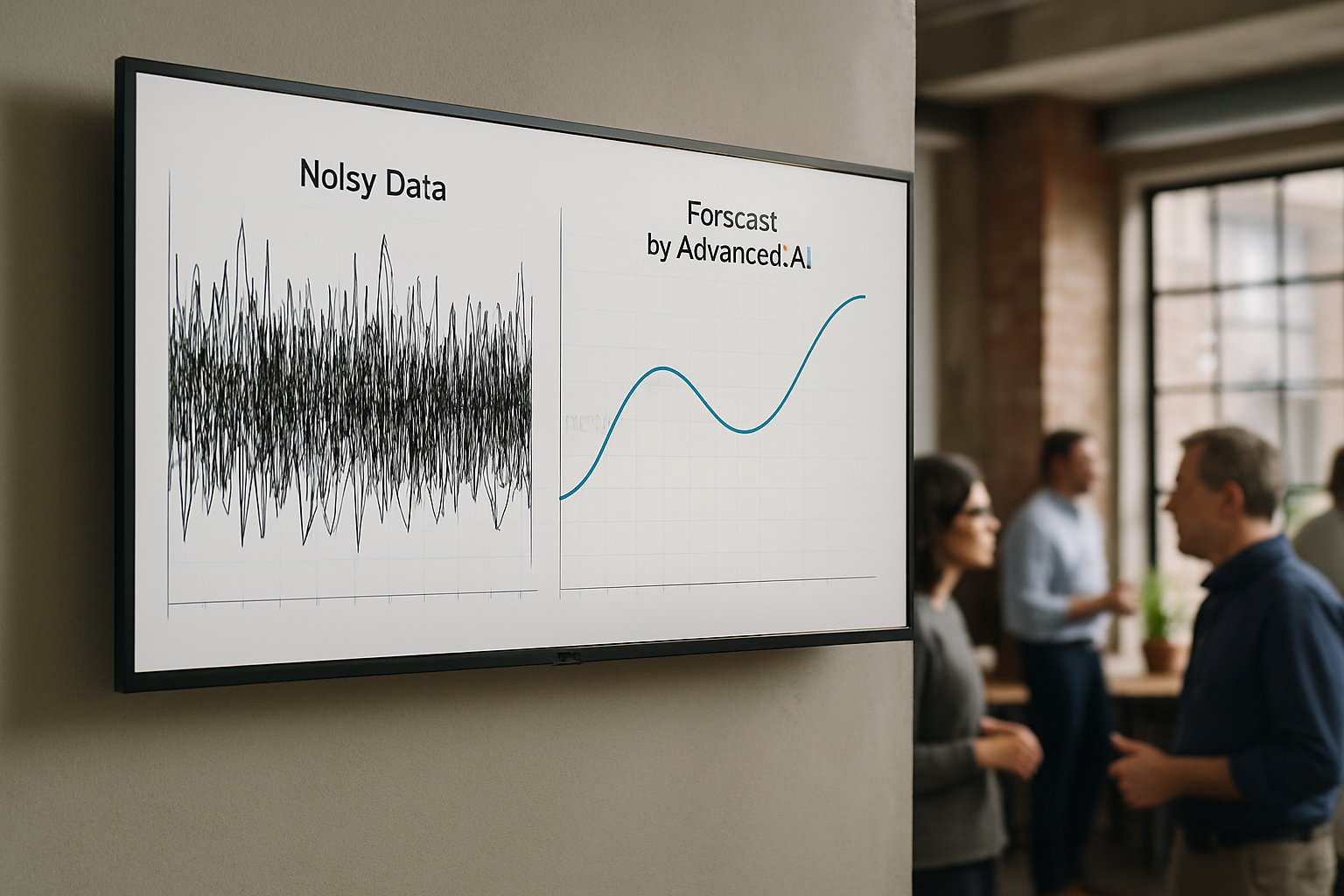
First, consider the headline result. The researchers designed an autoencoder whose latent space follows strictly linear motion. Therefore, nonlinear sensor readings map onto coordinates scientists can analyze with ordinary eigenvalue tools. Consequently, the model produced nearly two orders of magnitude less long-horizon error than baseline networks. Chaos often thwarts prediction, yet the framework extended useful forecasts on pendulum, neuron, and Lorenz-96 data. Duke engineers also highlighted interpretability advantages, noting compact three-dimensional embeddings for several benchmark cases. Such clarity turns raw readings into a navigable map of each System’s attractors and unstable directions. This Scientific AI approach targets interpretability as much as accuracy. These results signal a decisive step toward automated scientific Discovery. Consequently, Chaos becomes surprisingly traceable. Next, we examine how the team achieved this performance.
Methodology Under The Hood
The Scientific AI framework begins with time-delay embedding that stacks successive measurements into one snapshot. Subsequently, a deep encoder shrinks that vector into a low-dimensional latent coordinate. A learnable matrix then advances the latent state forward in discrete steps. Moreover, spectral penalties keep eigenvalues near the unit circle, avoiding runaway trajectories. Training follows a curriculum that gradually lengthens the prediction horizon. In contrast, earlier baselines optimized only short windows and overfit transient patterns. Optuna handled hyperparameter search, while PyTorch Lightning orchestrated efficient multigpu experiments. System identification therefore merges with modern machine learning engineering inside the same pipeline. The method mixes classic operator theory with neural training tricks. Consequently, implementation remains accessible for applied teams. Performance numbers reveal how effective these design choices proved.
Performance Metrics Compared Clearly
The paper benchmarks nine datasets spanning simulated and experimental setups. For single pendulum data, the Scientific AI model reduced rollout error by 98 percent versus baselines. Duffing oscillator experiments required six latent dimensions yet still achieved similar gains. Meanwhile, Lorenz-96 with 40 states demanded 14 dimensions but preserved forecast stability for thousands of steps. Chaos remains hard, yet this performance crosses a threshold where long-range planning becomes practical.
- Scientific AI delivers up to 100× error reduction on select benchmarks
- Latent models often 10× smaller than prior ML approaches
- Forecasts stable for 10,000 steps in several tests
Results demonstrate substantial efficiency and accuracy. Therefore, organizations gain confidence in deploying compact models. Interpretability now enters the discussion.
Interpretability And Stability Focus
Within Scientific AI, researchers framed their embeddings as approximate Koopman eigenfunctions. Consequently, each latent component carries physical meaning, such as energy or phase. Neural Lyapunov-like functions emerged, allowing empirical stability charts across the entire System. Furthermore, scientists used classical control theory to analyze those charts without black-box guesswork. Chen called this blend a bridge between data and intuition. Interpretability lifts trust beyond typical deep nets. Nevertheless, some chaotic regimes still resist simple explanation. We now turn to remaining challenges.
Limitations And Future Work
Data quality remains a gating factor. In contrast, noisy sensors can generate spurious modes and mislead stability estimates. Moreover, truly high-dimensional climate fields have yet to receive full treatment. The authors admit that Chaos with strong mixing often needs higher latent size, hurting readability. External experts also warn that linear embeddings may foster false confidence during control deployment. These caveats underscore the need for rigorous validation. Therefore, the roadmap includes larger datasets and external audits. Industry implications deserve separate focus.
Implications For Industry Adoption
Manufacturers monitor rotating machinery that can fail unpredictably. Scientific AI offers them early-warning models small enough to run at the edge. Similarly, energy utilities could study grid stability using interpretable latent coordinates. Moreover, roboticists may design agile controllers by forecasting joint chaotic motion further into the future. Professionals can enhance their expertise with the AI Educator™ certification. Consequently, certified teams will better translate Discovery into resilient operations. Duke already fields inquiries from several aerospace firms exploring pilot projects. Industry sees tangible cost and safety benefits. Meanwhile, regulators welcome transparent explanations over opaque black boxes. The final reflections follow next.
Key Takeaways
Scientific AI has moved from theoretical promise to measured performance. Duke researchers demonstrated major gains across nine datasets, edging closer to reliable forecasting amid Chaos. Interpretability, stability metrics, and compact size make the System attractive for safety-critical domains. Nevertheless, experts urge continued validation, especially where data noise or extreme dynamics threaten accuracy. Consequently, leaders should pair technical trials with workforce upskilling. Start that journey today by exploring the linked certification and staying informed about future Discovery. Furthermore, adopting interpretable tools aligns with emerging regulatory guidance on trustworthy Scientific AI across international markets. Future releases will likely extend the framework to weather models and neural population data. Therefore, early engagement offers strategic advantage.


