

AI CERTS
3 months ago
Agriculture Robotics Congresses Accelerate Farming Growth
Meanwhile, policymakers wrestle with questions around equity, data governance, and rural connectivity. Farmers from California to India witnessed live trials and tested return-on-investment calculators. Consequently, excitement meets caution in equal measure. This article unpacks the 2025 congress wave, market numbers, technology challenges, and policy trajectories. Additionally, it highlights benefits, risks, and certification paths for professionals seeking an edge. Globally, droughts and supply chain shocks intensify urgency, making automation a strategic priority. Prepare for a concise tour of the fast-maturing robotics landscape reshaping food production.
Congresses Drive Field Growth
July brought the AI for Good Summit to Geneva. There, FAO and ITU launched the Robotics for Good Youth Challenge 2025-26. Furthermore, delegates watched prototype weeders rolling across indoor plots. October shifted attention to FIRA USA in California's Central Valley. Demonstrations covered vineyards, orchards, cotton, tomatoes, and leafy greens. Consequently, growers saw autonomous tractors navigate uneven terrain at night.
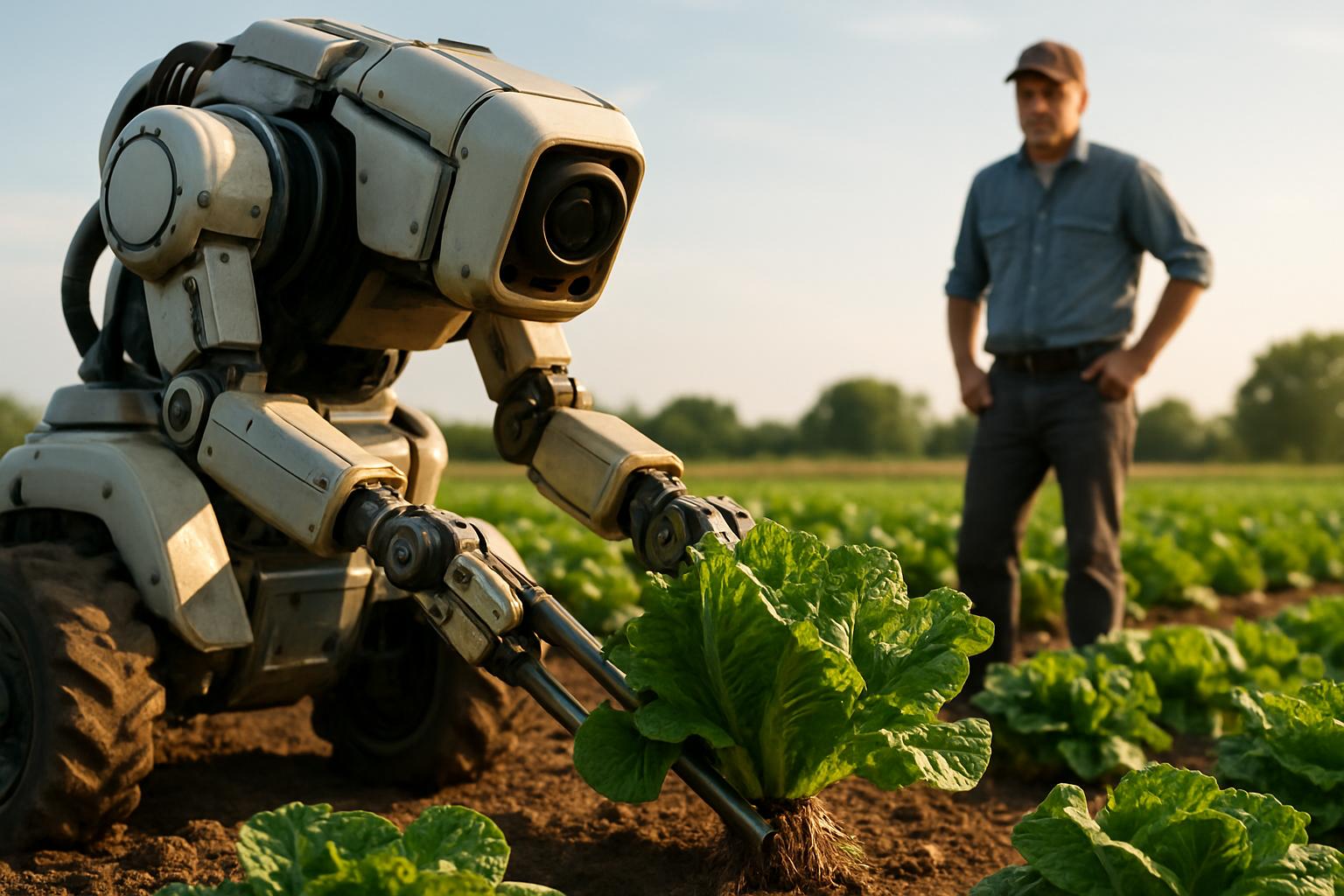
December closed the circuit with AIRSA-VBCON in Lucknow, India. Senior policymakers urged rapid digital infrastructure upgrades supporting rural youth and smallholders. Moreover, researchers presented pilot data showing herbicide savings above 60 percent. FAO Director-General QU Dongyu stressed empowerment over mere gadgetry, quoting hunger reduction goals.
These congresses propelled Agriculture Robotics momentum across continents. Therefore, investors, engineers, and Farming cooperatives now share a synchronized calendar for testing and scaling. Global events turned isolated trials into coordinated showcases. Meanwhile, diverging market numbers still complicate forecasting, as the next section explains.
Market Numbers Diverge Widely
Forecasting remains tricky for Agriculture Robotics despite evident traction. IMARC places the 2024 Agriculture Robotics market near USD 10.43 billion. In contrast, another firm reported USD 8.32 billion for the same year. Moreover, projected 2033 values swing between USD 30 and 40 billion depending on methodology. Consequently, compound annual growth estimates stretch from 15 to 25 percent. Such variance confuses boardrooms seeking investment certainty.
- Driverless tractor segment shows 20% CAGR in several reports.
- UAVs retain the largest 2025 revenue share at roughly 35%.
- Precision sprayers like See & Spray treated millions of acres during 2025.
- Robotics-as-a-Service models increasingly attract small and mid-size farms.
Meanwhile, analysts advise scrutinizing methodology notes before citing any headline figure. Therefore, stakeholders in Farming communities use ranges rather than point predictions when budgeting. These contrasting numbers underline the importance of ground truth validation, discussed in the next section.
Technology Stack Challenges Persist
Shiny demos hide persistent engineering headaches. Robots must perceive crops under shifting light, dust, and foliage occlusions. Moreover, soft fruit often bruises under rigid grippers. Researchers therefore advance dexterous end-effectors with compliant materials. Localization adds complexity when GNSS signals drop behind tall trees.
Battery endurance also limits long duty cycles. In contrast, diesel hybrid platforms raise Climate concerns about emissions. Agriculture Robotics developers experiment with swappable battery packs and solar charging mats. Additionally, interoperability across brands demands open protocols and secure data pipelines. Universities in the United States and India conduct multi-vendor field trials to address standards. Researchers in Europe publish open datasets to accelerate benchmarking under varied soil and light conditions.
Technical bottlenecks slow Agriculture Robotics scale but spur collaborative innovation. Consequently, benefits and risks remain tightly coupled, framing the next benefits discussion.
Benefits Inspire Global Farms
Despite hurdles, benefits motivate early adopters. See & Spray users report Agriculture Robotics reducing herbicide use by over 60 percent across several crops. Moreover, precision harvesters maintain consistent quality, boosting pack-out prices. Labor shortages in many Farming regions also push demand for autonomous fleets.
- Night-time operation improves machinery utilization and harvest windows.
- Targeted application lowers runoff, supporting Climate resilience goals.
- Data logs feed insurers, lenders, and carbon programs with verifiable performance records.
Moreover, robotics collected detailed plant health maps that support early disease intervention and targeted nutrition plans. Agriculture Robotics therefore offers stacked agronomic, economic, and environmental gains when deployed responsibly. Nevertheless, upfront costs threaten inclusion unless new business models spread risk. These advantages keep venture funding flowing even during market corrections. However, policy architecture determines who benefits, as the following section details.
Policy Shapes Inclusive Adoption
Governance discussions matured alongside technical showcases. FAO and ITU prioritize ethics, transparency, and smallholder access within every Agriculture Robotics pilot. Additionally, Indian states prepare agri-AI budgets exceeding INR 500 crore for connectivity and training. In contrast, some regions still lack broadband, undermining remote supervision capabilities. Therefore, policymakers endorse Robotics-as-a-Service to lower capital barriers.
Carbon pricing schemes and sustainable procurement policies further incentivize low-input robotic operations. Professionals can enhance their expertise with the AI Data Robotics™ certification. Moreover, such credentials help bridge workforce skill gaps highlighted during AIRSA-VBCON panels. Stakeholder workshops encourage cooperative governance models that balance innovation incentives with farmer protections.
Inclusive regulation aligns commercial innovation with food security goals. Subsequently, the final section outlines near-term actions for stakeholders.
Outlook And Action Steps
Stakeholders now face a decisive window. Agriculture Robotics deployments will expand fastest where broadband, capital, and training intersect. Furthermore, Farming cooperatives can share subscription fleets to dilute risk and accelerate learning. In India, state incentives already reduce adoption friction for small and marginal growers. Meanwhile, Climate volatility increases the urgency for precise, low-input operations.
Consequently, vendors must publish transparent performance data and embrace open safety standards. Moreover, cross-industry standards bodies will meet early next year to finalize safety test protocols. Professionals should therefore pursue continuous learning and recognized credentials. Explore the linked certification today and join the community shaping sustainable food systems.


