

AI CERTS
6 months ago
Z.ai GLM-4.7 boosts open coding agents
The announcement positions the system as a targeted upgrade for software creation, reasoning, and long-horizon agent workflows. Furthermore, open weights arrived immediately on Hugging Face, ModelScope, and through a turnkey API. Early vendor benchmarks claim new state-of-the-art scores across several respected software leaderboards. Nevertheless, practitioners still ask whether numbers hold outside curated test harnesses.
This article dissects the launch, performance data, technical advances, deployment realities, and competitive context. Along the way, we highlight opportunities, caveats, and next steps for enterprise engineering leads. Read on to decide if the upgrade fits your roadmap.
Release Timeline And Availability
Immediately after publishing its research note, Z.ai opened repository pages for the new release. Release assets include full weights, documentation, and quick-start scripts on Hugging Face and ModelScope. Meanwhile, API endpoints integrated Z.ai GLM-4.7 into the existing GLM Coding Plan with no migration work. Additionally, OpenRouter support lets developers swap the engine inside established tooling by changing one URL. Therefore, teams can evaluate the offering within hours rather than days.
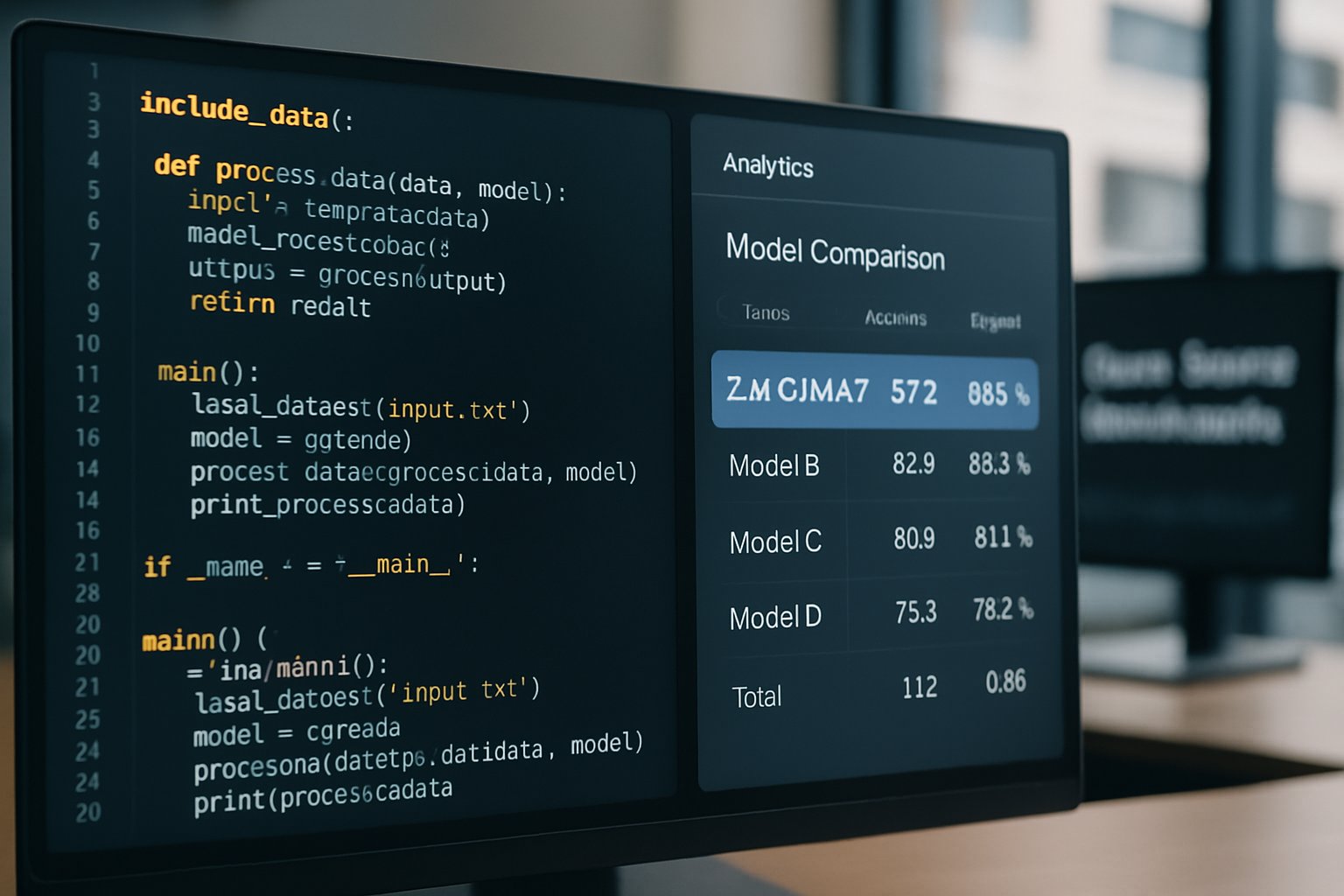
In short, distribution breadth signals serious intent from the vendor. Consequently, adoption barriers appear lower than previous iterations, setting the stage for performance scrutiny.
Performance Benchmarks At A Glance
Vendor numbers suggest sizable leaps over GLM-4.6 across popular suites. Moreover, the company claims several open-source firsts. The figures below summarise headline results.
- SWE-bench Verified: 73.8% (+5.8%)
- SWE-bench Multilingual: 66.7% (+12.9%)
- Terminal Bench 2.0: 41.0% (+16.5%)
- LiveCodeBench v6: 84.9 (open-source SOTA)
- τ²-Bench: 87.4 (open-source SOTA)
Furthermore, the 200K token context window dwarfs many rivals and underpins long refactor sessions. Z.ai GLM-4.7 ranks near closed engines on the demanding Humanity’s Last Exam reasoning test. Nevertheless, these statistics originate from internal runs without independent replication. Industry analysts therefore urge caution until cross-lab evaluations confirm parity. Overall, the reported uplift strengthens open-weight momentum yet still needs external validation.
Benchmark improvements look impressive on paper. However, real-world tests will reveal sustained value, leading to the technical discussion ahead.
Technical Advances For Agents
Beyond raw accuracy, the release introduces three “thinking” modes that plan before emitting tool calls. For agentic workflows, preserved reasoning blocks persist across turns, reducing redundant compute during long exchanges. Additionally, developers may disable reasoning to cut latency when simple completions suffice. Interleaved thinking meanwhile intersperses analysis and action, improving multi-step terminal flows. Moreover, aesthetic “Vibe Coding” tweaks aim to generate polished front-end assets without extra fine-tuning. Z.ai GLM-4.7 also includes tuned function calling that aligns with popular frameworks like Claude Code and Cline. Consequently, integrating the new model into existing agent stacks should require minimal glue code.
These advances enhance agent stability and output quality. The next section compares the model against heavyweight competitors to contextualise gains.
Competitive Landscape And Comparisons
In contrast, closed titans like OpenAI, Anthropic, and Google guard their newest parameters. However, vendor-stated scores place the open release neck-and-neck with many proprietary flagships. For example, LiveCodeBench parity suggests similar bug-fix success rates versus GPT-5.x Codex variants. Nevertheless, license freedom delivers a distinct strategic edge for organisations requiring on-prem data governance. Meanwhile, China-based researchers celebrate the advancement, viewing it as proof domestic talent can compete at frontier scale. Yet Western teams must still consider export-control obligations when procuring compute for the large model. Overall, choice now extends beyond proprietary paywalls, energising the broader open community.
Competitive pressure benefits end users through faster iteration and falling prices. Subsequently, deployment logistics demand closer inspection.
Deployment Costs And Hardware
Running full-precision checkpoints still demands heavyweight infrastructure. Z.ai advises clusters of H100 or H200 GPUs when running Z.ai GLM-4.7 at full precision. Moreover, memory footprints stretch into the multi-hundred-gigabyte range, straining smaller on-prem rigs. Consequently, many teams will favour the FP8 or quantised variants despite modest accuracy drops. Developers who stay cloud-native can instead subscribe to the GLM Coding Plan, which starts near three dollars monthly. Therefore, budget forecasts hinge on workload mix, latency needs, and whether strict data residency rules apply. Professionals can enhance their expertise with the AI Project Manager™ certification, ensuring smoother deployment governance.
In summary, hardware planning remains critical before large-scale rollout. The following section weighs benefits against persistent risks.
Opportunities And Caveats
Open weights empower security-sensitive industries to run audits and inject domain data offline. Moreover, the 200K token window enables complete multi-file reviews in one prompt. However, early testers report occasional hallucinated variables and runaway refactors. Consequently, human oversight remains mandatory, especially for production pipelines. Analysts also note that vendor benchmarks lack independent confirmation, particularly outside controlled lab settings. In contrast, community trials reveal performance variance depending on prompt engineering quality and tool wrappers. Z.ai GLM-4.7 therefore stands as a promising yet unverified workhorse rather than a silver bullet.
These mixed signals underscore prudent pilot testing before enterprise adoption. Next, we distil strategic takeaways.
Strategic Takeaways And Outlook
When weighed holistically, the release advances open ecosystems in three dimensions. Firstly, it narrows accuracy gaps with closed competitors while retaining permissive licensing. Secondly, it strengthens agent tooling through embedded thinking modes and long context. Thirdly, it showcases continued research momentum within China’s fast-growing AI sector. Nevertheless, compute budgets, benchmark verification, and governance policies still dictate real adoption speed. Organisations prioritising transparency will value that Z.ai GLM-4.7 arrives with reproducible assets and community extensions. Meanwhile, rivals must respond, accelerating innovation across the landscape. In the near term, expect intense benchmarking and rapid quantisation work. Strategic leaders should prepare evaluation sandboxes and cross-vendor pipelines now. These preparations will shorten decision cycles once independent scores surface.
Z.ai GLM-4.7 could redefine open development standards. However, disciplined testing separates hype from durable capability, linking directly to the conclusion below.
Z.ai GLM-4.7 delivers measurable open performance and expanded agent features, yet prudent diligence remains vital. Moreover, independent labs must rerun benchmarks before executives commit mission-critical workloads. The model still demands formidable GPUs, especially outside cloud subscriptions. Nevertheless, low entry pricing and permissive licensing lower experimentation friction for diverse teams worldwide. China watchers see the launch as further evidence local innovators can match Western pace. Meanwhile, enterprises seeking accountable governance should pursue internal project management skills. Professionals can pair Z.ai GLM-4.7 pilots with the AI Project Manager™ credential to strengthen oversight. Consequently, informed testing today may unlock durable productivity gains tomorrow. Act now: assemble your evaluation squad, launch controlled trials, and share findings with the community.
Disclaimer: Some content may be AI-generated or assisted and is provided ‘as is’ for informational purposes only, without warranties of accuracy or completeness, and does not imply endorsement or affiliation.


