

AI CERTS
6 months ago
Why Old Languages Still Power Critical Systems in 2025
Furthermore, we analyze fresh data from TIOBE, Stack Overflow, and market researchers about language endurance. We highlight emerging tooling, financial stakes, and strategic guidance for risk-averse teams. Moreover, we integrate quotes from Paul Jansen and HPC scientists to ground the narrative in evidence. Whether you manage C++, Java, or COBOL estates, the same modernization dilemmas apply.
Finally, readers will find a precise checklist and a proactive certification path. Consequently, you will leave equipped to debate boards, brief regulators, and guide modernization budgets. Keep reading to learn why the world still trusts code written before many current Developers were born.
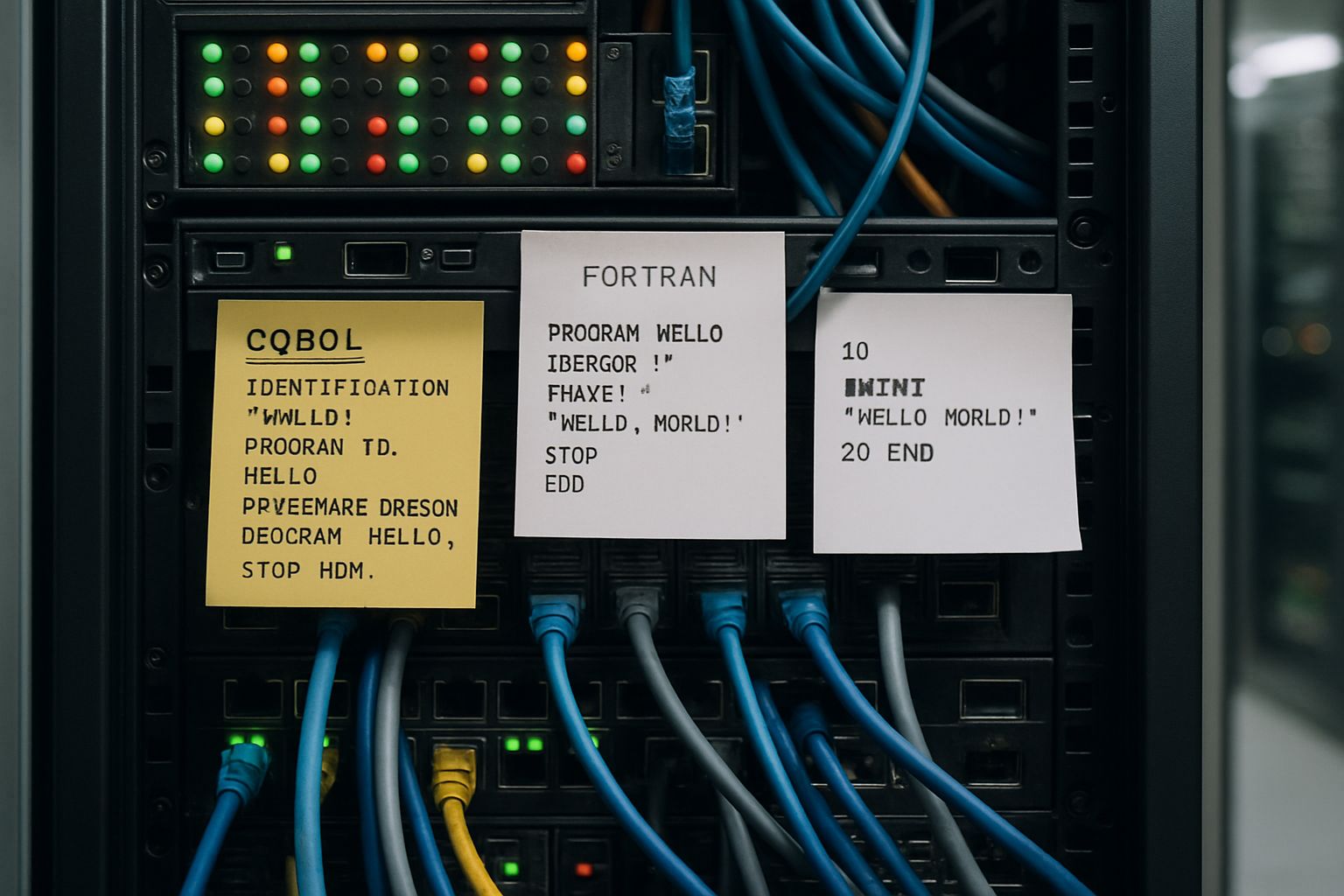
Stubborn Production Code Reality
Banks handle trillions yearly with applications written in Old Languages like COBOL and RPG. Research & Markets estimates roughly 220 billion COBOL lines still execute worldwide. Additionally, more than 70% of Fortune 500 retain mainframes for core processing. Consequently, replacing every module would require budgets rivaling infrastructure megaprojects.
Government agencies mirror that dependency. For instance, the U.S. Social Security Administration still maintains over sixty million COBOL lines. During the pandemic, outdated unemployment systems delayed payments and, according to economists, shaved $40 billion from GDP. Therefore, executives see production stability as existential. This reality frames every modernization conversation. Legacy scale is massive; ignoring it courts unacceptable risk. However, financial considerations also shape decisions.
Economics Behind Old Choices
Every modernization roadmap collides with hard economics. Moreover, institutions invested billions in Old Languages over decades, amortizing costs across stable hardware cycles. Rewriting eliminates that capital investment while introducing conversion hazards. Consequently, CFOs evaluate modernization like any merger: value preservation outranks novelty.
Talent scarcity raises stakes further. Experienced COBOL Developers often command premium salaries because few graduates learn the syntax today. Meanwhile, high turnover among Java and C++ engineers complicates wholesale rewriting strategies. Therefore, many firms prefer incremental API wrapping, which spreads cost across fiscal years.
Budget logic thus reinforces language persistence. In contrast, emerging modernization momentum offers fresh incentives.
Recent Modernization Momentum Rise
The last twelve months delivered notable shifts. AWS, Google Cloud, and IBM expanded mainframe modernization toolkits targeting Old Languages workloads. Additionally, AI-assisted refactoring prototypes promise semi-automatic COBOL to Java migrations with human validation loops. LFortran and Python front-end projects now bridge scientific Developers to established numerical kernels.
Moreover, TIOBE rankings showed modest ascents for Fortran and Delphi during 2025, signalling renewed attention. Paul Jansen remarked that pragmatism, not nostalgia, drives the trend. Consequently, vendors launched marketing that recasts incremental modernization as innovative rather than reactive. Toolchains now lower initial barriers, yet they do not eliminate risk. Subsequently, understanding tooling limitations becomes essential. The next section dissects the tooling wave.
Tooling And Cloud Push
API gateways like IBM z/OS Connect wrap Old Languages functions as secure REST endpoints. Furthermore, AWS Mainframe Modernization offers automated code analysis, dependency mapping, and testing harnesses. Google engineers integrate Anthos for rehosting workloads without code changes. Meanwhile, open-source translators attempt COBOL to Java bytecode conversion with variable accuracy. Therefore, governance teams must validate each generated artifact thoroughly.
Powerful tools speed pilots; disciplined testing still determines success. Next, we explore why many engineers remain emotionally attached to familiar syntax.
Why Developers Stay Loyal
Legacy engineers defend Old Languages for pragmatic reasons rather than sentimentality. Firstly, decades of bug fixes mean production incidents are rare. Secondly, COBOL handles fixed-point arithmetic better than many modern alternatives. Thirdly, Fortran remains optimized for vector and array computations essential in climate research.
Moreover, mature tooling exists for debugging, profiling, and batch scheduling on mainframes. Consequently, performance regressions after rewrites frequently exceed tolerance thresholds. In contrast, disciplined Developers can employ modern CI pipelines even around assembler exits. Trust, performance, and familiarity thus bind experts to existing code. However, risks grow as retirement waves hit the workforce.
Risks Of Rapid Rewrite
Failed migrations litter the industry press. For example, a banking group lost customers after a rushed C++ substitution for legacy COBOL. Additionally, regulators require parallel operation until new code proves identical, doubling operational expense. Moreover, undocumented business rules often disappear during specification meetings. Therefore, complete rewrites can introduce hidden compliance gaps that trigger fines.
Key risks include:
- Data loss from schema drift
- Unexpected latency due to chatty microservices
- Talent shortages delaying feature parity
Old Languages rarely break silently, yet new stacks often do. Consequently, organizations need structured evaluation frameworks before commissioning large rewrites. Next, we outline a balanced modernization path.
Balanced Path Forward
Hybrid strategies combine rehosting, API exposure, and selective microservice extraction. Consequently, mainframe cores running Old Languages stay untouched while new channels innovate quickly. IBM, AWS, and Google all market such approaches with managed testing pipelines. Moreover, AI tools now summarize copybooks, reducing discovery timelines by weeks.
Professionals can enhance their expertise with the AI Cloud Architect™ certification. Consequently, credentialed leaders can guide teams through incremental transformation sprints. Balanced methods keep uptime high and budgets predictable. Nevertheless, success depends on disciplined governance and ruthless test automation. Old Languages can coexist with cloud microservices when boundaries remain explicit.
Conclusion And Next Steps
Modernization has matured, yet Old Languages are nowhere near retirement. Consequently, executives must balance risk, talent, and cost rather than chase hype alone. Incremental rehosting, thorough testing, and AI-assisted analysis offer pragmatic progress. Meanwhile, fresh certifications build credibility for architects steering these complex transitions. Therefore, explore the linked AI Cloud Architect™ pathway and prepare your team for resilient innovation.
Disclaimer: Some content may be AI-generated or assisted and is provided ‘as is’ for informational purposes only, without warranties of accuracy or completeness, and does not imply endorsement or affiliation.


