

AI CERTS
6 months ago
Giant Microwaves Reshape Future War Doctrine
This article explains how giant microwave systems reshape battle calculus. It examines recent contracts, capabilities, drawbacks, and market forces. Readers gain a concise guide to decisions shaping the next decade. Finally, professionals learn where certifications, like the AI+ UX Designer™ credential, fit new talent demands.
Why Microwave Tech Matters
High-power energy weapons once filled science fiction. Nevertheless, Microwave systems now occupy real procurement lines. Engineers generate gigawatt pulses through compact gallium-nitride modules. Consequently, emitters overload drone circuitry within milliseconds.
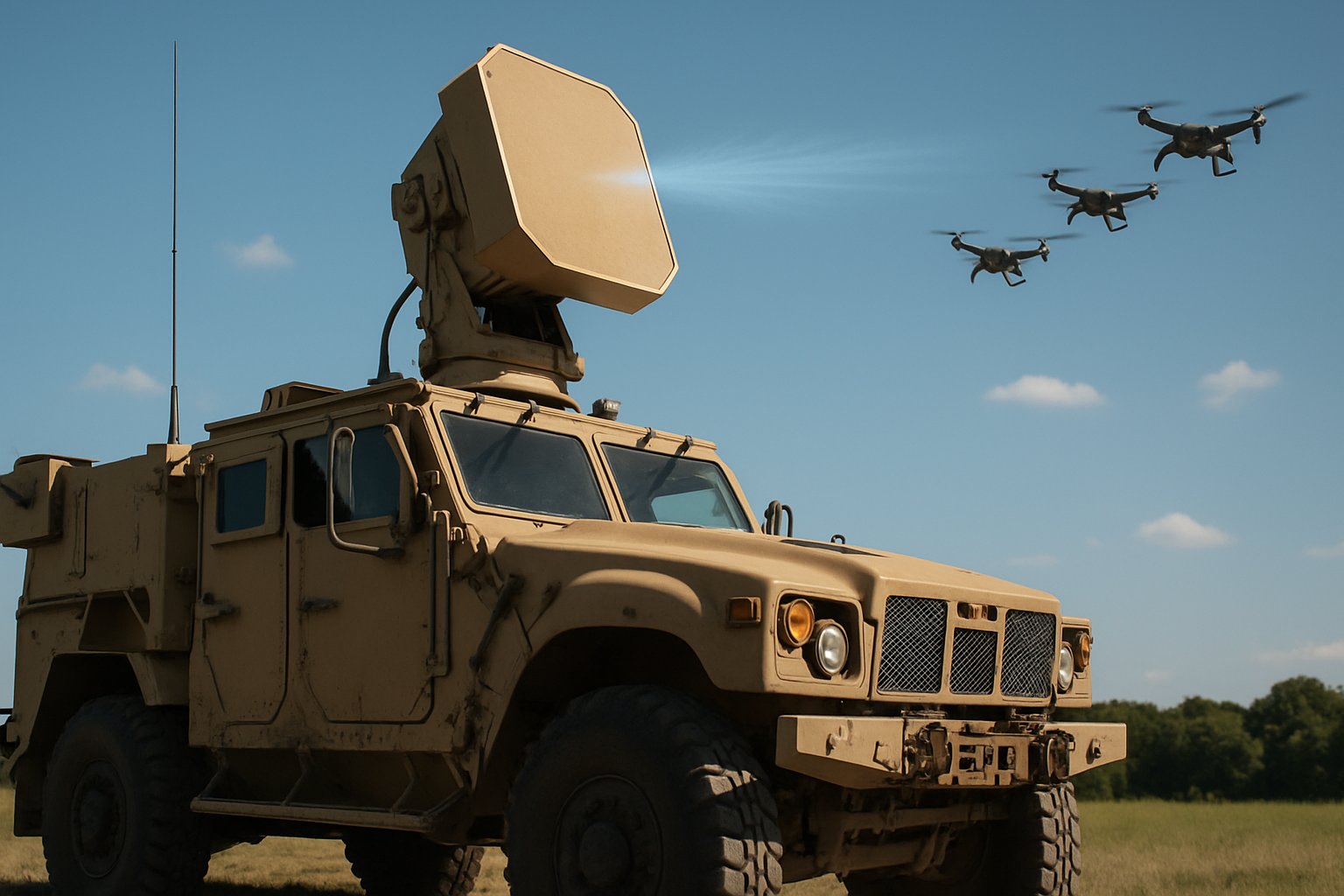
Such speed reshapes command timelines. Therefore, Future War planners treat electromagnetic dominance as critical as air superiority. Current prototypes fit on pallets, yet export credible pulse power.
Unlike lasers, wide-beam HPM demands less pointing precision. Moreover, one pulse can neutralize several airborne robots simultaneously.
These traits explain renewed interest in the technology. However, understanding recent milestones clarifies how quickly programs progress.
Key Recent Program Milestones
U.S. Shapes Future War
On 17 July 2025, Epirus secured a $43.5 million contract for IFPC-HPM Generation II. Consequently, range doubled and power increased thirty percent compared with earlier units. AFRL meanwhile evolves THOR into the Mjölnir prototype, aiming for producible counter-swarm systems. Demonstrations at Camp Atterbury disabled sixty-one drones with one Leonidas firing, according to vendor video. Leonidas, a truck-mounted Microwave array, validated swarm engagement claims under Army observation. U.S. Military observers praised the quick reset time.
China Accelerates Parallel Development
China debuted Hurricane-series mobile emitters during the 2024 Zhuhai Airshow. In contrast, later field tests reportedly integrated the weapons into PLA cyber-electromagnetic doctrine. Analysts warn the pairing could unsettle regional deterrence and escalate Future War scenarios.
These milestones prove prototype status is ending. Subsequently, attention shifts toward operational advantages and gaps.
Capabilities And Tactical Impact
HPM effects travel at light speed, eliminating ballistic lead times.
Moreover, a broad beam creates an electronic umbrella that protects bases without expensive interceptors.
For commanders, the deep magazine matters financially. Realistic drills show emitters recycle in under five seconds.
Nevertheless, mission planners must model collateral disruption to friendly radios.
- Engages multiple unmanned systems simultaneously
- Delivers near-zero cost per additional shot
- Provides tunable, reversible effects when required
- Reduces logistics burden compared with missile stocks
These benefits elevate HPM to a centerpiece of Future War doctrine across several services. A single Microwave burst covers an entire swarm geometry. Therefore, Military analysts highlight improved defense of ammunition depots.
Capability conversation now moves from lab tables to rulebooks. However, real limitations still constrain adoption.
Limitations And Ethical Risks
Field units still require significant prime power and cooling hardware. Consequently, truck-mounted emitters struggle to accompany fast maneuver forces.
Collateral interference remains another hurdle. In contrast, hardened electronics or optical command links reduce weapon effectiveness.
Legal scholars note International Humanitarian Law demands discrimination. Military lawyers now draft guidance on acceptable engagement envelopes. Spectrum regulators fear widespread interference with commercial aviation beacons.
Technical gaps and legal uncertainty slow procurement schedules. Nevertheless, industry investment continues to grow.
Market Growth And Players
IMARC values the broader directed-energy market at $8.6 billion in 2024. Furthermore, MRFR predicts the HPM segment may reach $10.1 billion by 2035.
Epirus, Thales, and Norinco lead commercial offerings. Research giants also forecast employment growth for design engineers and data scientists.
Meanwhile, smaller suppliers build gallium-nitride amplifiers and pulse capacitors. Military procurement documents confirm rising budgets for counter-drone trials. Investors view HPM as a hedge on Future War spending cycles.
Professionals can enhance their expertise with the AI+ UX Designer™ certification.
Capital flows follow credible test data. Therefore, skills development must keep pace with hardware advances.
Preparing For Operational Adoption
Doctrine writers now craft electromagnetic annexes for joint plans. Moreover, test ranges schedule live drone swarms to generate empirical data.
Agencies coordinate with spectrum regulators to avoid civilian outages. Units also practice combined cyber and HPM attacks to simulate Future War contingencies.
Consequently, tactical schools request new curricula covering HPM safety and equipment handling. Subsequently, acquisition offices plan multiyear buys tied to battery advancement trajectories.
Education underpins safe deployment and innovation. Meanwhile, leadership must align doctrine, training, and industry timelines.
Conclusion And Next Steps
High-power HPM systems have crossed the threshold from research to limited fielding. Consequently, policymakers no longer ask whether to fund them, but how quickly to scale. The evidence shows giant Microwave arrays can defend vital assets at a fraction of missile costs. Nevertheless, power, legal, and spectrum challenges require balanced governance. Future War will reward forces that integrate electromagnetic fires, resilient networks, and skilled operators. Therefore, every Military stakeholder should begin experimentation today. Future War readiness also demands continuous learning. Explore emerging courses and certifications to maintain a decisive edge.
Disclaimer: Some content may be AI-generated or assisted and is provided ‘as is’ for informational purposes only, without warranties of accuracy or completeness, and does not imply endorsement or affiliation.


