

AI CERTS
3 months ago
Apple Clustering Faces Rising Memory Costs
Moreover, the cluster achieved respectable token throughput on models exceeding 200 billion parameters. Researchers cheered the prospect of sub-$40k large-model inference without a noisy GPU rack. However, the celebration coincides with a brutal global DRAM squeeze. TrendForce data shows triple-digit price spikes as suppliers divert wafers toward high-bandwidth stacks. Therefore, the same expanded RAM that fuels these clusters is growing more expensive daily. This article unpacks the technical breakthrough, the economic storm, and the strategic implications for professionals. Each section ends with concise takeaways and clear next steps.
Apple Clustering Core Basics
Apple Clustering combines two existing ingredients. Firstly, Apple Silicon uses unified Memory shared by CPU, GPU, and Neural Engine. Secondly, macOS 26.2 now supports Remote Direct Memory Access across Thunderbolt Five cables. Consequently, each Mac can read another machine’s RAM almost as fast as local access.
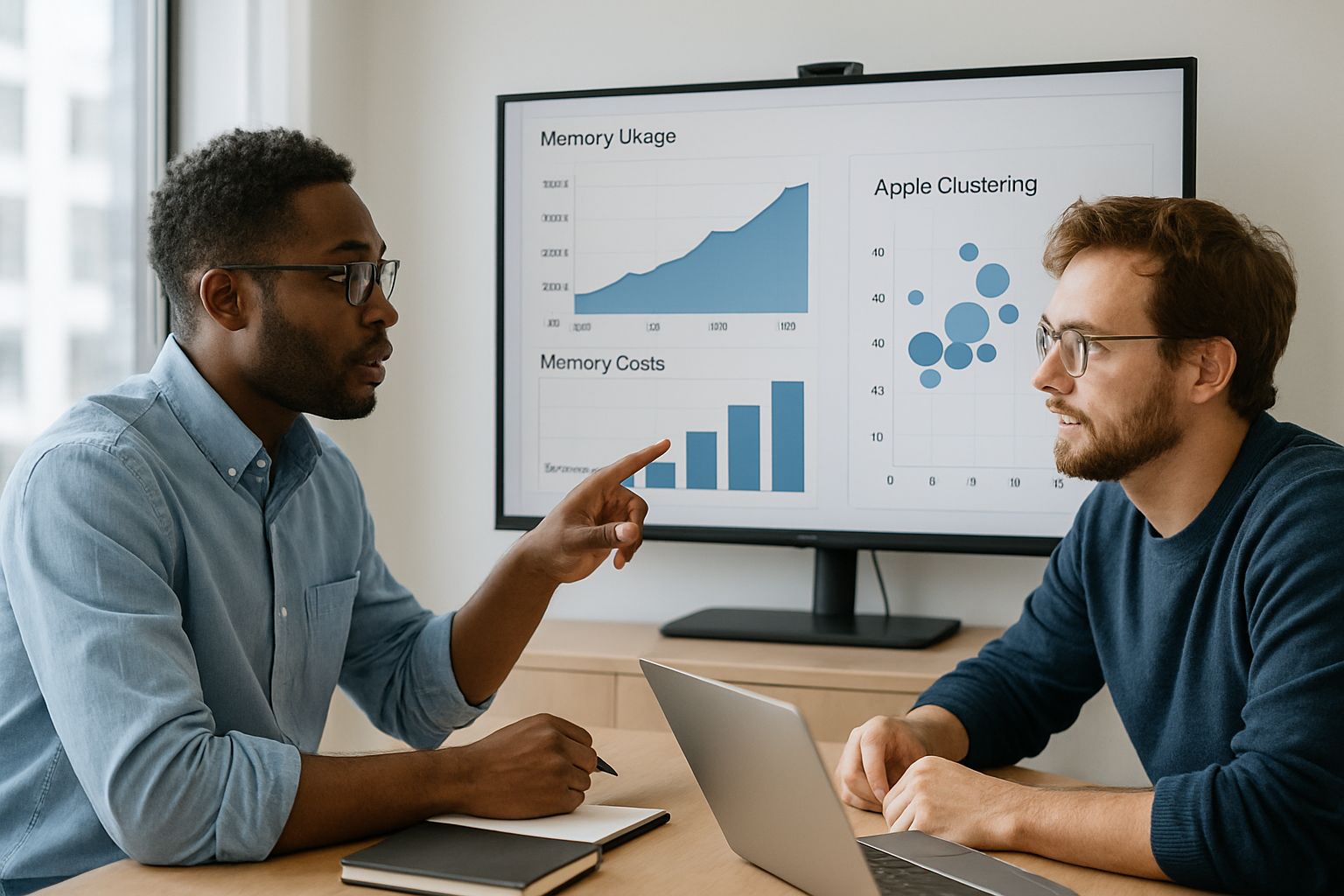
Geerling enabled the feature with Exo and a simple rdma_ctl flag inside recovery mode. Subsequently, software treated the four nodes as one logical address space. Developers reported negligible latency penalties for batch inference workloads. These fundamentals explain why Apple Clustering excites labs seeking inexpensive experimentation.
In short, pooled RAM over Thunderbolt transforms ordinary desktops into miniature supercomputers. However, technology alone does not guarantee sustainable economics, which our next section explores.
RDMA Over Thunderbolt Five
Apple Clustering relies on the raw bandwidth of Thunderbolt Five’s 80-gigabit channels. Furthermore, RDMA bypasses kernel networking stacks, reducing CPU overhead and jitter. Testers measured round-trip latencies under three microseconds, fast enough for transformer inference shards. Nevertheless, the daisy-chain topology caps clusters at four to six devices until switches reach market.
Mac mini owners asked whether their smaller systems could join the party. In contrast, Apple restricts Thunderbolt Five controllers to M3-Pro and above, limiting compatibility today. Therefore, most successful setups use Mac Studio or Mac Pro hardware.
Lightning-fast RDMA creates the technical foundation, yet cost efficiency determines adoption. The following segment dissects those dollars and cents.
Cost Efficiency Debate Continues
Early blogs claimed Apple Clustering halves inference costs versus comparable GPU servers. Moreover, Geerling spent about forty thousand dollars for his 1.5-terabyte configuration. He noted power draw below five hundred watts during sustained tests. Consequently, electricity savings compound over time, improving total cost of ownership.
- Pooled unified Memory: 1.5 TB
- Cluster price: $38-40k
- Tokens per second scaling: up to 2.8× on four nodes
Nevertheless, these numbers assume stable component pricing. Rapid DRAM inflation threatens that assumption, as the next section reveals.
Affordable entry costs made the concept viral among researchers. However, market forces already challenge that narrative.
Market Memory Squeeze Impact
TrendForce recorded a 171.8 percent year-over-year jump for server DRAM contracts in Q3 2025. Moreover, Samsung raised DDR5 prices up to sixty percent during November alone. Reuters quoted analysts calling the shortage a macroeconomic risk. Meanwhile, allocations favor HBM used by hyperscale accelerators, starving consumer lines.
Apple Clustering depends on abundant high-capacity unified Memory modules, which Apple sources from the same constrained suppliers. Consequently, future Mac Studio builds with 512-gigabyte Memory may become scarce or premium priced. Mac mini configurations already top out at 64 gigabytes, limiting their role in serious clusters. Therefore, any long-term plan must price in further volatility.
Soaring component costs could erase the headline savings within months. Our next section evaluates workload suitability to judge enduring value.
Workload Fit Issues Persist
Not every inference task benefits from Apple Clustering. Large mixture-of-experts models demand ultra-low latency fabrics like InfiniBand. Additionally, training workflows require high bandwidth HBM that unified Memory cannot match. Software support also lags; PyTorch plugins exist, yet TensorFlow patches remain experimental.
Mac mini hobby rigs often crash when saturating links because cooling and power delivery differ. Nevertheless, small language model serving, vector search, and audio processing scale well across four desktops. Therefore, organizations must profile workloads before purchasing hardware.
Technical limitations narrow the sweet spot for the technology. However, expert guidance clarifies realistic expectations, as our next voices show.
Expert Voices Speak Out
Jeff Geerling said, “RDMA lets Macs act like one giant pool of RAM.” Consequently, he believes small teams can postpone cloud spending. In contrast, analyst Sanchit Vir Gogia warned, “The memory shortage poses a macroeconomic risk.”
Market trackers echo that sentiment, predicting tight supply through 2027. Therefore, decision makers should weigh agility against long-term sustainability.
Expert commentary underscores both promise and peril. The final section offers actionable next steps.
Strategic Next Steps Ahead
Organizations evaluating Apple Clustering should perform a structured feasibility review. Firstly, benchmark priority models on a single node and document RAM needs. Secondly, source pricing quotes for high-capacity builds while factoring projected DRAM hikes. Additionally, track Thunderbolt Five switch announcements that may unlock larger fabrics.
- Model profiling and memory mapping
- Supplier negotiations for future-dated contracts
- Continuous firmware and driver monitoring
Professionals can sharpen skills through the AI+ Government™ certification. Consequently, they gain structured knowledge for secure, efficient cluster deployment.
Methodical planning maximizes the benefits of this emerging model. Finally, a balanced conclusion ties the insights together.
Apple Clustering proved that consumer desktops can punch above their weight in AI inference. Thunderbolt Five RDMA delivers impressive speed, while unified RAM simplifies deployment. However, volatile DRAM markets threaten the economics that fuel current enthusiasm. Moreover, topology limits and immature tooling still constrain large-scale adoption. Nevertheless, small labs, agencies, and startups can exploit the niche today. Consequently, leaders should pilot workloads, monitor pricing, and build skills before committing budgets. Act now to evaluate feasibility, refine procurement strategies, and future-proof AI roadmaps. Explore training resources and secure certification to stay ahead in this rapidly shifting landscape.


