

AI CERTs
3 months ago
$50M AI Injection: Education Funding Shift
Meanwhile, policy analysts began debating winners and losers of the coming awards. The present article unpacks key figures, timelines, and strategic considerations. Moreover, it assesses benefits, risks, and compliance realities institutions must address. Readers will gain actionable insights on positioning for future Education Funding rounds. Ultimately, informed planning can unlock transformative student outcomes.
AI Funding Overview 2025
Under the Special Projects strand, FIPSE will distribute seven priorities across four national needs. Two priorities concentrate on artificial intelligence adoption and workforce readiness. Collectively, they hold a $50 million Allocation, equal to roughly 30% of total competition resources. Therefore, observers view the set-aside as a landmark for federal Education Funding focused on emerging technology.
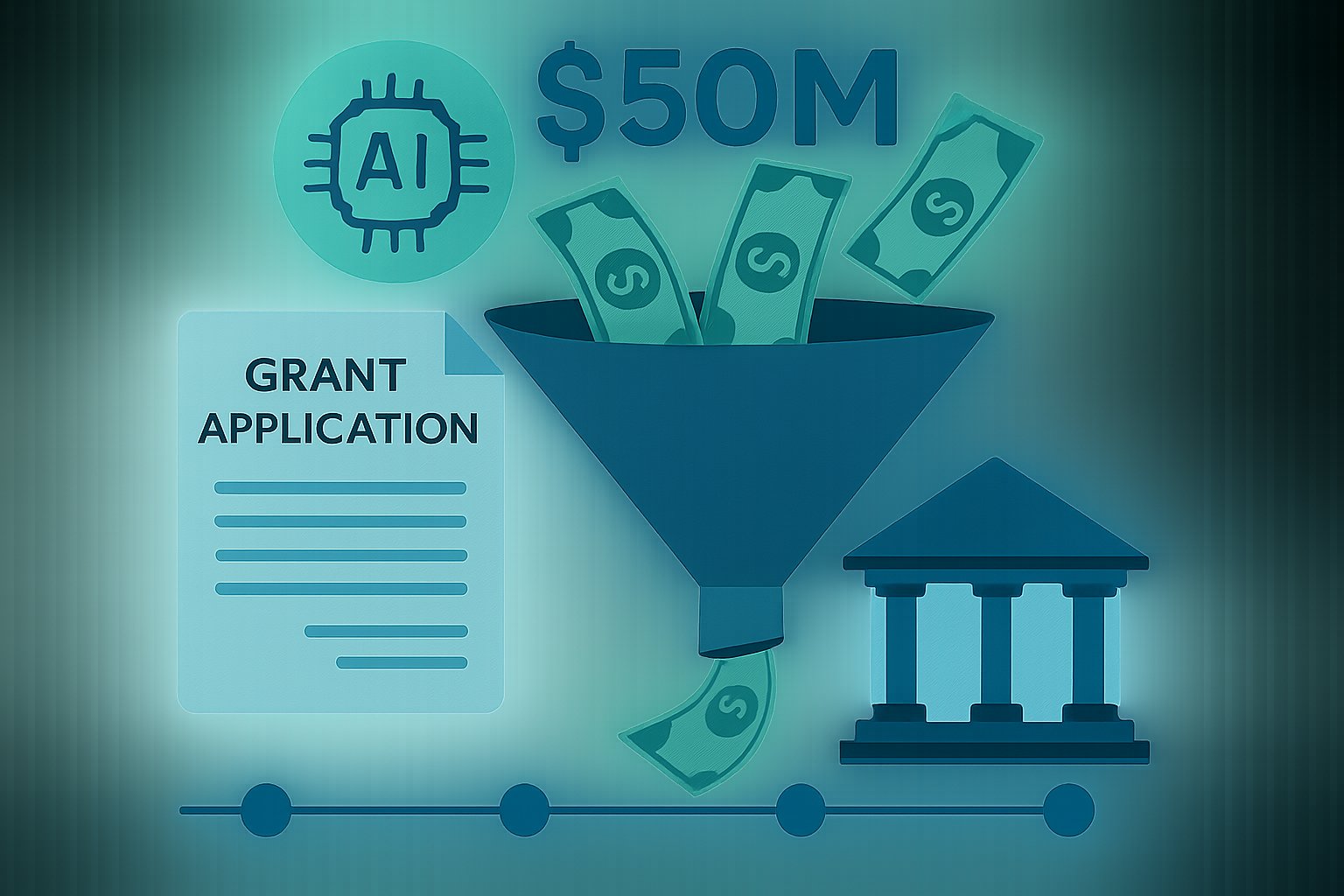
Absolute Priority 1 funds AI tutoring, advising, and analytics that improve postsecondary outcomes. Absolute Priority 2 supports curriculum design that exposes future educators and students to core AI concepts. Each priority carries an Allocation of $25 million. Estimated awards will range between $1 million and $4 million across roughly 25 projects.
Funding scale matters, yet governance requirements may shape proposal success equally. Applicants must offer open licensing, 8% indirect cost limits, and transparent evaluation plans. Consequently, compliance specialists are already mapping internal controls to secure these Grants. Such preparation could decide who converts Education Funding opportunities into durable institutional capacity.
The numbers illustrate robust potential for AI expansion. However, timing remains compressed, which raises operational stakes for every applicant. That reality directs attention to the official calendar.
Application Timeline Key Details
The Notice Inviting Applications appeared in the Federal Register on November 12, 2025. Subsequently, the portal opened on the federal application platform the same morning. Applicants had exactly 22 days until the December 3 cutoff at 11:59 p.m. Eastern. ED signaled award announcements by December 31, giving winners barely four weeks to mobilize. Additional Funding will not be released until grantees satisfy pre-award certifications.
Compared with past FIPSE cycles, that schedule felt lightning fast. In contrast, many community colleges require board approval before submitting multimillion-dollar proposals. Therefore, some leaders criticized the compressed period as a barrier for equitable Allocation. Nevertheless, the Dept. of Education defended the window, citing urgent national competitiveness objectives.
Project periods may extend up to 48 months, offering time for iterative implementation. Moreover, ED expects annual performance reports measuring outcomes like retention and credit completion. Institutions must plan data pipelines early or risk noncompliance. Clear milestones strengthen justification for future Education Funding escalations.
Deadlines drive focus and expose capacity gaps. Consequently, proactive scheduling becomes a competitive differentiator heading into FY 2025 decisions. Next, eligibility rules determine who can even participate.
Eligible Institutions And Requirements
Eligibility spans public and private nonprofit Institutions of Higher Education. Consortia that include state agencies or research bodies also qualify. Meanwhile, for-profit entities remain ineligible, aligning with historic FIPSE parameters. The Dept. of Education further requires partnership letters demonstrating stakeholder commitment.
Applicants must address exactly one absolute priority to pass initial screening. Additionally, reviewers score need, quality, management, and evaluation, each weighted between 15 and 35 points. Open licensing commitments and accessible design stand as cross-cutting requirements. These criteria emphasize responsible AI, echoing July guidance issued by the agency.
Financially, indirect costs cap at 8% of modified total direct costs. Therefore, budgeting specialists must balance technology procurement with staffing and assessment lines. Institutions that master this balance can stretch Education Funding farther. Strategic planning now will smooth FY 2025 implementation.
Eligibility rules combine flexibility with firm accountability. However, they also increase documentation demands during a compressed Grants cycle. Financial specifics shed further light on competitive positioning.
Key Financial Figures Breakdown
The overall FIPSE competition estimates $167 million in available resources. Of that sum, the $50 million AI Allocation attracts the most attention. Average awards hover around $2 million, though proposals may request up to $4 million. Smaller pilot projects must still justify minimum $1 million requests to remain viable.
Cost sharing is not mandatory, yet institutional commitment often boosts reviewer confidence. Consequently, many applicants attach letters describing complementary Funding streams. Such detail illustrates sustainability beyond initial Education Funding support. Every dollar requested must align with measurable student outcome gains.
Financial clarity underpins competitive proposals next fiscal year. Moreover, transparent budgets reassure oversight auditors. Governance topics now dominate stakeholder discussions.
Governance And Privacy Concerns
Civil-society groups applaud the opportunity yet urge caution. Privacy, equity, and integrity appear prominently in ED’s July letter. Furthermore, Forbes analysts warn that accreditors expect documented AI oversight frameworks. Institutions lacking mature governance may squander Grants despite strong technical designs.
Risk mitigation plans should address bias testing, human review, and secure data storage. Additionally, open-source deliverables require clear licenses protecting student information. In contrast, proprietary black boxes face skepticism during scoring. Consequently, teams are consulting legal counsel before finalizing submissions for FY 2025.
Professional development remains another governance pillar. Faculty may upskill via the AI Marketing Strategist™ certification. Such training embeds ethical AI concepts across campus culture. Therefore, governance and capacity building reinforce sustainable Education Funding impact.
Strong oversight builds trust among students, faculty, and regulators. Nevertheless, compliance alone will not guarantee award selection. Applicants must still articulate compelling educational value.
Strategic Steps For Applicants
Successful teams usually follow a clear roadmap. First, they convene cross-functional steering committees by week one. Next, assets and data inventories are matched against priority requirements. Subsequently, budget scenarios are drafted with multiple Allocation ranges.
Parallel grant writers refine narratives that link activities to quantifiable metrics. Meanwhile, institutional research offices model outcome baselines for cost-effectiveness analysis. Peer reviewers appreciate concise tables summarizing Governance, Timeline, and Evaluation at a glance. Finally, leadership secures approvals well before the FY 2025 deadline.
- Confirm eligibility under relevant absolute priority today.
- Build collaborative budget with finance, IT, and academic leads.
- Draft privacy impact assessment aligned with federal guidance.
- Create dissemination plan featuring open educational resources.
- Schedule mock review against FIPSE scoring rubric.
Structured planning minimizes errors and elevates proposal polish. Consequently, institutions improve odds of securing transformative Grants. The final section reviews overarching implications.
Broader Policy Implications Ahead
Federal interest in AI signals a longer horizon for competitive Education Funding. Analysts expect similar set-asides to surface in other innovation programs. Moreover, the Dept. of Education intends to track evidence from early awardees to inform policy. Results may shape accreditation standards and future awards across sectors.
State policymakers also monitor these projects because evidence can justify matching investments. Consequently, institutions that collect robust data may pioneer nationally recognized models. Success will likely attract follow-on Education Funding beyond FY 2025. Stakeholders should therefore view the present competition as a strategic inflection point.
Policy ripple effects extend far past individual campuses. Nevertheless, sustained momentum hinges on early project results. A concise recap follows.
In summary, the $50 million AI initiative marks a watershed moment for Education Funding. Institutions that align pedagogy, governance, and analytics will capture the greatest value. However, compressed timelines demand disciplined project management and strong executive support. Moreover, transparent budgets and privacy safeguards enhance reviewer confidence. Data-driven results could influence future Dept. of Education priorities and state investments. Stakeholders should therefore consolidate teams now and prepare for subsequent cycles. Additionally, professionals can validate skills through the AI Marketing Strategist™ program. Act decisively today to turn policy momentum into lasting student success.


